Global Dementia Cases Projected to Double by 2050, According to Landmark JAMA Neurology Study

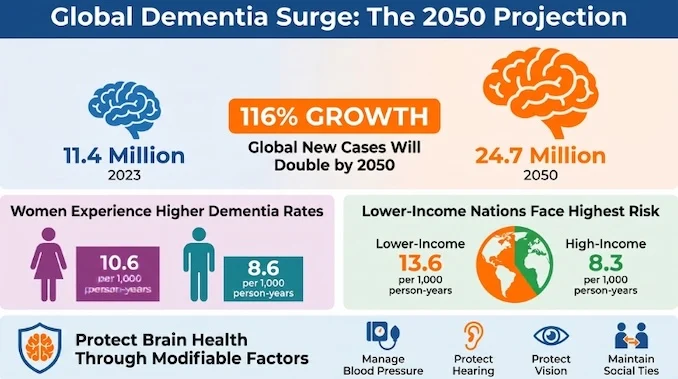
A landmark study published in JAMA Neurology has issued a sobering projection regarding global health: the number of new dementia cases worldwide is expected to double over the next quarter-century. Released in October 2026, the research indicates that annual new diagnoses will surge by 116%, rising from an estimated 11.4 million cases in 2023 to 24.7 million cases per year by 2050. This staggering escalation presents monumental challenges for healthcare systems, policymakers, and the millions of family caregivers who form the backbone of long-term elder care.
While the raw numbers point toward an impending crisis, public health officials and medical researchers emphasize that the projections are not an unalterable destiny. Instead, they serve as a critical warning, underscoring the urgent necessity for coordinated global leadership, enhanced prevention strategies, and targeted medical interventions.
The Core Drivers Behind the 2050 Projections
To fully comprehend the trajectory of cognitive decline, researchers look closely at the underlying mechanisms propelling these statistics. The projected 116% increase is not primarily driven by an inherent rise in the aggressiveness of neurodegenerative conditions such as Alzheimer’s disease or vascular dementia. Rather, the primary catalyst is the rapid and unprecedented aging of the global population.
Age remains the single most significant risk factor for the development of dementia. As life expectancy rises globally—a testament to advancements in modern medicine, sanitation, and nutrition—a larger percentage of the world’s population is reaching advanced age, the demographic most vulnerable to cognitive impairment.

Dr. Emer MacSweeney, a prominent consultant neuroradiologist, characterized the findings as an essential wake-up call. According to medical experts, society can no longer view dementia as an inevitable consequence of growing old. Instead, healthcare infrastructures must pivot toward aggressive early detection, preventative cardiology, and accelerated therapeutic drug development to alter this trajectory.
Comparative Data Analysis: Current versus Projected Metrics
| Key Metric | Baseline Data (2023) | Projected Data (2050) | Percentage Change |
|---|---|---|---|
| Annual New Global Cases | 11.4 Million | 24.7 Million | +116% |
| Incidence Rate: Women | 10.6 per 1,000 person-years | Not applicable (Constant rate model) | N/A |
| Incidence Rate: Men | 8.6 per 1,000 person-years | Not applicable (Constant rate model) | N/A |
| Incidence Rate: Low/Middle-Income Countries | 13.6 per 1,000 person-years | Projected upward trend | Significant relative risk |
| Incidence Rate: High-Income Countries | 8.3 per 1,000 person-years | Stabilizing or slower growth | Slower relative growth |
As illustrated by the data, the sheer volume of individuals crossing the threshold into advanced age guarantees an expanding patient population unless substantial interventions are deployed at both the individual and population levels.
The Gender Gap: Unpacking Vulnerabilities Among Women
The JAMA Neurology study revealed a pronounced demographic disparity in dementia incidence between men and women. The data shows an incidence rate of 10.6 new cases per 1,000 person-years for women, compared to 8.6 new cases per 1,000 person-years for men.
While women statistically exhibit longer overall lifespans—and age remains the principal risk factor—researchers stress that longevity alone does not entirely account for the gap. Scientists are increasingly focusing on sex-specific biological variables to explain the discrepancy. Hormonal shifts, particularly the physiological transitions occurring during menopause and the cumulative lifelong exposure to estrogen, appear to play a substantial role in maintaining neurological health.
This distinct vulnerability highlights the necessity for tailored medical approaches. Public health advocates argue that women must prioritize proactive cardiovascular and cognitive risk management decades before entering their senior years, ensuring that preventative care addresses these distinct biological markers.

The Geography of Cognitive Decline: The Heart-Brain Connection
Another critical dimension revealed by the research is the geographical divide in dementia incidence. Low- and middle-income countries (LMICs) face a considerably higher incidence rate, registering 13.6 cases per 1,000 person-years, compared to 8.3 cases per 1,000 person-years in high-income nations.
This divergence underscores a vital physiological link: the profound connection between cardiovascular health and brain health. Over recent decades, high-income countries have achieved notable successes in public health initiatives aimed at reducing smoking rates, improving the detection and management of high blood pressure, and controlling cholesterol levels. These vascular improvements have yielded a secondary benefit of stabilizing or slowing cognitive decline rates.
Conversely, many low- and middle-income countries are experiencing rapid epidemiological transitions, characterized by rising rates of obesity, hypertension, stroke, and cardiovascular disease. Because the brain relies on an intricate, healthy network of blood vessels to deliver oxygen and nutrients, systemic cardiovascular damage directly restricts cerebral blood flow. This restriction significantly accelerates the onset of vascular dementia and exacerbates Alzheimer’s pathology.
Modifiable Risk Factors and Practical Prevention
While genetic predispositions and chronological aging cannot be altered, medical consensus indicates that a significant proportion of dementia cases are linked to modifiable risk factors. Public health frameworks emphasize that addressing these foundational health metrics can substantially reduce individual risk profiles:
- Blood Pressure Management: Maintaining optimal blood pressure protects the fragile micro-vessels within the brain, reducing the risk of ischemic damage and cognitive deficits.
- Cardiovascular and Metabolic Health: Controlling cholesterol, managing diabetes, and preventing obesity directly preserves vascular integrity, supporting long-term neurological function.
- Sensory and Social Engagement: Addressing hearing loss, maintaining active social connections, and participating in continuous cognitive stimulation help build cognitive reserve, delaying the manifestation of symptoms.
- Lifestyle Interventions: Incorporating regular physical activity, maintaining a balanced diet, and avoiding tobacco use remain cornerstone defenses against neurodegeneration.
Socioeconomic and Systemic Implications
The projection of 24.7 million new annual cases by 2050 carries profound implications for global economic stability and social infrastructure. Healthcare systems worldwide are already strained by the demands of chronic disease management. A doubling of dementia incidence will require massive expansions in specialized long-term care facilities, professional training programs for geriatric specialists, and financial support mechanisms for unpaid family caregivers.

At present, informal caregivers—often family members balancing employment and personal lives—bear the brunt of daily care responsibilities. Without robust public policy investments, community support networks, and subsidized respite care, the looming demographic shift risks overwhelming both formal medical institutions and private households.
Frequently Asked Questions
Is it inevitable that global dementia cases will double by 2050?
While demographic aging guarantees an increase in the absolute number of cases, the trajectory is not completely fixed. Aggressive public health campaigns targeting modifiable risk factors—such as hypertension, diabetes, and cardiovascular health—alongside breakthroughs in disease-modifying therapies, could alter these projections significantly.
Why do women exhibit a higher incidence rate of dementia than men?
Women generally live longer than men, and age is the primary risk factor for cognitive decline. However, researchers also point to sex-specific biological factors, including hormonal shifts during menopause and the neuroprotective mechanisms associated with estrogen exposure, as contributing variables to the observed disparity.
How does cardiovascular health directly impact the risk of dementia?
The brain requires a continuous, unimpeded supply of blood to function properly. Conditions that damage the cardiovascular system—such as hypertension, high cholesterol, smoking, and obesity—restrict cerebral blood flow and damage blood vessels in the brain, greatly increasing the likelihood of developing vascular dementia and Alzheimer’s disease.
Conclusion and Path Forward
The projection of nearly 25 million new dementia cases annually by 2050 serves as an urgent call to action for the international medical community, policymakers, and society at large. Mitigating this rising tide of cognitive decline requires a dual approach: empowering individuals with actionable knowledge regarding cardiovascular and lifestyle risk factors, and fostering global collaboration among political and healthcare leaders to build resilient care infrastructures before the demographic peak arrives.