
Prevent catastrophic falls with these 5 bathroom safety modifications for seniors


As family caregivers navigate the daily realities of supporting aging loved ones, a persistent anxiety often looms around domestic safety, peaking specifically within the confines of the bathroom. While this room is essential for personal privacy and hygiene, it simultaneously presents a high-risk environment where safety is frequently compromised by physical design. According to recent public health data from federal agencies such as the Centers for Disease Control and Prevention, falls remain a leading cause of fatal and non-fatal injuries among older adults, with the bathroom accounting for a disproportionate percentage of domestic accidents due to the convergence of hard surfaces, moisture, and reduced physical stability.
Addressing these pervasive hazards requires moving beyond superficial fixes and adopting a clinical, methodical approach to home modification. To better understand the scope of the issue, public health officials, occupational therapists, and aging-in-place advocates have increasingly emphasized structural interventions. By analyzing the biomechanical needs of seniors alongside architectural best practices, families can proactively neutralize the highest-risk zones within a residence. This comprehensive guide outlines five critical structural modifications designed to mitigate fall risks, protect vulnerable bones, and preserve the independence of older adults aging in place.
Why the Bathroom Ranks as the Most Hazardous Room in the Home
The residential bathroom represents a unique confluence of environmental and physical risk factors. By definition, the space is dominated by hard, non-yielding surfaces like ceramic tile, porcelain, and glass, which offer zero shock absorption during an impact. When combined with water, soap, and steam, these surfaces lose traction, creating an ideal environment for slips and loss of balance. Furthermore, the physical realities of aging—including progressive muscle sarcopenia, joint stiffness, vestibular decline, and diminished visual acuity—compound these environmental hazards.
Historically, home safety for seniors was approached reactively, with families making adjustments only after a debilitating accident had already occurred. However, modern geriatric care strongly favors a proactive framework. Public health economists note that the financial and emotional toll of a single catastrophic fall often permanently disrupts an aging-in-place strategy, frequently forcing an abrupt and involuntary transition to a skilled nursing facility. Consequently, treating the bathroom with clinical precision is no longer viewed as an optional home improvement, but rather as an essential preventative health measure.
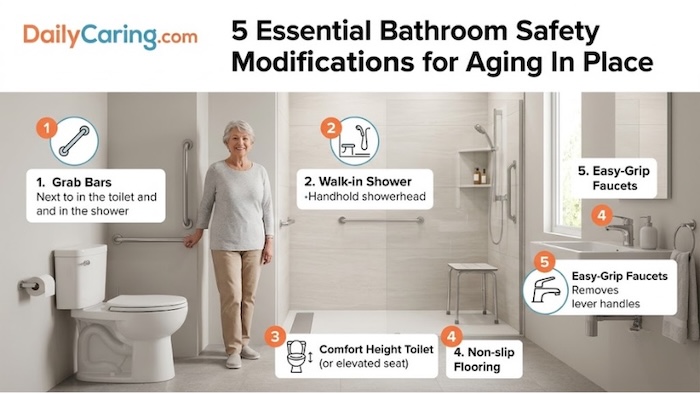
1. Professional Installation and Clinical Placement of Grab Bars
One of the most common mistakes in senior home modification is treating grab bars as simple, do-it-yourself accessories that can be purchased at a local hardware store and mounted with suction cups. In a clinical context, grab bars must be regarded as precision safety tools mapped directly to an individual’s specific functional reach, height, and mobility limitations.
Occupational therapists evaluate how a senior moves within the space—identifying the exact trajectory of a potential slip—before determining where support is fundamentally required. Furthermore, professional installation anchored directly into structural wall studs is mandatory. Suction-cup or tension-mounted bars are incapable of withstanding the sudden kinetic energy of a falling adult, transforming a supposed safety device into a catastrophic hazard if it detaches under pressure.
When selecting appropriate hardware, caregivers should look for bars with specific structural characteristics. Industry standards recommend a diameter between 1.25 and 1.5 inches, which accommodates the grip strength and arthritis common in aging hands. Additionally, ADA-compliant knurled or textured finishes should be prioritized over smooth chrome surfaces, as textured metals provide essential friction when hands are wet or soapy. Adhering to these strict installation parameters ensures that the hardware can successfully arrest a fall and prevent severe trauma.
2. Engineering the Optimal Toilet Height to Reduce Joint Stress
Standard residential toilets, typically manufactured at a height of 15 inches from the floor to the top of the bowl, present a significant biomechanical hurdle for older adults. As individuals age, quadricep strength and knee joint flexibility naturally decline, making the descent onto and ascent from a low seat an arduous and risky physical maneuver. While the Americans with Disabilities Act mandates toilet heights of 17 to 19 inches primarily for wheelchair accessibility, residential environments require a customized calculation to optimize safety and independence.
To determine the ideal toilet height for a specific senior, specialists recommend measuring the vertical distance from the floor to the back of the individual’s knee, where the lower leg meets the thigh. This measurement dictates the exact elevation required to ensure that the user’s feet remain flat on the floor while their hips maintain an optimal angle, significantly reducing the torque placed on the knee and hip joints. Achieving this custom fit minimizes the risk of muscle fatigue or sudden loss of balance during the transition from sitting to standing.

3. Upgrading Illumination for High Contrast and Visual Clarity
Vision degradation is an inevitable component of the aging process, characterized by decreased pupil reactivity, lens clouding, and reduced peripheral awareness. These physiological changes demand higher levels of ambient illumination to safely navigate indoor spaces. However, a common pitfall in home remodeling is the installation of excessively bright, unshielded bulbs that create harsh glare, which can severely impair depth perception and blind an older adult momentarily.
The objective of modern geriatric lighting design is uniform illumination paired with high visual contrast. Lighting engineers recommend utilizing bulbs with a Color Rendering Index (CRI) of 80 or higher and a color temperature ranging between 2700K and 3000K to mimic natural light without causing optical strain. Furthermore, creating stark visual boundaries—such as distinguishing the edge of a white bathtub from a contrasting floor tile—ensures that seniors with depth perception deficits can clearly interpret spatial dimensions, drastically lowering the incidence of missteps.
4. Transitioning to Shock-Absorbing, Slip-Resistant Flooring
While traditional ceramic and porcelain tile remain popular choices for bathrooms due to their water-resistant qualities, they offer zero energy dissipation or shock absorption. In the event of a fall, a rigid tile floor provides no cushioning, drastically increasing the likelihood of fractures, head trauma, and severe orthopedic injuries. Modern safety standards encourage a paradigm shift that balances high surface traction with impact-mitigating materials.
Alternative flooring solutions have emerged as superior options for senior-friendly renovations. Rubber flooring provides both exceptional traction when wet and maximum shock absorption to protect joints and bones during an impact. Similarly, textured cork utilizes natural air-filled cellular structures to cushion falls while maintaining a high-friction grip. While slip-resistant sheet vinyl offers a cost-effective compromise with moderate cushioning, standard ceramic tile remains a high-risk liability that should be phased out in high-fall-risk environments.
5. Eliminating Thresholds and Door Saddles to Prevent Shuffling Trips
Among the most frequently overlooked architectural elements in home safety is the doorway threshold or door saddle. Standard transitions between rooms often create a sudden, elevated ridge where different flooring materials meet, such as the edge of a hallway carpet transitioning into a bathroom tile. For older adults who exhibit a shuffling gait—a common symptom associated with various neurological and musculoskeletal conditions—even a minor height variation of half an inch can catch the toe and precipitate a severe fall.

Mitigating this risk involves removing raised door saddles and replacing them with graded, zero-edge transitions. These smooth architectural modifications allow individuals with limited lower-extremity lift to glide seamlessly from one room to the next without encountering physical barriers. By eliminating these micro-obstacles, families can remove one of the most common yet easily correctable causes of domestic tripping incidents.
The Financial Case for Proactive Home Modifications
When evaluating the cost of comprehensive bathroom renovations, families are often initially deterred by upfront expenditures. Professional installation of grab bars, upgraded lighting systems, comfort-height toilets, and threshold removals typically require an investment ranging between $2,000 and $5,000, depending on the complexity of the home’s existing infrastructure. However, financial analysts and healthcare economists urge caregivers to weigh these expenses against the reactive costs associated with a severe domestic accident.
According to healthcare utilization data, the baseline cost of a single major fall resulting in emergency hospitalization, surgical hip replacement, and subsequent skilled nursing rehabilitation routinely exceeds $50,000. Viewed through this economic and clinical lens, a localized structural investment of a few thousand dollars functions essentially as an insurance policy. It protects the physical well-being of the older adult while safeguarding their long-term ability to age in place safely, preserving both household capital and personal independence.
Engaging Certified Aging-in-Place Specialists (CAPS)
Executing these critical home modifications requires specialized knowledge that extends far beyond the scope of a general handyman or traditional residential contractor. Families are strongly advised to seek out professionals who hold the Certified Aging in Place Specialist designation. Administered by the National Association of Home Builders, the CAPS credential signifies that a contractor has completed rigorous training focused on the biomechanical needs of aging populations, accessible design solutions, and the structural load-bearing requirements necessary for medical-grade safety installations.
To ensure that modifications meet the highest standards of safety and structural integrity, consumers can locate vetted, credentialed professionals through official industry directories. Consulting with a CAPS-certified builder, ideally in collaboration with a licensed occupational therapist, ensures that every adjustment made to the bathroom is scientifically sound, legally compliant, and tailored to the unique physical profile of the individual senior. Through prompt execution and professional oversight, families can successfully transform a hazardous environment into a secure space that supports dignified aging in place.