Beyond the Panic Button: How Modern Medical Alert Systems Are Reshaping Senior Independence and Home Care


The landscape of senior care and independent living is undergoing a profound transformation, driven largely by rapid advancements in assistive technology. For decades, the standard response to senior safety concerns inside the home was the traditional medical alert pendant—a simple, hardwired button tethered to a base station that relied on a landline connection. While groundbreaking for its time, that legacy model was severely constrained by physical range limitations and the explicit requirement that a user remain conscious, mobile, and cognizant enough to manually press the device. Today, however, the global medical alert systems market is projected to reach $11.8 billion, fueled by a surging demand for proactive, intelligent monitoring solutions that allow aging adults to maintain their autonomy safely.
This market expansion aligns directly with broader demographic preferences. According to comprehensive data from AARP, nearly 90 percent of adults aged 65 and older express a strong desire to age in place—remaining within their private residences rather than transitioning into assisted living facilities or nursing homes. Yet, the physical realities of aging, including heightened risks of slips, falls, and cognitive decline, present significant challenges to realizing this goal safely. In response, engineers, healthcare providers, and technology developers have reimagined the personal emergency response system (PERS), turning basic reactive alarm triggers into sophisticated health-monitoring ecosystems.
The Evolution of Personal Safety Technology: A Chronological Overview
The journey from the iconic yet limited "I’ve fallen and I can’t get up" commercial era to today’s integrated smart devices reflects decades of incremental technological progress:
- The 1970s–1990s (The Landline Era): The foundational years of medical alerts introduced stationary base units linked to traditional analog landlines. Users wore rudimentary radio-frequency pendants, but coverage was strictly confined to the immediate interior or perimeter of the home (typically within 300 to 800 feet of the base).
- The 2000s–2010s (The Cellular Transition): As landline usage declined, manufacturers integrated cellular chips into base units and mobile buttons. This era introduced early GPS tracking capabilities, allowing users to venture outside their homes while remaining tethered to a mobile monitoring center via cellular towers.
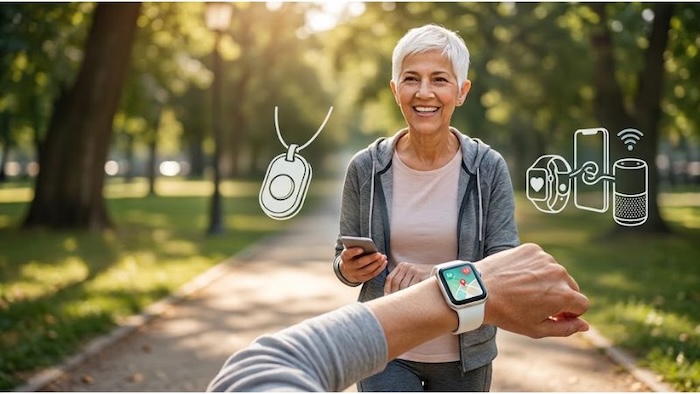
- The Early 2020s (Wearable Health Integration): The widespread adoption of smartwatches paved the way for biometric tracking. Devices began incorporating heart-rate monitors, step counters, and primitive accelerometer-based fall detection, bridging the gap between fitness trackers and emergency response tools.
- 2025–2026 and Beyond (The AI and Ambient Sensor Revolution): Modern systems leverage wearable artificial intelligence, multi-axis gyroscopes, and passive wall-mounted radar. These tools eliminate false alarms, operate invisibly without requiring a wearable device, and integrate seamlessly into caregiver-facing mobile applications.
Traditional Landlines Versus Modern Smartwatch and Ambient Ecosystems
To understand the scope of this technological shift, industry analysts frequently contrast the legacy infrastructure with contemporary solutions across several core performance metrics.
Traditional landline systems remain budget-friendly but are fundamentally restricted to homebound seniors. Their fall detection features rely on rudimentary impact thresholds, which historically resulted in a higher volume of false alarms or missed triggers if a user slid gradually to the floor rather than suffering a sudden impact. Furthermore, these older units offer zero integration with modern smartphone applications, restricting caregiver communication to automated phone calls from monitoring centers.
In contrast, modern cellular smartwatches provide unlimited nationwide coverage supported by advanced GPS tracking. Their internal accelerometers and gyroscopes are governed by AI-driven algorithms capable of distinguishing between a genuine, high-impact fall and everyday movements like dropping a device on a table or sitting down quickly. Simultaneously, ambient radar systems offer an alternative for seniors experiencing cognitive decline who routinely remove or refuse to wear traditional jewelry or watches. These wall-mounted sensors track movement patterns and deviations in daily routines across entire households via Wi-Fi networks, transmitting real-time data directly to family members or professional care coordinators.
Market Drivers and Economic Implications
The rapid acceleration of the medical alert sector is not merely a byproduct of technological innovation; it is a direct economic response to aging populations across North America, Europe, and parts of Asia. Healthcare economists note that institutionalized care facilities represent a substantial financial burden for families and healthcare systems alike. By enabling older adults to remain safely in their homes for extended periods, advanced monitoring technology helps defer or entirely avoid costly long-term residential care expenditures.

Furthermore, the integration of companion smartphone applications has fundamentally altered the caregiver-senior dynamic. Rather than waiting for an emergency dispatch center to place an emergency notification call, family members now have real-time visibility into battery statuses, device location, daily activity levels, and medication management reminders. This proactive transparency significantly reduces caregiver burnout by replacing constant anxiety with objective, data-driven reassurance.
Limitations, Professional Guidance, and Choosing the Right System
Despite the sophistication of 2026-era safety technology, healthcare professionals emphasize that no device can completely replace human supervision and structured in-home care. Medical alert systems are fundamentally risk-mitigation tools designed to compress emergency response times, minimizing the dangerous health complications that can arise from long lie-times following a fall.
When selecting a system, consumer advocates and geriatric care managers advise matching the technology precisely to the senior’s cognitive and physical capabilities. For instance, an advanced touchscreen smartwatch loaded with complex menus is often counterproductive for an individual suffering from advanced dementia or severe macular degeneration. Conversely, passive ambient radar systems or simple, single-function pendants are far more appropriate for users with memory impairments.
The National Institute on Aging (NIA) continues to stress that technology should be implemented as part of a comprehensive, multi-faceted fall prevention strategy. This includes conducting physical therapy assessments, removing household tripping hazards such as loose rugs, improving domestic lighting, and consulting occupational therapists regarding bathroom safety modifications.

Regulatory Landscape and Financial Coverage Realities
As these devices become more deeply integrated into the continuum of care, questions regarding healthcare coverage and standardization frequently arise. Under current federal guidelines, Original Medicare (Parts A and B) does not classify standard medical alert systems as durable medical equipment (DME), meaning out-of-pocket costs typically fall squarely on the consumer or their family. However, an increasing number of Medicare Advantage (Part C) plans, along with specific state Medicaid programs, have begun offering partial subsidies, reimbursements, or targeted discounts as supplemental benefits to promote preventative home safety.
Industry analysts expect regulatory frameworks to evolve further as wearable medical devices increasingly blur the line between consumer electronics and clinical-grade diagnostic tools. For now, caregivers are encouraged to thoroughly research individual product capabilities, evaluate monitoring center response times, and consult qualified healthcare providers before committing to a specific safety platform.
Ultimately, the transformation of the medical alert system represents a cultural shift in how society approaches aging. By trading the stigmatized, bulky panic buttons of the past for sleek, intelligent health hubs, modern technology successfully bridges the gap between total independence and safety, preserving the dignity of older adults while granting invaluable peace of mind to the families who care for them.