Beyond the Panic Button: How Modern Medical Alert Systems Are Reshaping Senior Independence


The landscape of senior care and independent living is undergoing a profound technological transformation, driven by an aging global demographic and rapid innovations in wearable electronics, artificial intelligence, and passive monitoring. According to recent data compiled by AARP, nearly 90 percent of adults aged 65 and older express a strong preference for aging in place within their own homes rather than transitioning to assisted living facilities or nursing homes. To meet this immense societal demand while mitigating the inherent safety risks associated with independent living, the global market for personal emergency response systems (PERS) has expanded exponentially. Industry projections from Grand View Research estimate that the medical alert systems market will reach $11.8 billion, fueled largely by the integration of sophisticated health-monitoring features that bear little resemblance to the traditional safety devices of past decades.
For generations, the standard medical alert apparatus remained largely unchanged. Popularized by ubiquitous late-night television commercials, the legacy format consisted of a lightweight plastic pendant housing a single physical button. This wearable device communicated via radio frequency with a localized base station plugged into a traditional analog landline, which in turn dialed a centralized monitoring facility upon activation. While these foundational systems undoubtedly saved lives, they suffered from critical vulnerabilities. Their operational range was strictly confined to the immediate vicinity of the base unit—usually within a few hundred feet—rendering them useless the moment an older adult stepped outdoors, visited a neighbor, or traveled. Furthermore, these systems were entirely reactive; they required the user to remain conscious, oriented, and physically capable of pressing the button following a medical emergency, a fall, or a sudden incapacitating event.
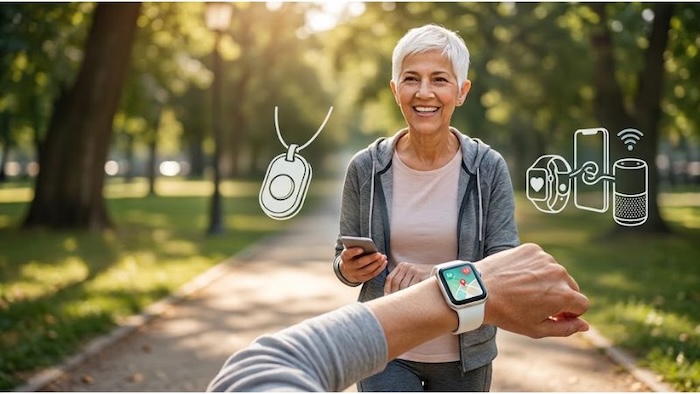
The technological paradigm shift observed in contemporary safety monitoring is largely attributable to the integration of wearable artificial intelligence, cellular connectivity, and ambient sensor arrays. Modern devices have evolved from simple distress triggers into proactive health and safety hubs. This evolution addresses the multifaceted challenges of aging in place, accommodating varying levels of physical mobility and cognitive health among older adults. Industry experts note that today’s safety ecosystem is broadly categorized into cellular-enabled smartwatches, passive ambient radar systems, and advanced wearable pendants equipped with multi-axis sensors.
A comparative analysis of these technologies highlights how far the industry has progressed. Traditional landline-dependent systems offered a limited operational radius of approximately 800 feet from a home base, featured high false-alarm rates for basic fall detection, and lacked any form of caregiver application integration beyond basic telephone notifications. In contrast, modern cellular-enabled smartwatches provide unlimited nationwide coverage supported by integrated GPS tracking, real-time battery status monitoring, and sophisticated AI-filtered accelerometers and gyroscopes designed to accurately differentiate between a jarring movement and an actual hard fall. Meanwhile, ambient radar and wall-mounted AI sensors offer whole-home coverage via Wi-Fi networks, making them an ideal solution for seniors experiencing cognitive decline or dementia who frequently refuse to wear traditional watches or pendants.
The financial and regulatory landscape surrounding these technologies has also sparked considerable discussion among healthcare providers, policymakers, and families. Under current federal guidelines, Original Medicare—specifically Parts A and B—does not provide financial coverage for medical alert systems, as regulatory frameworks do not classify them as durable medical equipment. However, the expansion of Medicare Advantage (Part C) plans, alongside certain state-specific Medicaid programs, has introduced partial coverage options, subsidies, or direct reimbursement models for qualifying policyholders. This shift acknowledges the preventive value of such technology in reducing emergency room admissions and costly inpatient rehabilitation stays resulting from unaddressed falls.

Choosing the appropriate medical alert system requires a careful, individualized assessment of a senior’s physical capabilities, lifestyle habits, and cognitive health. Healthcare professionals emphasize that advanced smartwatches featuring complex touchscreens or multi-function menus may prove overwhelming or entirely unusable for individuals coping with severe cognitive impairment, advanced dementia, or degenerative visual conditions such as macular degeneration. Conversely, passive monitoring solutions that operate without requiring user interaction can provide a vital safety net for those who might otherwise forget or actively reject wearable technology.
Despite the remarkable advancements in wearable and ambient safety technology, gerontologists and caregiving organizations stress that automated alert systems should never be viewed as a complete substitute for direct human supervision, professional in-home care, or structured family caregiving networks. Industry analysts view modern medical alert systems strictly as risk-mitigation instruments—tools engineered to drastically reduce emergency response times and provide critical peace of mind when seconds matter. Families are consistently advised to consult comprehensive fall-prevention guidelines published by institutions such as the National Institute on Aging, conducting thorough home risk assessments of stairways, bathrooms, and kitchens before relying solely on electronic safeguards.
The broader implications of this technological boom point toward a future where healthcare monitoring becomes increasingly decentralized, shifting from institutional settings directly into private residences. By replacing the social stigma associated with bulky, industrial panic buttons with sleek, consumer-friendly designs, manufacturers have successfully bridged the gap between personal dignity and safety. As the population continues to age, the ongoing refinement of artificial intelligence, geolocation accuracy, and predictive health analytics will undoubtedly play an instrumental role in shaping how society approaches elder care, ensuring that millions of older adults can navigate their golden years with security, autonomy, and peace of mind.