Prevent Catastrophic Falls With These 5 Bathroom Safety Modifications For Seniors

For millions of family caregivers navigating the complexities of eldercare, a persistent, low-grade anxiety follows them throughout the day. This worry inevitably peaks when an aging parent or loved one steps into the bathroom—a private sanctuary that simultaneously transforms into the most perilous environment in a residential home. As the global population ages and a record number of older adults express a strong preference to "age in place," public health officials, geriatricians, and home modification specialists are placing a renewed focus on environmental risk factors. Recent data from the Centers for Disease Control and Prevention underscores a sobering reality: falls are the leading cause of fatal and non-fatal injuries among older Americans, with the bathroom accounting for a disproportionate share of emergency room admissions.
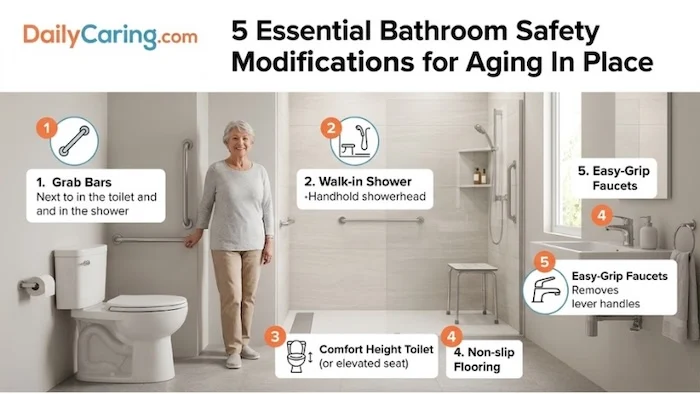
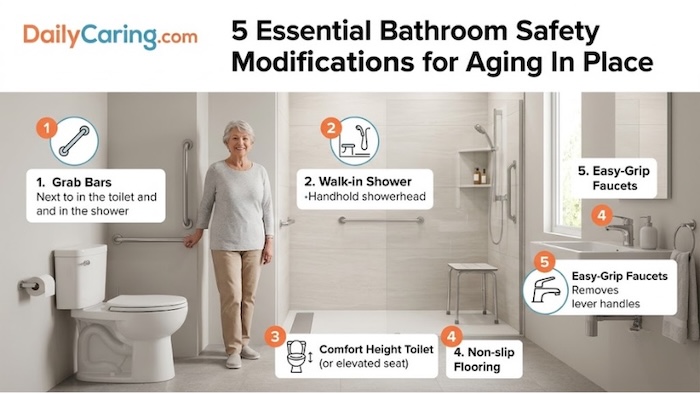
Addressing these profound domestic hazards requires shifting away from superficial home repairs and adopting a clinical, engineering-focused approach to bathroom architecture. To safeguard aging loved ones and preserve their independence, safety experts have identified five critical bathroom modifications that neutralize environmental hazards, mitigate fall risks, and support long-term residential independence.
The Anatomical and Environmental Hazards of the Residential Bathroom
To understand why bathrooms are frequent sites of severe trauma, one must examine the intersection of human physiology and environmental design. As individuals age, they commonly experience sarcopenia (age-related muscle loss), decreased joint flexibility, proprioceptive decline, and visual impairments such as cataracts, glaucoma, or age-related macular degeneration. Concurrently, the traditional bathroom is constructed from unforgiving materials: glazed ceramic tiles, porcelain tubs, and glass shower enclosures. When these hard surfaces encounter water, soap, and steam, traction is instantly obliterated.
When a physically vulnerable individual experiences a momentary lapse in balance within a confined space devoid of shock absorption or structural support, a minor slip rapidly escalates into a catastrophic incident. Medical professionals emphasize that a severe fall often triggers a devastating cascade of events: emergency hospitalization, surgical intervention for hip or pelvic fractures, prolonged immobility, and a subsequent transition to a skilled nursing facility. Consequently, proactive environmental modification is not merely a matter of domestic convenience; it is a primary clinical intervention designed to protect fragile skeletal structures.
1. Treating Grab Bars as Clinical Tools Rather Than DIY Accessories
The installation of grab bars is arguably the most fundamental modification for fall prevention, yet it is frequently executed incorrectly. Hardware stores and online retailers abound with suction-cup grab bars marketed as quick, damage-free solutions for renters or temporary users. However, safety engineers and occupational therapists uniformly condemn suction-cup devices for load-bearing applications. Under the sudden, dynamic kinetic energy of a falling adult, suction mechanisms invariably fail, transforming a perceived safety device into a secondary hazard that accelerates the fall.
Instead, grab bars must be treated as clinical tools mapped directly to an individual’s specific functional reach, gait pattern, and mobility limitations. A professional evaluation by a licensed occupational therapist determines the optimal placement, height, and angle for each bar—whether adjacent to the toilet, inside the shower enclosure, or along the tub perimeter. Furthermore, installation demands professional anchoring directly into structural wall studs or reinforced blocking to withstand loads exceeding 250 pounds, in strict compliance with Americans with Disabilities Act (ADA) standards.
When selecting hardware, consumers should prioritize specifications tailored to aging hands. Standard smooth chrome rails can become dangerously slippery when wet or soapy. Experts recommend purchasing bars with a diameter between 1.25 and 1.5 inches, featuring an ADA-compliant knurled or textured finish that ensures a secure grip even under adverse conditions.
2. Engineering the Optimal Toilet Height to Reduce Joint Stress
Standard residential toilets are typically manufactured at a height of 15 inches from the floor to the top of the bowl rim. For young, able-bodied adults, this standard is largely inconsequential. However, for an aging body suffering from osteoarthritis, muscle weakness, or compromised balance, a low toilet seat poses a significant biomechanical challenge. Transitioning from a seated position on a low surface demands excessive knee and hip joint flexion, alongside tremendous exertion from the quadriceps. This struggle frequently leads to lost balance during the descent or a failure to stand upright, resulting in lateral falls.
While commercial spaces adhere to ADA guidelines mandating toilet seat heights between 17 and 19 inches for wheelchair accessibility, residential safety requires a customized calculation. Occupational therapists utilize a precise formula to determine the ideal height for an individual user: measuring the vertical distance from the floor to the underside of the senior’s knee (the popliteal crease), and matching the toilet seat height to that exact measurement. Achieving this ergonomic alignment minimizes joint stress, preserves remaining lower-body strength, and allows for safe, independent transfers.
3. Upgrading Illumination Through High Contrast and Uniform Lighting
Visual acuity naturally declines with age, a physiological process characterized by smaller resting pupil diameters, thickening and yellowing of the eye’s crystalline lens, and a reduced ability to process rapid changes in light levels. Consequently, older adults require up to three times more ambient light than younger individuals to navigate a space safely. Paradoxically, simply installing high-wattage, glaring incandescent or LED bulbs often exacerbates the problem by creating harsh shadows, blinding reflections, and severe glare off wet tile surfaces, thereby obscuring depth perception.
The objective of modern senior lighting design is uniform illumination paired with high visual contrast. Lighting specialists recommend utilizing bulbs with a Color Rendering Index (CRI) of 80 or higher and a color temperature ranging between 2700 Kelvin and 3000 Kelvin to mimic natural daylight without creating harsh glare. Beyond fixture selection, environmental contrast is vital. Painting bathroom walls a distinct color from the flooring, utilizing contrasting color toilet seats, and applying high-visibility strips to the edges of bathtubs and shower thresholds enable seniors with impaired vision to accurately discern spatial boundaries and elevation changes.
4. Transitioning to Shock-Absorbing Flooring Materials
Ceramic and porcelain tiles have long reigned as the default standard for bathroom flooring due to their exceptional water resistance and ease of cleaning. From a fall-prevention and impact-mitigation perspective, however, traditional tile represents a worst-case scenario. Offering zero shock absorption and minimal traction when wet, ceramic tile ensures that any accidental fall results in direct, unmitigated impact against an unyielding surface, dramatically increasing the incidence of traumatic brain injuries, facial fractures, and hip breaks.
As part of a comprehensive home safety overhaul, homeowners are increasingly turning to advanced, slip-resistant flooring alternatives designed specifically for aging-in-place environments.

- Rubber Flooring: Widely considered the gold standard in clinical and residential fall mitigation, rubber flooring provides exceptional traction combined with maximum impact absorption to protect joints and bones.
- Textured Cork: Utilizing natural air-filled cellular structures, cork offers high slip resistance and substantial shock absorption while retaining a warm, comfortable tactile feel underfoot.
- Slip-Resistant Vinyl: Available in sheet or luxury plank formats, high-grade textured vinyl delivers moderate-to-high slip resistance at a cost-effective price point, though its impact absorption properties are lower than rubber or cork.
5. Eliminating Thresholds and Door Saddles to Accommodate Shuffling Gaits
Neurological changes, joint stiffness, and natural muscular fatigue frequently result in an altered walking pattern known among geriatric specialists as a "shuffle gait," wherein older adults lift their feet minimally off the floor during ambulation. Within the domestic landscape, even minor elevation changes—such as the standard wooden or metal door saddle where a bedroom carpet transitions to a bathroom tile floor—become formidable tripping hazards. A vertical discrepancy as small as half an inch is sufficient to catch the toe of a shuffling senior, precipitating a forward fall.
Remediating this hazard requires removing traditional raised thresholds and replacing them with graded, zero-edge transition strips. These sloped modifications create a seamless, flush plane between adjacent rooms, allowing individuals using walkers, wheelchairs, or unassisted shuffling gaits to traverse doorways without encountering abrupt vertical barriers.
Professional Credentials: The Critical Role of the CAPS Specialist
A recurring pitfall in home modification is the reliance on general contractors or handymen who lack specialized training in senior biomechanics and geriatric safety standards. To ensure clinical efficacy and structural integrity, families are strongly advised to hire professionals holding the Certified Aging-in-Place Specialist (CAPS) designation.
Administered by the National Association of Home Builders (NAHB) in collaboration with AARP, the CAPS certification signifies that a builder, remodeler, or designer has undergone rigorous coursework regarding the unique physical, psychological, and physiological needs of older adults. CAPS professionals are trained to evaluate mobility-barrier solutions, assess structural load-bearing requirements for heavy medical-grade hardware, and design aesthetically pleasing home modifications that avoid an overtly clinical or institutional appearance. Vetted CAPS professionals can be located directly through the official NAHB directory of certified industry experts.
Financial Analysis: Investment Versus Reactive Crisis Management
The decision to execute comprehensive bathroom safety modifications often sparks initial financial hesitation among family members. A professional project encompassing grab bar installation, lighting upgrades, comfort-height toilet integration, threshold removal, and flooring replacement typically ranges from $2,000 to $5,000 in upfront costs.
However, industry analysts and health economists urge families to view these expenditures through the lens of long-term risk management. According to federal healthcare data, the average baseline cost of a single major fall resulting in emergency transport, hospitalization, surgical hip replacement, and subsequent inpatient rehabilitation frequently exceeds $50,000. Furthermore, the physical and psychological toll of a catastrophic fall often permanently compromises an older adult’s independence, rendering aging-in-place strategies untenable and forcing an abrupt, expensive transition to a skilled nursing facility.
Viewed through this economic and humanitarian framework, a $5,000 investment in professional bathroom modifications functions not as a discretionary home improvement expense, but as an essential insurance policy protecting both the physical well-being of the senior and the financial stability of the caregiving family. By executing these structural changes proactively and under the guidance of certified specialists, families can successfully neutralize the high-risk environment of the bathroom, ensuring a safe, dignified, and independent future for aging loved ones.
Related posts: