Global Dementia Cases Projected to Double by 2050, Warns Landmark JAMA Neurology Study

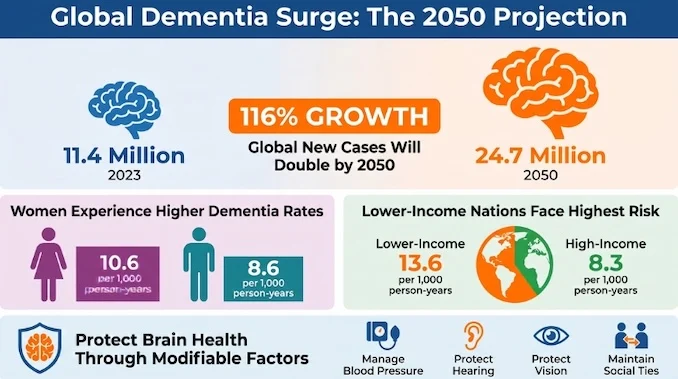
A landmark study published in JAMA Neurology has issued a sobering projection for global public health: the number of new dementia cases worldwide is expected to double over the next quarter-century. Released in October 2026, the comprehensive epidemiological research reveals that annual diagnoses will surge by 116%, rising from an estimated 11.4 million new cases in 2023 to an anticipated 24.7 million by the year 205
- This dramatic trajectory underscores an escalating crisis for health systems, governments, and the millions of family caregivers who form the backbone of long-term care infrastructure.
The findings arrive at a critical juncture for international health policy. As life expectancies rise globally, demographic shifts are fundamentally altering the age distribution of populations. While medical science has made strides in understanding neurodegenerative diseases, the sheer velocity of population aging threatens to outpace current prevention, diagnosis, and treatment frameworks. Public health advocates emphasize that confronting this impending crisis will require coordinated global leadership, substantial investment in medical research, and targeted healthcare access in vulnerable regions.
The Scale of the Crisis: Analyzing the 2050 Projections
To understand the mechanics behind the projected doubling of dementia cases, researchers analyzed global incidence trends, mortality rates, and demographic shifts. The study points out that the primary driver behind the 116% increase is not an inherent mutation or accelerated aggression of neurodegenerative diseases, but rather the rapid expansion of the world’s elderly population. Age remains the single most significant risk factor for conditions such as Alzheimer’s disease and other forms of dementia.
Historically, global health initiatives have focused heavily on acute care and infectious disease eradication. However, chronic non-communicable diseases—particularly those associated with cognitive decline—now represent the leading edge of long-term global disability. Dr. Emer MacSweeney, a consultant neuroradiologist, noted that the data should be interpreted as a vital wake-up call rather than a fatalistic inevitability. According to MacSweeney and co-researchers, accelerating early diagnosis and expanding preventative interventions can alter this trajectory significantly.

| Key Metric | Current Data (2023 Baseline) | Projected Data (2050 Forecast) |
|---|---|---|
| Annual New Global Cases | 11.4 Million | 24.7 Million |
| Percentage Increase | — | 116% |
| Incidence Rate (Women) | 10.6 per 1,000 person-years | Projected upward trend |
| Incidence Rate (Men) | 8.6 per 1,000 person-years | Projected upward trend |
Source: JAMA Neurology, October 2026.
The Gender Disparity: Investigating Higher Incidence Rates Among Women
A critical finding within the JAMA Neurology report is the pronounced gender gap in dementia incidence. The study documented a higher rate of new diagnoses among women, registering at 10.6 new cases per 1,000 person-years, compared to 8.6 per 1,000 person-years for men.
While epidemiological experts acknowledge that women, on average, live longer than men—and that age is the primary catalyst for dementia—longevity alone fails to account for the entire statistical discrepancy. Emerging biomedical research points toward sex-specific biological factors. Hormonal fluctuations during menopause, lifelong exposure to estrogen, and subtle variations in immune and inflammatory responses are believed to play substantive roles in female brain health. These insights highlight the necessity for gender-informed medical research, prompting health agencies to advocate for cognitive health monitoring tailored specifically to women well before their senior years.
The Global Divide: The Heart-Brain Connection and Socioeconomic Factors
The research also mapped distinct geographical and socioeconomic disparities in dementia incidence. Low- and middle-income countries (LMICs) face a considerably heavier burden, with an incidence rate of 13.6 cases per 1,000 person-years, contrasted with 8.3 cases per 1,000 person-years in high-income nations.
This geographical divide illuminates the critical nexus between cardiovascular health and neurological well-being. Over recent decades, high-income countries have implemented successful public health campaigns resulting in reduced smoking rates, more aggressive management of hypertension, and better control of cholesterol. Conversely, many LMICs are experiencing a rapid epidemiological transition, marked by rising rates of obesity, stroke, and cardiovascular disease.

Medical professionals emphasize that the heart-brain connection is undeniable. Conditions that compromise the vascular system—such as high blood pressure, diabetes, and atherosclerosis—simultaneously restrict adequate blood flow to the brain, accelerating cognitive decline and predisposing individuals to vascular dementia and Alzheimer’s disease.
Modifiable Risk Factors and Preventative Strategies
Although advanced age and genetic predispositions cannot be altered, public health authorities stress that a significant percentage of dementia cases are linked to modifiable risk factors. International health organizations have increasingly focused on lifestyle interventions that can preserve cognitive function across the lifespan.
Medical consensus points toward several foundational pillars for brain health:
- Cardiovascular Management: Rigorous monitoring and control of blood pressure, blood glucose, and lipid profiles.
- Sensory Preservation: Early detection and treatment of hearing and vision loss, which are increasingly linked to cognitive isolation and decline.
- Social and Mental Engagement: Maintaining active social networks and engaging in lifelong learning to build cognitive reserve.
- Physical Activity: Incorporating regular aerobic exercise to support neurogenesis and vascular health.
Addressing these factors requires a dual approach: empowering individuals with actionable lifestyle guidance while implementing systemic policy changes that improve access to preventative healthcare, particularly in underserved global regions.
Chronology of Dementia Research and Global Policy Responses
- 2019: The World Health Organization (WHO) releases its first-ever guidelines on risk reduction of cognitive decline and dementia, emphasizing lifestyle interventions.
- 2021: Breakthrough monoclonal antibody treatments for Alzheimer’s disease begin receiving regulatory reviews, signaling a shift toward disease-modifying therapies.
- 2023: Global incidence estimates establish a baseline of 11.4 million new dementia cases annually, prompting expanded international epidemiological surveillance.
- October 2026: JAMA Neurology publishes the landmark study projecting that annual new cases will reach 24.7 million by 2050, triggering widespread calls for global policy reform.
Socioeconomic Implications and the Future of Caregiving
The economic and social ramifications of a 116% surge in dementia cases extend far beyond clinical settings. Healthcare systems globally face the prospect of unprecedented strain on long-term care facilities, specialized neurology workforces, and social safety nets. Furthermore, the burden falls disproportionately on informal family caregivers—spouses, adult children, and relatives—who provide the vast majority of daily care without financial compensation or adequate institutional support.

Experts argue that mitigating the societal impact of these projections demands immediate, coordinated action from international governing bodies. Without robust investments in community-based care infrastructures, respite programs, and economic support for caregivers, families will find themselves unequipped to manage the growing crisis.
Ultimately, while the projection of 24.7 million annual cases by 2050 serves as a sobering warning, researchers reiterate that the future is not entirely predetermined. Through strategic investments in medical research, equitable distribution of preventative healthcare, and a unified global commitment to addressing cardiovascular and lifestyle risk factors, policymakers still possess the window of opportunity necessary to bend the curve of cognitive decline before mid-century.
Related posts: