
5 Essential Bathroom Safety Modifications to Prevent Catastrophic Falls in Older Adults


The modern landscape of eldercare is increasingly defined by a singular, persistent anxiety among family caregivers: the moment an aging parent or relative steps into the bathroom. While this space is essential for maintaining personal hygiene and dignity, it simultaneously functions as the most hazardous architectural zone within a residential home. According to public health data compiled by federal agencies and geriatric medical associations, millions of older adults experience severe falls each year, with a disproportionate number of these incidents occurring in the bathroom. The combination of hard ceramic surfaces, moisture, soap, and the natural physiological declines associated with aging creates a high-risk environment that demands immediate, clinical-grade intervention rather than casual, aesthetic home improvements.
To understand the urgency of bathroom safety modifications, one must examine the broader demographic and public health context surrounding senior housing. As the global population ages and a record number of older adults express a strong preference for "aging in place"—remaining in their lifelong homes rather than transitioning to institutional care facilities—the architectural safety of residential properties has emerged as a critical public health priority. However, the physical reality of a standard home often clashes with the mobility limitations of an aging body. Muscle weakness, compromised balance, stiff joints, diminished proprioception, and progressive vision loss transform routine daily activities into perilous endeavors. When an individual experiences a slip or a misstep in a space devoid of adequate support structures, the consequences are rarely benign.
The chronology of a typical home safety intervention often follows a reactive, rather than proactive, trajectory. Historically, families tend to address home modifications only after a near-miss or an actual catastrophic fall has occurred. Public health researchers and geriatric care managers have long criticized this reactive model, noting that a single fall resulting in hospitalization frequently serves as the catalyst for a permanent loss of independence. The financial and emotional toll of such an event is staggering. Medical literature indicates that the baseline cost of treating a major fall resulting in a fractured hip, subsequent surgical intervention, and mandatory rehabilitation in a skilled nursing facility routinely exceeds fifty thousand dollars. In contrast, comprehensive, professional home safety modifications generally require an upfront investment ranging from two thousand to five thousand dollars. Industry experts emphasize that structural upgrades should be viewed not as discretionary household expenses, but as vital financial and physical insurance policies designed to preserve long-term independence.
Addressing these complex environmental hazards requires moving past conventional hardware store solutions and adopting precise, clinical methodologies. Experts in occupational therapy and home modification advocate for five foundational adjustments that systematically neutralize the primary risk factors found in residential bathrooms.
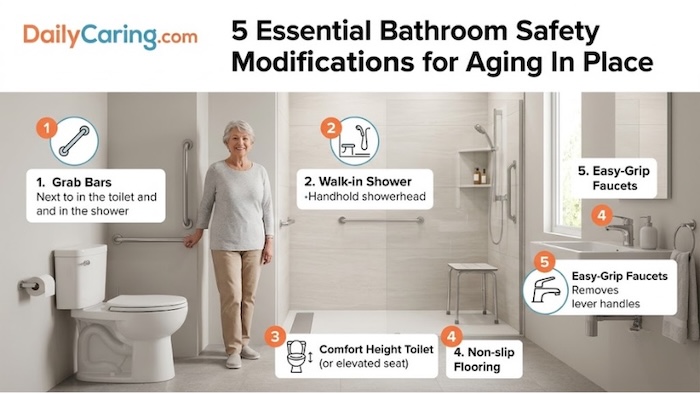
The first and most critical intervention involves the strategic installation of grab bars. Too often treated as generic accessories or do-it-yourself projects, grab bars must instead be evaluated as clinical medical tools mapped directly to a user’s specific functional reach and biomechanical limitations. A qualified professional, such as a Certified Aging in Place Specialist (CAPS) or a licensed occupational therapist, evaluates how an individual navigates the space before determining where support is fundamentally required. Furthermore, professional installation anchored directly into structural wall studs is mandatory. Suction-cup and tension-mounted bars are notoriously unreliable under the sudden, intense kinetic energy of a falling adult, frequently failing precisely when they are needed most. When selecting hardware, safety guidelines recommend bars with diameters between 1.25 and 1.5 inches to accommodate aging hands comfortably, alongside ADA-compliant knurled finishes that provide superior traction compared to smooth, slippery chrome surfaces.

The second major area of concern is the standard residential toilet, which presents a significant barrier to safe mobility. Standard toilets installed at a height of fifteen inches require a high degree of quadricep strength and joint flexion to transition from a seated position to a standing posture. For seniors suffering from arthritis, muscle atrophy, or generalized weakness, this movement is both painful and hazardous. While building codes often mandate heights between seventeen and nineteen inches for commercial accessibility, residential safety requires a customized calculation. Caregivers and specialists must measure the precise distance from the floor to the back of the senior’s knee, tailoring the toilet seat height to match these specific anthropometric dimensions. By eliminating excessive joint stress during transfers, the risk of a misstep or a collapse during a bathroom visit is substantially reduced.
The third element requiring systematic overhaul is environmental lighting. Aging eyes undergo physiological changes, including pupil constriction and lens opacification, which drastically reduce the amount of light reaching the retina. Consequently, older adults require significantly higher levels of illumination to navigate safely. However, simply installing high-wattage bulbs often backfires by creating harsh glares and deep shadows that obscure depth perception and disorient the user. To mitigate this hazard, lighting design must focus on uniform illumination and high visual contrast. Industry standards recommend bulbs with a Color Rendering Index (CRI) of eighty or higher and a color temperature ranging between 2700K and 3000K. Additionally, creating clear visual boundaries—such as distinguishing the edge of a bathtub or shower threshold from the surrounding floor through contrasting colors—prevents spatial misjudgments that frequently lead to stumbles.
Fourthly, flooring materials must be re-evaluated through the dual lens of slip resistance and impact absorption. Traditional ceramic tile, while popular for its water resistance, offers zero shock absorption. If a fall occurs on a tile floor, the rigid surface provides no energy dissipation, dramatically increasing the likelihood of bone fractures and severe trauma. Modern safety protocols encourage the incorporation of alternative flooring solutions, such as rubberized surfaces, textured cork, or specialized slip-resistant vinyl. Rubber flooring, in particular, offers an optimal balance by combining high traction with maximum impact absorption to cushion potential falls and protect fragile bones.

Finally, the elimination of transitional thresholds—commonly referred to as door saddles—remains an essential step in preventing trips. Standard architectural thresholds create abrupt height differentials where different flooring materials meet, such as bathroom tile and hallway carpeting. For seniors who exhibit a shuffling gait, a common manifestation of various neurological and musculoskeletal conditions, even a fraction of an inch variance can trigger a catastrophic forward fall. Replacing these rigid dividers with graded, zero-edge transitions ensures a smooth, uninterrupted pathway for walkers, wheelchairs, and unassisted walking alike.
Executing these modifications successfully requires specialized expertise that extends far beyond the scope of a general handyman or traditional contractor. Industry stakeholders strongly advise families to engage professionals holding the Certified Aging in Place Specialist designation, a credential administered by the National Association of Home Builders. Professionals who have earned this certification undergo rigorous training concerning the unique physiological challenges of older adults, barrier-free design principles, and structural load-bearing requirements. Vetted professionals can be located through official industry directories, ensuring that the installation of safety equipment meets stringent engineering standards.
Public health analysts and eldercare advocates maintain that proactive home modifications represent a cornerstone of sustainable aging-in-place strategies. By addressing environmental hazards before an accident occurs, families can drastically mitigate the physical and emotional devastation associated with senior falls. As healthcare systems continue to emphasize preventive care and independent living, the systematic upgrading of residential bathrooms stands out as a proven, cost-effective measure capable of safeguarding the well-being of older populations for years to come.