Why Standard Leg Workouts Fail to Protect Senior Independence and the Hidden Role of Ankle Mobility


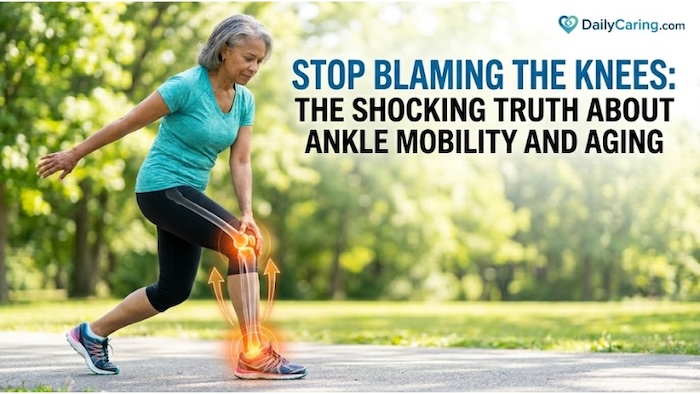
As populations age worldwide, standard approaches to senior fitness and eldercare face a growing re-evaluation from geriatric specialists and biomechanical researchers. Traditional exercise regimens emphasizing squats, lunges, and general lower-body strength are frequently prescribed to maintain mobility in older adults. However, recent clinical findings suggest that these routines often miss a primary driver of physical decline: the structural and neurological transformation of the ankles. When an aging parent experiences exhaustion during a routine walk to a local grocery store, family members and caretakers routinely attribute the fatigue to generalized aging or weak knees. According to emerging scientific literature, the true physical bottleneck is located lower, directly at the feet and ankles.
The connection between ankle mobility and the preservation of independence in older adults has historically been overshadowed by broader concerns regarding hip strength and overall cardiovascular endurance. Recent data, however, indicates that the aging human nervous system undergoes distinct adaptations that fundamentally alter how the ankles function during locomotion. Rather than failing simply due to a lack of raw muscle mass, the lower extremities often suffer from a neurological response designed to prioritize immediate fall prevention at the expense of mechanical efficiency. Understanding this biological trade-off is becoming increasingly central to modern eldercare strategies and clinical fall-prevention frameworks.
The Biomechanics of Aging: Wasted Effort and the Safety-First Strategy
To understand why traditional leg exercises frequently fall short, researchers are examining the complex interplay between the central nervous system and peripheral joints. A study published in the Journal Gait & Posture outlines how the aging nervous system adopts a rigid, safety-first strategy characterized by muscle co-contraction. In a younger, mechanically efficient musculoskeletal system, opposing muscles around a joint fire in a coordinated, sequential pattern—one contracts while the other relaxes to allow fluid motion.
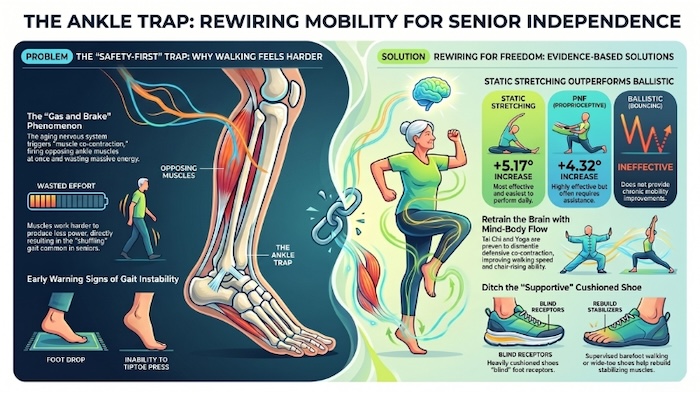
As individuals age, the nervous system often triggers simultaneous activation of opposing muscle groups around the ankle joint. This phenomenon effectively forces the body to apply the gas and the brake at the exact same time. The resulting joint stiffness improves momentary balance when the foot makes contact with the ground, but it introduces massive mechanical inefficiency. Older adults must expend significantly more energy to generate only a fraction of the forward push-off power seen in younger cohorts. Consequently, stride lengths shorten, walking speeds decline, and physical exertion mounts rapidly. This continuous battle against one’s own muscle contractions explains why routine tasks induce disproportionate fatigue and why gait instability remains a primary precursor to injurious falls among seniors.

Expert Perspectives on Natural Movement and Neuromuscular Adaptation
Medical professionals specializing in geriatric health are increasingly advocating for movement practices that challenge the nervous system to adapt to natural, uneven surfaces rather than relying solely on fixed-resistance gym equipment. Dr. Kristie Leong, a medical writer and healthcare advocate, emphasizes the value of incorporating varied terrain into older adult fitness routines. According to Dr. Leong, activities such as hiking or walking on uneven ground require the ankles, hips, and feet to continuously adjust, optimizing real-world movement capacity while engaging stabilizing reflex systems.
Furthermore, experts are revisiting the influence of footwear design on proprioception—the body’s ability to sense its position in space. Heavy, heavily cushioned orthopedic shoes, while designed to provide maximal support and shock absorption, can act similarly to a rigid cast. These thick-soled designs can insulate the foot from sensory feedback, dulling the proprioceptive signals sent from the soles of the feet to the central nervous system. Transitioning to flexible footwear or incorporating supervised periods of barefoot walking allows the foot to spread naturally, recruiting stabilizing intrinsic muscles that standard footwear often renders dormant.

Recognizing the Early Warning Signs of Gait Instability
Clinical guidelines consistently emphasize that intervention must occur well before a catastrophic fall takes place. The human nervous system typically provides observable, physical indicators that defensive ankle co-contraction and declining mobility are taking hold. Caregivers and family members are encouraged to monitor older adults for specific behavioral and mechanical changes during routine daily activities.
Early warning signs often include a noticeable transition from a clean, lifted step to a shuffling gait where the feet sweep close to or drag along the floor. Foot drop—a condition where the front part of the foot drags due to reduced neuromuscular control—frequently leads to tripping over low thresholds or area rugs. Additionally, evaluating an individual’s ability to rise onto their tiptoes to reach an elevated shelf can offer immediate insight into their remaining push-off power. Identifying these markers of gait instability early allows families and healthcare providers to implement targeted interventions before minor mobility issues escalate into medical emergencies.
Targeted Frameworks for Restoring Ankle Efficiency
Because conventional strength training routines often overlook the neurological component of ankle stiffness, specialized protocols are required to retrain the nervous system. Clinical biomechanics data suggests a multi-faceted approach focused on proprioception, tendon strength, joint mobility, and neuromuscular coordination.
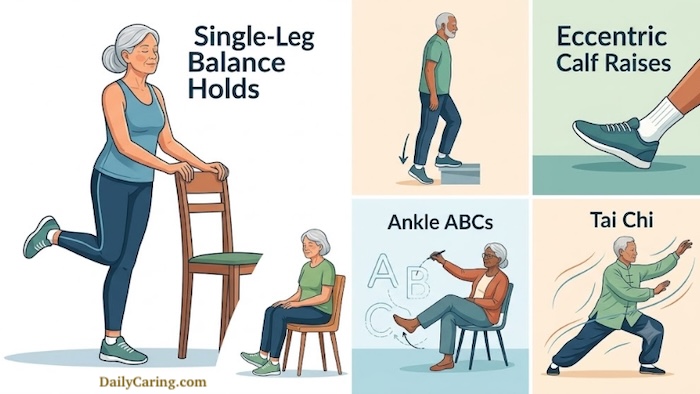
Single-leg balance holds, performed with structural support nearby such as a sturdy chair, challenge the proprioceptive system and improve timing. Eccentric calf raises—where an individual elevates onto both toes and lowers their heels as slowly as possible—strengthen the Achilles tendon and rebuild the capacity for effective push-off power. Ankle alphabet exercises, performed while seated by tracing letters in the air with the big toe, help break down localized joint stiffness. Finally, disciplines like Tai Chi offer continuous, fluid movements that have been clinically demonstrated to reduce excessive muscle co-contraction around the ankle joint, fostering smoother and more efficient locomotion.
Broader Implications for Eldercare and Fall Prevention Policies
The growing body of research surrounding ankle mechanics carries significant implications for institutional eldercare, physical therapy protocols, and public health policies aimed at reducing senior injuries. Falls among older adults represent a leading cause of morbidity, mortality, and escalating healthcare expenditures globally. By shifting the clinical focus from generalized lower-limb strength to specific neuromuscular efficiency at the ankle, healthcare providers can design more targeted preventative programs.
Economic and social impacts are equally substantial. Preserving independent mobility directly correlates with extended periods of independent living, reduced caregiver burden, and lower rates of long-term care facility admissions. As healthcare systems adapt to rapidly aging demographics, integrating biomechanical assessments of the foot and ankle into routine geriatric evaluations may become a standard pillar of preventative medicine. Ultimately, addressing the root causes of gait instability requires moving beyond conventional exercise paradigms to embrace therapies that retrain the nervous system, ensuring that older adults maintain both their physical safety and their long-term autonomy.