Prevent Catastrophic Falls With These 5 Bathroom Safety Modifications For Seniors

The silent crisis unfolding in homes across the country rarely makes evening news broadcasts, yet its impact reverberates through emergency rooms and rehabilitation centers daily. For aging adults and the family members who care for them, the most dangerous space in any residence is not a high-traffic highway or a dimly lit staircase; it is the residential bathroom. Defined by hard porcelain surfaces, moisture, soap, and spatial constraints, this room creates a volatile environment that routinely challenges declining balance, failing eyesight, and reduced muscle mass.
According to public health data compiled by federal agencies, falls remain the leading cause of fatal and non-fatal injuries among older Americans. When these incidents occur, they frequently happen behind closed bathroom doors where privacy is valued, but physical security is severely compromised. Healthcare executives, occupational therapists, and elder-care advocates increasingly emphasize that preventing these life-altering accidents requires moving beyond generic home improvements and adopting clinical precision in home design. Implementing targeted, professional structural modifications can drastically reduce injury rates, preserve an older adult’s dignity, and secure their ability to age in place safely.
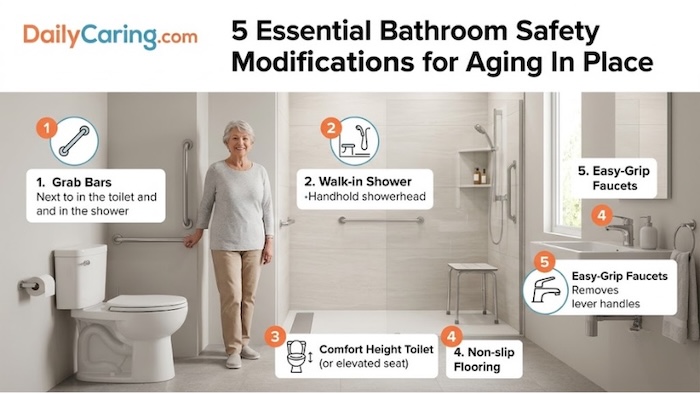
To help families navigate this critical home upgrade, safety experts have identified five essential bathroom modifications designed to neutralize the highest-risk hazards in the home.
The Anatomy of Bathroom Vulnerability
To understand why the bathroom poses such an extreme hazard, one must examine the intersection of environmental factors and the physiological realities of aging. As individuals grow older, common bodily changes include the gradual loss of muscle mass (sarcopenia), joint stiffness, diminished proprioception (the body’s ability to sense its position in space), and declining visual acuity.
When these physical limitations encounter a room featuring slippery ceramic tile, low-slung plumbing fixtures, and abrupt architectural thresholds, the probability of a fall escalates exponentially. Public health analysts note that a single severe fall often triggers a catastrophic cascade: hospitalization, surgical intervention for fractures such as a broken hip, and a prolonged stay in a skilled nursing or rehabilitation facility. For many seniors, this transition permanently ends independent living. Consequently, proactive environmental modifications are no longer viewed as optional aesthetic choices, but rather as necessary clinical interventions.
1. Treat Grab Bars as Clinical Tools, Not DIY Accessories
The most common mistake homeowners make when attempting to secure a bathroom is treating grab bars as simple hardware store accessories that can be installed haphazardly over a weekend. Industry professionals stress that grab bars must be approached as clinical tools mapped directly to a user’s specific functional reach and mobility limitations.
An occupational therapist or a specialized contractor evaluates how a senior moves within the space, identifying the exact physical vectors where a person might lose balance. These devices must never be anchored solely into drywall or secured using suction cups. Under the sudden kinetic energy of a falling adult, suction-cup bars inevitably fail, transforming a supposed safety device into a secondary hazard that can exacerbate a fall.
Professional installation requires locating and anchoring the bars directly into structural wall studs or utilizing heavy-duty blocking behind the wall. When shopping for hardware, caregivers should look for bars with a diameter between 1.25 and 1.5 inches, which provides an optimal grip for aging hands. Furthermore, experts recommend ADA-compliant knurled finishes rather than slick, polished chrome, as textured surfaces prevent hands from slipping when wet.
2. Engineer the Perfect Toilet Height to Protect Joints
Standard residential toilets, typically standing at roughly 15 inches from the floor to the top of the bowl, present a significant ergonomic challenge for older adults. Lower toilets demand excessive joint flexion in the knees and hips, as well as substantial quadriceps strength, to transition from a seated position to a standing posture.
While the Americans with Disabilities Act (ADA) recommends a toilet height of 17 to 19 inches for commercial wheelchair accessibility, residential safety requires a customized calculation tailored to the individual. Occupational therapists use a specific formula to determine the ideal height: measuring the distance from the floor to the back of the senior’s knee and lower thigh, then adjusting the fixture or adding a secure riser to match that exact dimension. Eliminating the physical strain of sitting and standing drastically reduces the likelihood of a loss of balance in close proximity to hard vanity corners and tiled walls.
3. Implement High-Contrast, Uniform Lighting
Visual degradation is an inevitable component of the aging process. Aging eyes frequently suffer from decreased pupil size, thickened lenses, and clouding, all of which demand significantly higher levels of ambient illumination to navigate safely. However, a common counterproductive reaction by homeowners is installing excessively bright, glaring lightbulbs, which can severely impair depth perception and blind a senior with sensitive eyes.

The objective of modern senior-friendly lighting design is uniform illumination paired with high visual contrast. Lighting specialists recommend utilizing bulbs with a Color Rendering Index (CRI) of 80 or higher and a color temperature maintained strictly within the 2700K to 3000K range. Additionally, creating stark visual boundaries—such as ensuring the edge of a white bathtub contrasts sharply with the surrounding floor—allows individuals with low vision to accurately gauge spatial dimensions and avoid missteps.
4. Install Impact-Absorbing Flooring Materials
Ceramic and porcelain tile have long been the standard for bathroom flooring due to their water-resistant qualities; however, they offer zero shock absorption. If a fall does occur on traditional tile, the unforgiving surface provides no energy dissipation, frequently resulting in severe bone fractures and traumatic injuries.
Modern safety protocols encourage a shift in perspective: while maintaining high slip-resistance remains paramount, protecting the skeletal system from impact is equally vital. Property owners are increasingly turning to alternative flooring options such as rubber flooring, which offers both maximum traction and exceptional impact absorption to protect joints and bones. Other viable alternatives include textured cork, which features natural grip and air-filled cellular structures that cushion impacts, and specialized slip-resistant vinyl.
| Flooring Material | Slip Resistance | Impact Absorption | Cost Factor |
|---|---|---|---|
| Rubber Flooring | Excellent (High Traction) | Maximum (Protects Joints/Bones) | $$$ |
| Textured Cork | High (Natural Grip) | High (Air-filled cells) | $$ |
| Slip-Resistant Vinyl | Moderate to High | Low to Moderate | $ |
| Ceramic Tile | Low (Extreme Fall Risk) | Zero (High Fracture Risk) | $$ |
5. Eliminate Architectural Door Saddles and Thresholds
One of the most frequently overlooked tripping hazards in any residential home is the transition threshold between rooms, often referred to as the door saddle. Standard thresholds create an abrupt height variation where a carpeted hallway meets a tiled bathroom floor.
For seniors who develop a characteristic shuffling gait—a common symptom associated with various neurological and mobility conditions—even a half-inch elevation change is enough to catch a foot and cause a violent fall. Remediating this hazard involves removing traditional thresholds and installing graded, zero-edge transitions that create a smooth, seamless plane from room to room.
The Importance of Hiring Certified Professionals (CAPS)
Executing these structural modifications requires specialized knowledge that exceeds the scope of a general handyman or traditional home contractor. Industry experts strongly advise families to hire professionals holding the Certified Aging in Place Specialist (CAPS) designation.

Administered by the National Association of Home Builders (NAHB), the CAPS credential signifies that a designer or builder has undergone rigorous training regarding the biomechanical needs of older adults, mobility barrier solutions, and structural load-bearing requirements for residential safety equipment. Vetted professionals can be located directly through official industry registries and home building associations.
Financial Analysis: Cost Versus Consequence
While undertaking comprehensive bathroom renovations involves an upfront financial commitment—typically ranging between $2,000 and $5,000 for professional grab bar installation, upgraded lighting, comfort-height plumbing, and threshold removal—industry analysts urge families to view these expenditures in proper context.
By contrast, the reactive financial consequence of a single catastrophic fall resulting in emergency medical transport, hospitalization, surgical hip replacement, and subsequent inpatient rehabilitation frequently exceeds $50,000. Economists and elder-care advocates therefore characterize a $5,000 home modification not as a discretionary expense, but as a vital insurance policy designed to preserve financial assets and protect an older adult’s independence.
Failing to address these environmental hazards leaves the home fundamentally hostile to an aging body. Executing these structural changes promptly and professionally remains the most effective strategy for securing the bathroom, mitigating liability, and ensuring the long-term physical well-being of older adults aging in place.