Prevent Catastrophic Falls With These 5 Bathroom Safety Modifications for Seniors

For millions of family caregivers across the globe, the daily routine of looking after an aging parent is accompanied by a persistent, quiet anxiety. While worry accompanies almost every aspect of elder care, it routinely spikes during moments that require absolute privacy—most notably, when a senior enters the bathroom. This space, designed for personal hygiene and comfort, represents a hazardous intersection of hard ceramic surfaces, moisture, soap, and physiological vulnerability. According to public health data compiled by federal agencies and geriatric medical associations, millions of older adults suffer from severe falls each year, with a significant percentage of these incidents occurring directly inside the bathroom.
Addressing this domestic hazard requires moving beyond superficial fixes or off-the-shelf gadgets. Public health officials, occupational therapists, and home modification specialists emphasize that safeguarding a bathroom for aging in place demands clinical precision, structural integrity, and thoughtful design. To help families navigate these life-saving updates, experts have outlined five essential bathroom safety modifications designed to drastically reduce the risk of catastrophic injury, preserve independence, and provide peace of mind for both seniors and their caregivers.
The Underlying Crisis: Why the Bathroom is the Most Dangerous Room in the Home
To understand why the bathroom poses such an acute threat, one must examine the combination of environmental risk factors and age-related physical decline. As the human body ages, it undergoes subtle yet impactful shifts in biomechanics. Muscle mass gradually decreases, a process known medically as sarcopenia; joints often become stiff or arthritic; and sensory systems, including vision and proprioception, begin to degrade. When an older adult enters a bathroom, these physical realities collide with a room defined by uncompromising architecture.
Tile floors, porcelain tubs, and glass shower doors offer zero forgiveness when a loss of balance occurs. The introduction of water and soap completely eliminates traction, transforming ordinary tile into a skating rink. For a senior experiencing a shuffle gait, dizziness, or sudden drops in blood pressure upon standing, the room becomes a high-risk zone where a simple misstep can result in fractures, traumatic brain injuries, or prolonged immobility on the floor. Public health economists note that the consequences of these falls extend far beyond physical trauma, frequently serving as the pivotal tipping point that forces an older adult out of their family home and into an institutional nursing facility.
- Treating Grab Bars as Clinical Tools, Not DIY Accessories
The most common mistake families make when attempting to secure a bathroom is treating grab bars as simple hardware accessories that can be installed haphazardly over a weekend. Industry standards and clinical guidelines dictate that grab bars must be treated as critical medical devices mapped precisely to an individual’s functional reach and unique mobility limitations.
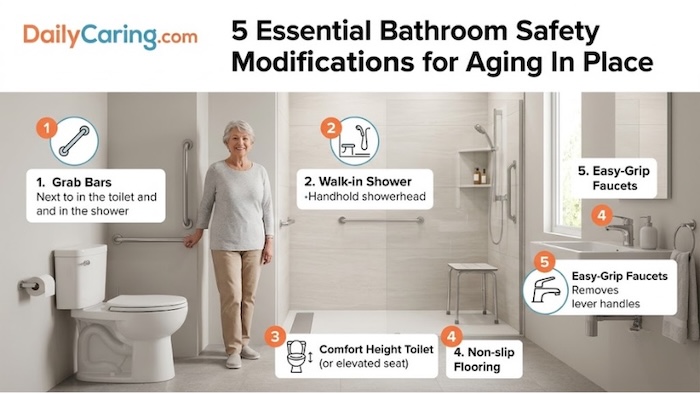
An occupational therapist does not merely locate a wall stud to mount a bar; they evaluate how an aging adult moves, where their balance fails, and how they transition from a sitting to a standing position. This clinical assessment ensures the bar is positioned where the body naturally reaches during a stumble. Furthermore, professional installation anchored directly into structural framing is mandatory. Portable suction-cup grab bars, while convenient, frequently fail under the sudden, intense kinetic energy of a falling adult, turning a perceived safety device into a secondary hazard.
When purchasing hardware, caregivers should look for specific design elements. Grab bars with a diameter between 1.25 and 1.5 inches are optimal for aging hands to securely grasp. Additionally, experts recommend ADA-compliant knurled finishes rather than smooth, polished chrome, as textured surfaces provide critical friction for wet or arthritic hands.
- Achieving the Ideal Toilet Height to Protect Joints
Standard residential toilets, typically standing at a height of 15 inches from the floor to the top of the bowl, present a hidden danger for older adults. As quadricep strength diminishes and knee or hip joints become stiff, lowering oneself onto a standard toilet and subsequently rising from it demands immense lower-body power. This physical strain frequently leads to falls, loss of balance, or individuals becoming stranded on the commode.
While the Americans with Disabilities Act (ADA) recommends commercial toilet heights ranging from 17 to 19 inches for wheelchair accessibility, residential safety requires a customized calculation tailored to the specific user. Healthcare providers utilize a simple ergonomic formula: measuring the distance from the floor to the back of the senior’s knee, and adjusting the seat height accordingly to ensure the thighs remain parallel to the floor when seated. Achieving this optimal height significantly reduces joint stress, minimizes the risk of orthostatic hypotension caused by rapid postural changes, and empowers seniors to use the restroom independently.
- Maximizing Visual Independence Through High-Contrast Lighting
Vision loss is an insidious component of the aging process. Conditions such as cataracts, glaucoma, and age-related macular degeneration diminish the eye’s ability to process light and shadow. Older eyes naturally suffer from decreased pupil size and lens clouding, meaning a senior often requires up to three times more ambient light to see clearly compared to a young adult.
However, a common pitfall in home modification is simply installing excessively bright bulbs. This often creates harsh, blinding glares that obscure depth perception, making tiled floors look like wet surfaces and hiding the edge of a bathtub. The solution lies in uniform illumination and high-contrast design. Safety experts recommend utilizing LED bulbs with a Color Rendering Index (CRI) of 80 or higher and a warm color temperature ranging between 2700K and 3000K. By creating stark visual boundaries—such as contrasting the color of grab bars against the wall, or using distinct hues for the shower threshold and flooring—caregivers can help seniors safely navigate the room even with compromised vision.
- Selecting Flooring Materials That Cushion Impact
Traditional ceramic tile is selected for bathrooms primarily due to its water resistance, yet it remains one of the most hazardous flooring choices for aging-in-place environments. Ceramic tile offers zero shock absorption; in the event of a fall, the rigid surface delivers maximum kinetic energy back into the body, dramatically increasing the likelihood of hip fractures, wrist breaks, and head trauma.

Modern home safety planning requires a shift in perspective: floors must be engineered to prevent slips while simultaneously providing energy dissipation for potential impacts. Several alternatives have gained traction in geriatric design. Rubber flooring offers exceptional slip resistance and maximum impact absorption, protecting fragile bones. Textured cork provides natural grip and high shock absorption due to its air-filled cellular structure. While slip-resistant vinyl offers moderate traction at a lower cost, untreated ceramic tile remains a primary contributor to severe senior injuries and should be covered with non-slip, securely anchored mats if full replacement is financially unfeasible.
- Eliminating Door Saddles and Threshold Transitions
One of the most frequently overlooked architectural hazards in residential bathrooms is the humble door saddle or floor threshold. As rooms transition from hallway carpeting to bathroom tile, builders traditionally install a raised wooden or metal strip to bridge the gap. For an older adult navigating the home with a shuffle gait, muscle weakness, or assistive devices like walkers and canes, this sudden height variation acts as an invisible tripwire.
Eliminating this barrier is vital. Professional home modifiers replace standard elevated thresholds with graded, smooth transition strips that create a zero-edge boundary. This subtle architectural adjustment ensures that walking aids glide smoothly across the surface and minimizes the risk of a toe catching on an abrupt edge during a midnight trip to the restroom.
The Importance of Hiring Certified Professionals (CAPS)
Executing these modifications requires specialized knowledge that extends far beyond the scope of a general handyman or weekend DIY enthusiast. Families are strongly encouraged to seek out professionals holding the Certified Aging in Place Specialist (CAPS) designation, a credential administered by the National Association of Home Builders (NAHB).
Professionals holding a CAPS certification undergo rigorous training regarding the biomechanical needs of older adults, modern mobility barrier solutions, and the structural load-bearing requirements necessary for anchoring safety equipment safely into household walls. Vetted contractors can be located through official national registries, ensuring that the modifications meet strict safety codes and provide genuine, long-lasting protection.
Economic Implications: Upfront Investment Versus Reactive Costs

When families evaluate the cost of professional bathroom modifications—which typically range between $2,000 and $5,000 depending on the scope of work—it is easy to view the expense through a purely budgetary lens. However, healthcare analysts urge caregivers to weigh these preventative investments against the staggering reactive costs associated with a catastrophic fall.
According to healthcare utilization data, the baseline cost of a single major fall resulting in emergency room transport, surgical hip replacement, inpatient hospital care, and subsequent weeks in a skilled nursing rehabilitation facility frequently exceeds $50,000. Beyond the immense financial toll, such an event often marks an irreversible decline in the senior’s functional independence. Viewed through this analytical framework, investing in professional bathroom modifications is not a home improvement expense; it is a vital insurance policy designed to preserve health, safety, and autonomy.
Conclusion and Future Outlook
As global demographics shift toward an increasingly aging population, the conversation surrounding elder care is pivoting heavily toward aging in place. Public health officials emphasize that proactive environmental modification is the single most effective tool in preventing life-altering accidents before they occur.
Ignoring the warning signs and leaving a high-risk environment unmodified exposes vulnerable adults to unnecessary danger. By treating the bathroom with the clinical seriousness it demands—installing properly anchored grab bars, optimizing lighting, upgrading toilet heights, choosing forgiving flooring, and removing tripping hazards—families can successfully neutralize the most dangerous room in the house. Through timely action and the guidance of certified professionals, caregivers can secure the domestic environment, ensuring that older adults can live out their golden years with dignity, safety, and independence.