Prevent catastrophic falls with these 5 bathroom safety modifications for seniors


For millions of family caregivers across the country, the daily routine is shadowed by a persistent and quiet anxiety. While aging parents value their privacy and autonomy, navigating the home environment presents hidden perils, with worry peaking dramatically at the door of the bathroom. Characterized by slippery ceramic surfaces, hard porcelain fixtures, and isolated spaces, the domestic bathroom has long been identified by geriatricians as the single most hazardous room in a residential home. As physical realities such as muscle weakness, progressive joint stiffness, declining visual acuity, and balance disorders set in, the margin for error narrows dangerously.
Public health data consistently underscore the severity of the issue. According to federal health agencies, accidental slips and falls are the leading cause of fatal and non-fatal injuries among older adults, with a significant percentage of these incidents occurring in the bathroom. The financial, emotional, and physical tolls are immense. A single catastrophic fall can result in complex fractures, traumatic brain injuries, immediate hospitalization, and subsequent stays in skilled nursing rehabilitation facilities. Consequently, public health advocates and clinical specialists are increasingly emphasizing proactive home modifications. Rather than viewing architectural adjustments as optional upgrades, safety experts frame them as necessary clinical interventions designed to preserve independence and prevent life-altering trauma.
The Biomechanical Anatomy of Bathroom Hazards
To understand why bathrooms pose such an extreme risk, experts point to a convergence of environmental and physical factors. The room is fundamentally defined by water, soap, and hard surfaces, a combination that systematically destroys traction. When an older adult experiences a momentary loss of balance, the lack of shock-absorbing materials means that every stumble carries the potential for severe skeletal impact. Furthermore, age-related changes in the human body alter spatial awareness and reaction times. Conditions like peripheral neuropathy can deaden the sensation in the soles of the feet, making it difficult for seniors to gauge flooring transitions or wet surfaces.
Addressing these systemic risks requires moving beyond rudimentary, off-the-shelf solutions typically found at local hardware stores. Clinical precision and professional evaluation are vital to ensure that safety hardware matches the specific biomechanical needs of the user. Below are five essential, evidence-based structural modifications recommended by occupational therapists and certified aging-in-place specialists to mitigate fall risks effectively.
1. Treating Grab Bars as Clinical Mobility Tools
One of the most common mistakes in senior home modification is the improper selection and installation of grab bars. Too often, households rely on consumer-grade, suction-cup accessories purchased online, assuming any bar attached to a wall will suffice. Safety engineers and occupational therapists warn that suction-cup devices will inevitably fail under the sudden, intense kinetic energy of a falling adult, transforming a perceived safety net into a catastrophic secondary hazard.
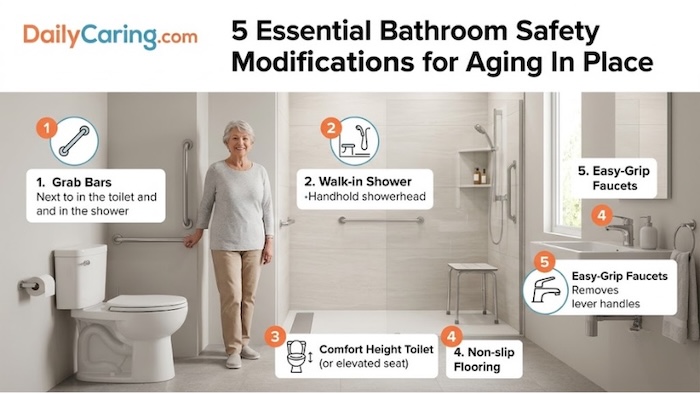
Instead, grab bars must be treated as clinical tools mapped directly to an individual’s specific functional reach and mobility limitations. Proper installation requires anchoring the hardware securely into structural wall studs capable of bearing heavy loads. When shopping for appropriate hardware, specialists recommend bars with a diameter of 1.25 to 1.5 inches, which provides optimal grip for aging hands suffering from arthritis or reduced muscle mass. Additionally, opting for American National Standards Institute (ANSI) and Americans with Disabilities Act (ADA)-compliant knurled finishes rather than smooth chrome ensures a secure, non-slip hold even when hands are wet.
2. Engineering the Optimal Toilet Height and Transitory Mechanics
Standard residential toilets, typically manufactured at a height of 15 inches from the floor, present a severe ergonomic challenge for aging bodies. Lower seating arrangements demand excessive knee joint flexion and substantial quadricep strength to execute the transition from a seated to a standing position. This mechanical strain frequently leads to hesitation, loss of balance, or sudden stumbles upon rising.
While commercial guidelines established by the ADA recommend a seat height of 17 to 19 inches to accommodate wheelchair transfers, residential safety requires a customized approach. Occupational therapists utilize a specific measurement formula to determine the ideal toilet height for an individual: measuring the distance from the floor to the back of the senior’s knee, then matching the fixture or added riser to that precise dimension. By eliminating awkward joint stress and reducing the physical effort required for standing, caregivers can drastically lower the incidence of bathroom-related stumbles.
3. Optimizing Illumination through High-Contrast Visuals
Vision degradation is an inevitable component of the aging process, marked by decreased pupil size, thickened lenses, and a reduced capacity to process rapid changes in light levels. Aging eyes demand significantly higher levels of ambient illumination to navigate safely. However, a common pitfall in home lighting design is the installation of excessively bright, unshielded bulbs that generate harsh glares and deep shadows. This contrast distortion obscures depth perception, making step edges, transition thresholds, and tub ledges virtually invisible.
The objective of modern senior-friendly lighting design is uniform illumination paired with high visual contrast. Experts recommend utilizing LED bulbs with a Color Rendering Index (CRI) of 80 or higher and a color temperature ranging between 2700K and 3000K to mimic natural daylight without creating glare. Furthermore, introducing contrasting colors between bathroom walls, floors, and fixtures allows seniors with declining vision to accurately map their surroundings, significantly reducing navigational errors.
4. Upgrading Flooring Materials for Shock Absorption
While traditional ceramic tile remains popular for its water-resistant properties, it offers zero shock absorption and minimal traction when wet. If a fall does occur on ceramic tile, the rigid surface provides no energy dissipation, frequently resulting in shattered hips, wrist fractures, and severe head trauma.

To address this vulnerability, forward-thinking home modifications prioritize materials that offer both slip resistance and impact cushioning. Rubber flooring has emerged as the gold standard for senior bathrooms, providing exceptional traction and maximum shock absorption to protect joints and bones during an accidental impact. Textured cork, featuring microscopic air-filled cells, and slip-resistant vinyl represent highly effective, cost-efficient alternatives that combine natural grip with cushioning properties, shifting the focus from mere slip prevention to comprehensive impact management.
5. Eliminating Door Saddles and Threshold Transitions
Households frequently overlook architectural thresholds, yet door saddles and sudden floor transitions are among the primary culprits behind tripping incidents. In many homes, a raised wooden or metal saddle bridges the gap where hallway carpeting transitions to bathroom tile. For older adults experiencing a shuffle gait—a common walking pattern associated with neurological changes, fatigue, or joint stiffness—even a half-inch elevation change acts as an unexpected barrier.
Mitigating this risk involves removing standard, abrupt thresholds and replacing them with graded, zero-edge transitions. By creating a smooth, flush surface between adjoining rooms, contractors eliminate the physical snag points that routinely cause seniors to lose their footing.
The Importance of Professional Expertise: Certified Aging-in-Place Specialists (CAPS)
Executing these critical home modifications requires specialized knowledge that extends far beyond the scope of a general handyman or traditional contractor. Recognizing this need, the National Association of Home Builders (NAHB), in collaboration with AARP, established the Certified Aging-in-Place Specialist (CAPS) designation. Professionals holding this credential undergo rigorous training regarding the biomechanical needs of older adults, common mobility barrier solutions, and structural load-bearing requirements necessary for medical-grade safety installations.
Families seeking to future-proof their homes are strongly encouraged to consult the official NAHB directory to locate vetted CAPS professionals in their region. Collaborating with certified experts ensures that all modifications comply with structural engineering standards and clinical safety guidelines.
Financial Analysis: Prevention Versus Reactive Healthcare Costs
When evaluating the price tag of home renovations, families often experience sticker shock. Comprehensive professional modifications—including grab bar installations, lighting upgrades, comfort-height toilets, and threshold removals—typically require a one-time investment ranging from $2,000 to $5,000.

However, public health economists urge caregivers to weigh this expenditure against the reactive costs of a catastrophic fall. Federal healthcare data indicate that the baseline cost of a single fall resulting in emergency hospitalization, surgical hip replacement, and subsequent skilled nursing rehabilitation routinely exceeds $50,000. From a practical and financial standpoint, investing in structural home modifications functions less like a discretionary renovation and more like an essential insurance policy against an event that can permanently terminate an older adult’s ability to live independently.
Broader Implications for Aging in Place
As demographic shifts continue to alter the population pyramid, with the proportion of older adults expanding rapidly across developed nations, societal infrastructure must adapt. The demand for aging-in-place solutions is no longer a niche market concern; it is a critical public health priority. Healthcare systems, policymakers, and residential architects are increasingly focusing on proactive environmental design to reduce the burden on acute care facilities and long-term nursing institutions.
Ultimately, modifying the home environment serves a dual purpose: it mitigates physical danger while preserving the psychological well-being and dignity of aging individuals. By addressing hazards in high-risk zones like the bathroom, families can foster a secure, supportive habitat that honors the desire of older adults to age safely and comfortably in the familiar surroundings of their own homes. Prompt action, guided by clinical expertise and professional execution, remains the most effective defense against the pervasive threat of domestic falls.