State Budgets Face Mounting Pressure as Slowing Revenues and Federal Medicaid Cuts Threaten Core Public Services

State governments across the United States are confronting a complex and tightening fiscal landscape, driven by a post-pandemic cooling of state tax revenues, persistent inflationary pressures, and significant federal policy shifts. Chief among these challenges is the strain on Medicaid—the foundational health and long-term care program covering one in five Americans. With federal policy changes under the 2025 reconciliation law reducing federal health spending and state revenue growth moderating significantly, budget analysts warn that state legislatures may soon be forced to enact restrictive measures on healthcare access, provider reimbursement rates, and program eligibility.
Main Facts: The Intersection of State Budgets and Medicaid
Medicaid remains the single largest engine of federal revenue for state governments while simultaneously representing one of their heaviest budgetary commitments. According to data compiled by the National Association of State Budget Officers (NASBO), Medicaid accounted for 31 percent of total state spending across all budget items for state fiscal year (FY) 2025. While it constituted just 17 percent of expenditures drawn directly from state funds—such as general revenues and dedicated state accounts—it made up a staggering 57 percent of all expenditures derived from federal funds.
The program is jointly financed by states and the federal government through an open-ended federal matching structure. On average, the federal government covers roughly two-thirds of total Medicaid expenditures, with individual state shares varying based on the Federal Medical Assistance Percentage (FMAP). Because states possess broad administrative flexibility to determine their financing mechanisms, provider payments, and specific benefit structures, the depth, availability, and generosity of Medicaid coverage vary widely across state lines.
However, this architecture leaves state treasuries highly vulnerable when broader economic conditions shift or when federal funding streams contract. As states grapple with narrower revenue margins, the sheer size of the Medicaid program makes it an inevitable focal point for lawmakers searching for structural savings.
Chronology and Economic Context: From Pandemic Surpluses to Fiscal Tightening
The current fiscal friction is best understood against the backdrop of an unprecedented economic roller coaster over the past several years. When the COVID-19 pandemic struck, state economies suffered immediate shocks, but federal stimulus measures and a rapid, consumer-driven economic recovery triggered an era of record-breaking revenue surpluses. During this peak period, state tax collections surged, and rainy day funds swelled to historic highs as states accumulated substantial fiscal cushions.
By FY 2023, however, the economic tide began to turn. A combination of intentional state tax cuts—particularly reductions in personal and corporate income tax rates—alongside stock market volatility, shifting consumer spending patterns, and lingering inflation began to decelerate revenue growth.
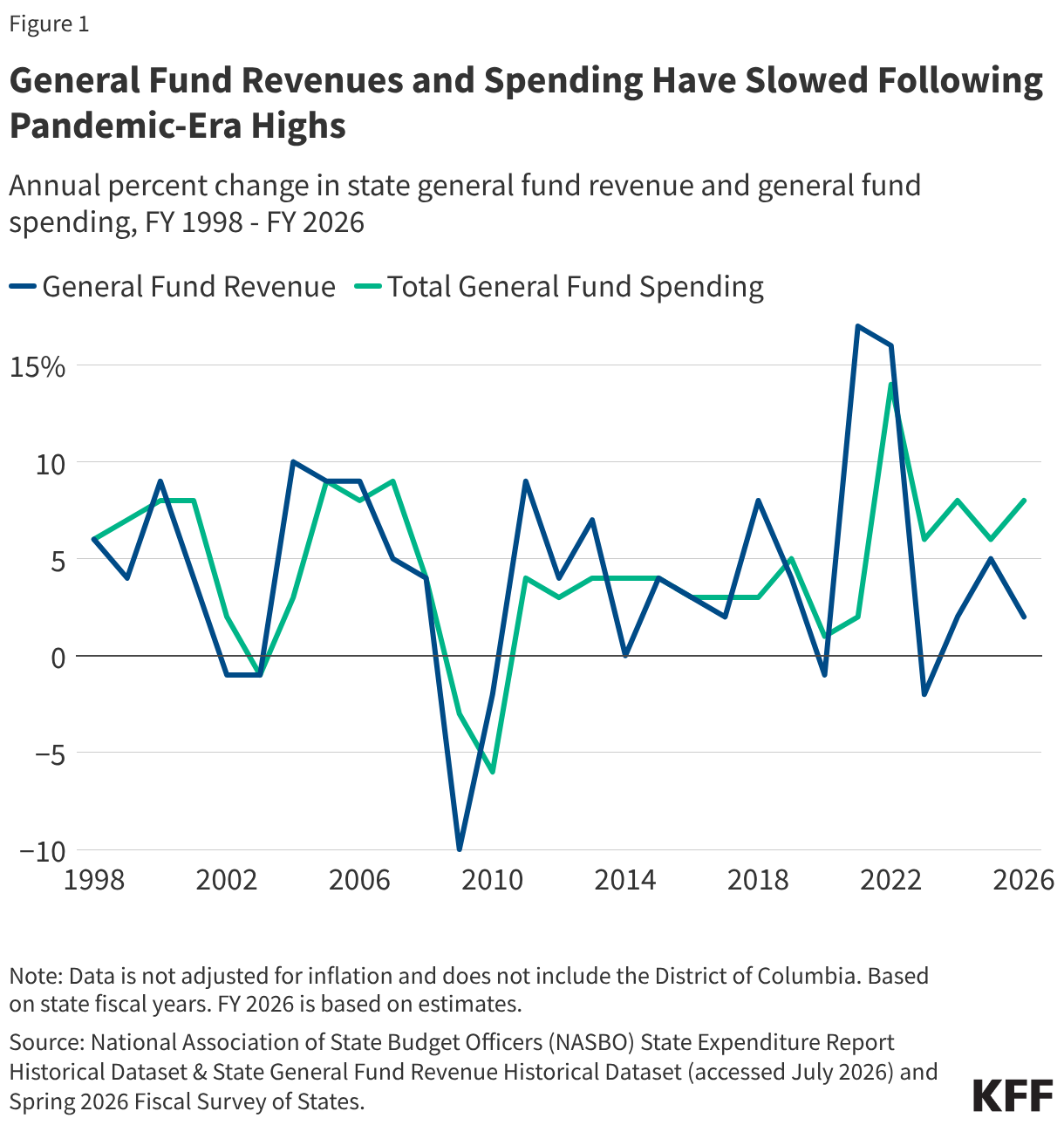
- FY 2023 through FY 2025: State revenue and spending growth steadily moderated from pandemic-era highs. General fund spending growth, which peaked at an unsustainable 14 percent in FY 2022, continued a downward trajectory.
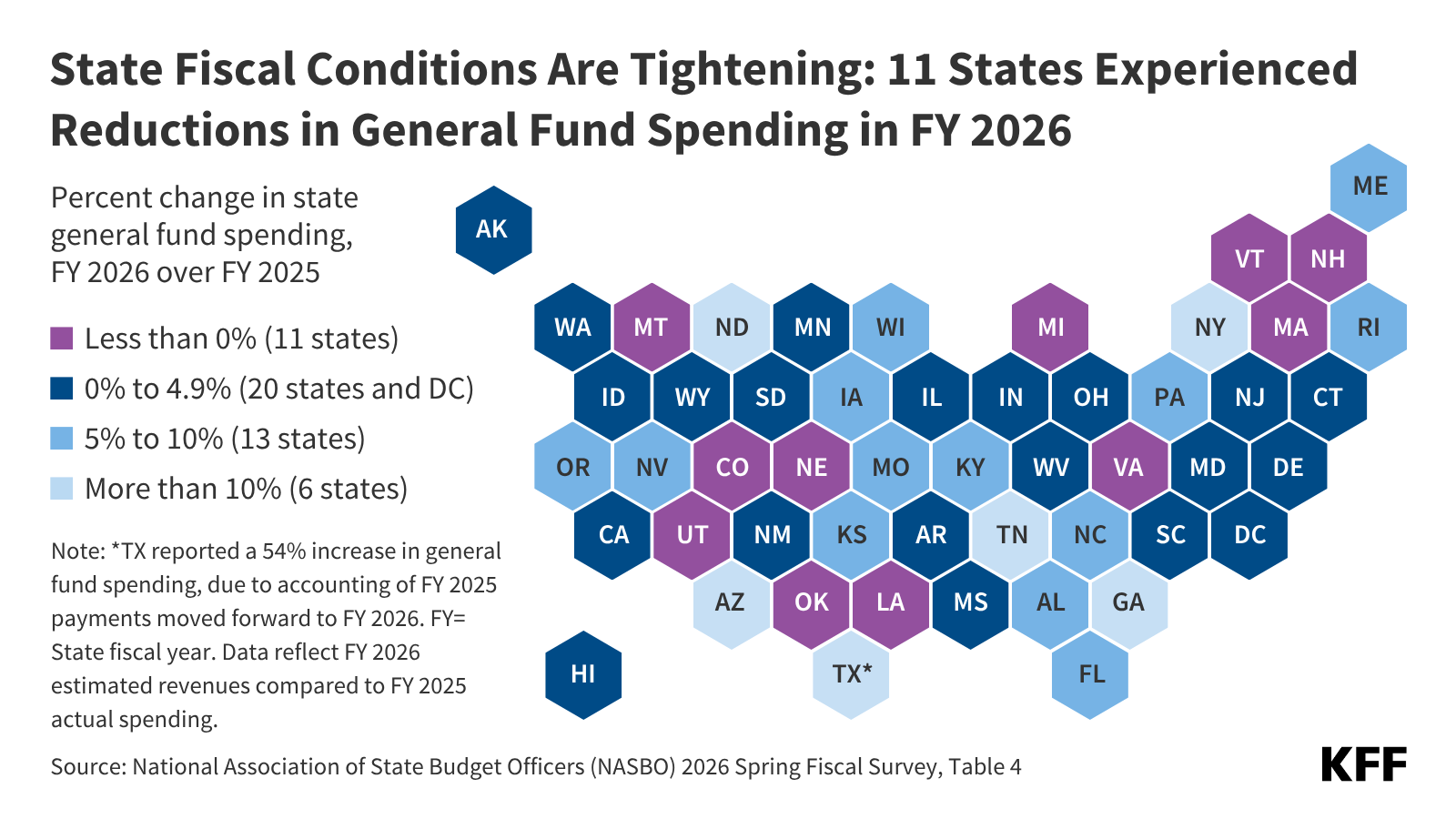
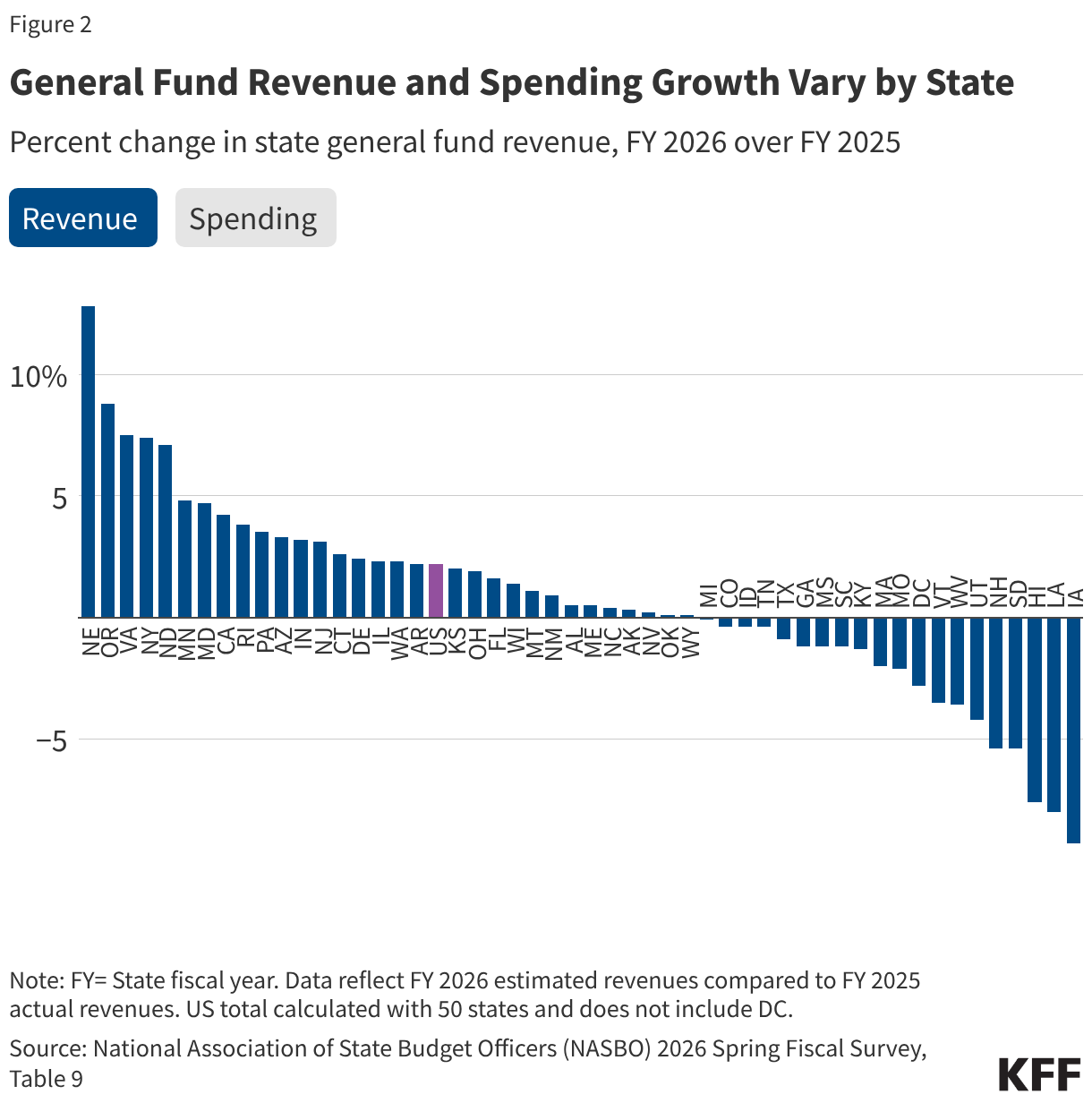
- FY 2026: State revenues slowed to an estimated average growth rate of just 2 percent compared to the previous year. Crucially, 20 states experienced outright revenue declines. Concurrently, 11 states recorded general fund spending reductions, while five states were forced to enact painful mid-year budget cuts to avoid deficits—the highest number of mid-year cuts since FY 2021.
- FY 2027 Enacted Budgets: State budgets enacted for the current fiscal year project anemic revenue growth of only 2 to 3 percent. General fund spending growth has flattened correspondingly, shifting state policy away from the expansion of services and toward strict preservation of core operations.
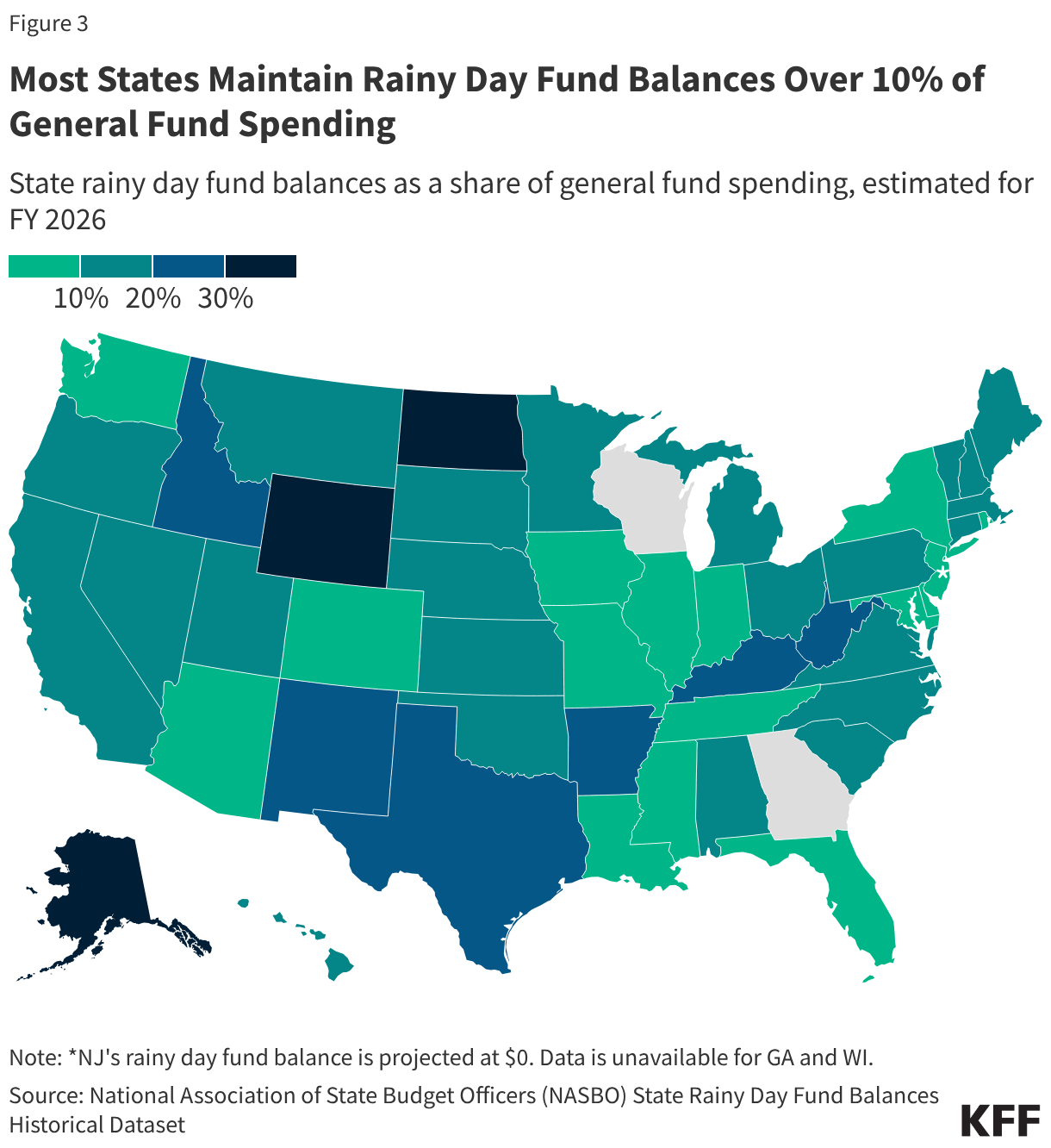
Furthermore, while rainy day funds remain a vital backstop, their balances have eroded from their pandemic-era peaks. Seventeen states now maintain rainy day fund balances totaling less than 10 percent of their general fund spending, while general fund ending balances continue to shrink as states exhaust one-time surplus revenues.
Supporting Data: Varied State Realities and Fiscal Divergence
National averages often mask stark regional and structural differences among the 50 states. State general fund revenues rely heavily on a combination of personal income taxes, corporate income taxes, and general sales taxes. Consequently, states that rely more heavily on volatile income taxes experienced sharper fluctuations during recent market swings.
In FY 2026, while a majority of states (30) managed modest revenue increases between 0 and 10 percent, 20 states watched their revenue collections shrink. On the expenditure side, although 34 states reported modest spending growth under 10 percent, 11 states cut overall spending to keep pace with cooling revenues.
State savings cushions have similarly fractured. Although rainy day funds cushion many state treasuries, total balances and ending balances have declined across the board. Budget experts note that this depletion severely diminishes the capacity of states to absorb future economic shocks or sudden federal funding reductions without resorting to immediate austerity measures.
Broader Impact and Implications: The Threat of Medicaid Restrictions
Looking ahead to FY 2027 and beyond, state fiscal stability faces compounded threats from both domestic economic uncertainties and major federal policy adjustments.
Foremost among these federal pressures is the implementation of the 2025 reconciliation law. The legislation introduced sweeping tax code modifications alongside significant cuts to federal funding for safety-net programs, including Medicaid and the Supplemental Nutrition Assistance Program (SNAP). Furthermore, complying with the administrative and technological mandates embedded within the reconciliation law imposes heavy, non-negotiable costs on state agencies already operating with strained administrative workforces.
These federal contractions arrive as states face mounting baseline spending demands across multiple sectors, including public education, employee health benefits, infrastructure, housing, and emergency disaster response. In addition, upcoming gubernatorial and legislative elections introduce potential shifts in leadership and policy priorities across dozens of states, creating additional administrative uncertainty.
When faced with structural deficits, states operate under strict constitutional or statutory balanced-budget requirements, leaving them with severely limited options. Because raising broad-based taxes or cutting education and public safety funding is politically perilous, cash-strapped state legislatures frequently look to Medicaid to absorb the blow.
Policy analysts warn that as the full impacts of the 2025 reconciliation law take effect, states may increasingly turn to defensive cost-containment strategies. These potential measures include:
- Reducing or freezing Medicaid provider reimbursement rates, which can threaten network adequacy and patient access to care.
- Narrowing optional benefit packages, scaling back coverage for specific services.
- Implementing stricter eligibility checks, procedural hurdles, or enrollment freezes that could strip coverage from vulnerable populations.
While a small number of states proactively initiated Medicaid spending adjustments or debated program rollbacks for FY 2026 and FY 2027, health policy experts anticipate that these restrictive measures could accelerate rapidly. As federal matching funds decline and state revenue growth remains subdued, the structural tension between maintaining comprehensive healthcare coverage and balancing state ledgers will likely define fiscal policy debates nationwide for years to come.
Related posts: