Global COVID-19 Data and Policy Trackers Conclude Operations Amid Shifting Public Health Paradigms

The architecture of pandemic tracking is undergoing a definitive structural contraction as public health institutions worldwide wind down legacy data systems established during the height of the COVID-19 crisis. Among these systemic changes is the formal conclusion of the Policy Actions tracker component within major global health databases, stemming from the cessation of data collection by foundational government response monitors such as the Oxford Covid-19 Government Response Tracker (OxCGRT). While cumulative tracking of confirmed COVID-19 cases and deaths persists on a weekly update schedule, the operational closure of active policy monitoring marks a symbolic and administrative transition in how international health organizations measure, archive, and analyze the governmental interventions that defined the early 2020s.
Historical Background and the Evolution of Pandemic Tracking
To understand the scope of these retired tracking mechanisms, one must examine the unprecedented global administrative mobilization that began in early 2020. As the SARS-CoV-2 virus spread across international borders, governments implemented a patchwork of non-pharmaceutical interventions (NPIs), fiscal stimuli, and emergency healthcare adjustments. To quantify and compare these responses, academic initiatives like the OxCGRT—housed at the Blavatnik School of Government at the University of Oxford—began systematically scoring and logging government policies across diverse metrics, ranging from international travel controls and workplace closures to economic income support and vaccine rollout mandates.
Concurrently, public health data aggregators stepped forward to provide centralized access to epidemiological metrics. In the initial phases of the pandemic, the Johns Hopkins University (JHU) Coronavirus Resource Center served as the definitive global dashboard, synthesizing fragmented national reports into a cohesive, map-based interface. However, as the acute phase of the pandemic stabilized and institutional responsibilities shifted, these primary data streams underwent significant transitions.
By March 2023, the landscape of epidemiological reporting experienced a major consolidation. On March 7, 2023, data tracking responsibilities for confirmed cases and deaths transitioned fully to the World Health Organization’s (WHO) Coronavirus (COVID-19) Dashboard, coinciding with the sunsetting of the JHU Coronavirus Resource Center map on March 10, 2023. This centralization under the WHO established a standardized global baseline, though it also reflected a broader institutional pivot away from granular, real-time tracking toward periodic epidemiological surveillance.
Methodological Framework and Data Architecture

The mechanics of tracking global health indicators and policy measures required complex methodological frameworks to ensure cross-country comparability. The epidemiological trackers were designed to provide cumulative totals and daily incidence rates for confirmed cases and deaths, categorized globally, by geographic region, and by World Bank income-level classifications. Population denominators relied on United Nations World Population Prospects 2021 estimates, ensuring consistency across disparate geopolitical units.
To maintain system performance and prevent performance degradation—such as slow load times—online visualization tools typically restricted interactive displays to data from the preceding 200 days. Nevertheless, transparency was maintained through comprehensive archival practices, allowing researchers and public health analysts to download full historical datasets via repositories like GitHub.
A notable administrative correction occurred on March 18, 2024, when database administrators updated tool parameters to clarify that reported metrics represented new cases and deaths cumulated over a full seven-day period rather than mathematically averaged daily rates. This distinction proved critical for epidemiologists analyzing transmission waves and healthcare system strain over time.
Categorization of Policy Actions and Government Responses
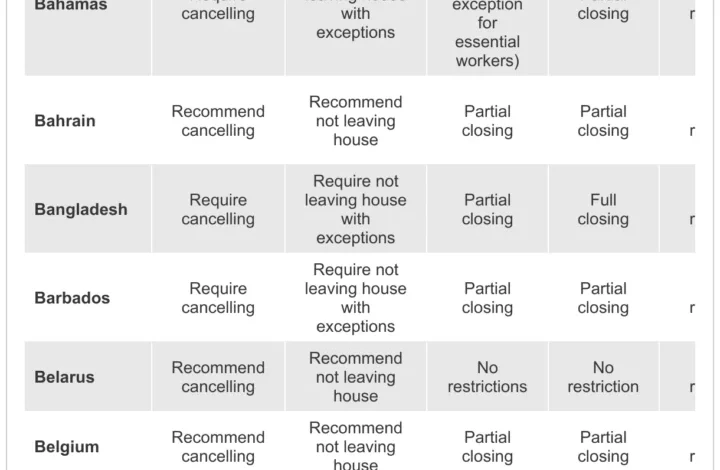
The policy action trackers evaluated governmental interventions through three primary vectors: social distancing and closure measures, economic support systems, and health system adjustments. Each category encompassed standardized sub-indicators designed to capture the intensity and breadth of state interventions.
Social Distancing and Closure Measures
Under the umbrella of social distancing, tracking systems monitored strictness levels across several domains:
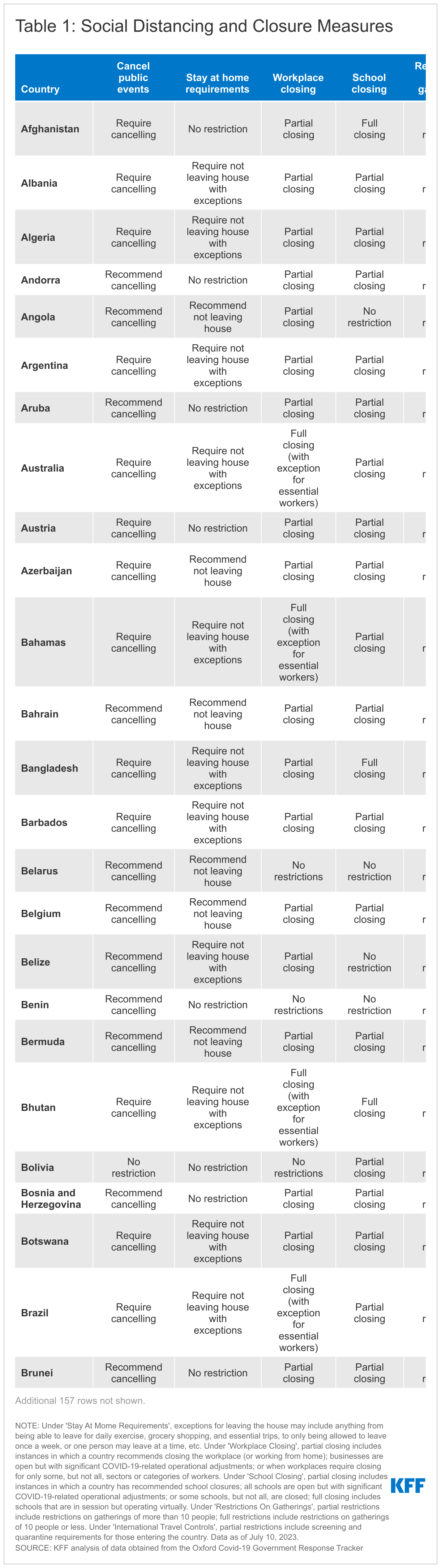
- Stay-at-Home Requirements: Evaluated from light recommendations to strict curfews, capturing varying exemptions for daily exercise, essential grocery procurement, or restrictions limiting households to a single designated shopper.
- Workplace Closures: Classified by the degree of mandated shutdowns, ranging from comprehensive closures of all non-essential businesses to partial recommendations, remote-work mandates, or targeted sector-specific closures.
- School Closures: Documented instances of full in-person suspensions, transitions to mandatory virtual learning, or partial operational adjustments affecting specific age groups or educational tiers.
- Restrictions on Gatherings: Quantified thresholds of prohibited assembly sizes, distinguishing between full restrictions on groups of ten or fewer individuals and partial limitations on larger gatherings.
- International Travel Controls: Monitored border closures, mandatory quarantine protocols, and diagnostic screening requirements for arriving international travelers.
Economic Interventions and Relief Programs
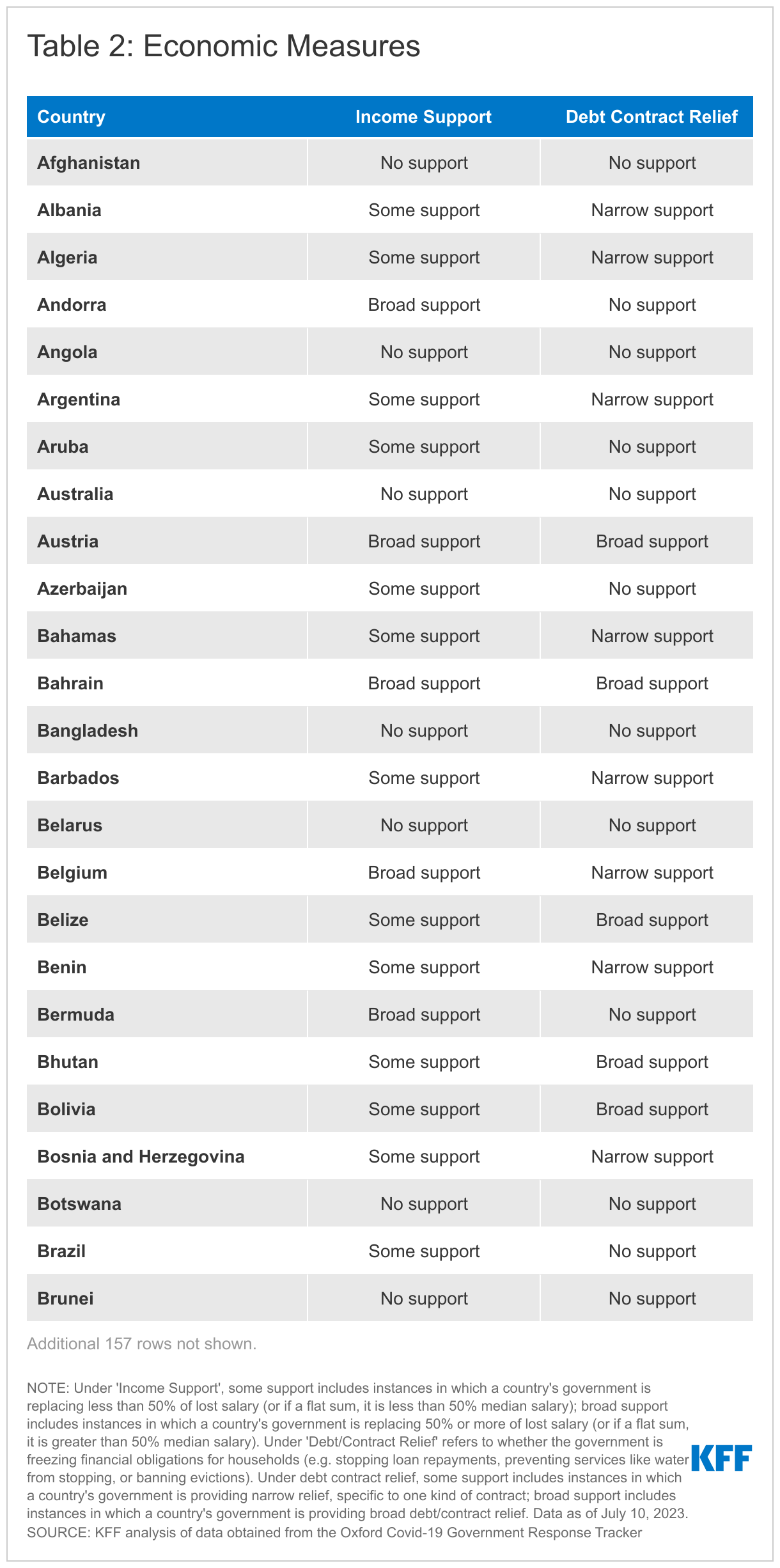
The fiscal shock of the pandemic prompted unprecedented state intervention in labor and financial markets. Trackers quantified these efforts through targeted metrics:
- Income Support: Measured the extent to which governments replaced lost wages. Categories distinguished between narrow support—where state compensation covered less than 50 percent of lost median salaries—and broad support, where wage replacement met or exceeded the 50-percent threshold.
- Debt and Contract Relief: Evaluated government-mandated moratoria or financial relief instruments applied to consumer loans, mortgages, commercial leases, or specific contract categories.
Health Systems and Clinical Measures
Public health infrastructure metrics focused heavily on operational readiness and medical countermeasure deployment:
- Vaccine Eligibility: Tracked the chronological expansion of immunization campaigns, noting partial availability phases prioritized for frontline key workers, clinically vulnerable non-elderly populations, and geriatric cohorts.
- Facial Coverings: Logged mandates, advisories, and conditional requirements for mask-wearing in public spaces, particularly noting instances where face coverings were mandated specifically when social distancing was unachievable.
Official Statements and Institutional Perspectives
The decision by data providers to archive policy tracking databases has drawn commentary from public health policy analysts, who view the move as a natural reflection of endemic disease management. Representatives from academic tracking consortia have emphasized that while active daily monitoring of pandemic-specific NPIs has concluded, the historical datasets compiled between 2020 and 2022 represent an invaluable empirical record for future pandemic preparedness research.
International public health bodies have continually stressed that the retirement of dedicated COVID-19 policy trackers does not signal an end to epidemiological vigilance. Rather, it signifies the integration of COVID-19 surveillance into routine respiratory pathogen monitoring frameworks, aligning it with established protocols for influenza and other circulating infectious diseases.
Broader Implications for Global Health Security
The phasing out of comprehensive policy action trackers carries significant implications for future health security governance. The data compiled through initiatives like the OxCGRT and WHO dashboards provide empirical foundations for retrospective policy evaluations. Researchers are currently utilizing these datasets to model the socioeconomic efficacy of varying lockdown strictness levels, evaluate the secondary impacts of school closures on educational attainment, and assess the correlation between fiscal relief programs and macroeconomic stability during systemic shocks.
Furthermore, the operational challenges encountered during the pandemic—such as data reporting lags, inconsistencies in mortality attribution across different national healthcare systems, and the technical burdens of maintaining real-time global databases—have catalyzed modernization efforts within international health informatics. Future pandemic response frameworks are expected to rely on automated, interoperable data standards designed to eliminate reporting bottlenecks and enhance cross-border transparency.
As the global community distances itself from the acute crisis management phase of the SARS-CoV-2 pandemic, the legacy of these tracking instruments remains embedded in the institutional memory of public health agencies. By preserving historical codebooks, methodological guidelines, and open-source repositories, the scientific community ensures that the lessons encoded within these datasets will inform the architecture of future global health responses.
Related posts: