The Crucial Role of Early Disability Inclusion in Shaping a More Empathetic Future

From the earliest stages of childhood development, children begin to observe and interpret the world around them, actively forming perceptions about themselves and others. This formative period, particularly between the ages of three and four, is when research indicates that children start to develop an understanding of social categories and can begin to internalize biases. These early impressions are not solely derived from direct instruction but are heavily influenced by a complex interplay of cues from caregivers, peers, media representations, and the overall classroom environment. Even subtle, non-verbal signals from adults can shape a young learner’s developing preferences and assumptions about different groups of people. Consequently, the messages children absorb, both explicitly and implicitly, play a pivotal role in shaping their understanding of diversity and belonging in profound and lasting ways.
When disability is intentionally and meaningfully integrated into a child’s early experiences, it yields significant benefits for all learners. This inclusion broadens their understanding of human variation, cultivates stronger empathy, and fosters a natural curiosity and respect for diverse ways of living and learning. Crucially, early and authentic representation of disability helps to cultivate environments where every child feels recognized, valued, and inherently a part of the community. This foundational principle is paramount in building a society that embraces and celebrates diversity from its inception.
The Pervasive Representation Gap in Children’s Media
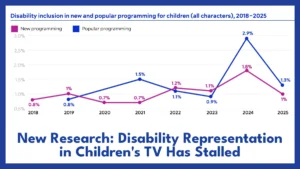
The media consumed by children—television shows, streaming content, books, and visual aids—serves as a significant source of learning and understanding. Despite its critical role in shaping young minds, disability remains strikingly underrepresented in children’s media. Data from the Centers for Disease Control and Prevention (CDC) reveals that approximately 1 in 6 children in the United States live with at least one developmental disability, highlighting that disability is a common facet of childhood diversity. Further underscoring this disparity, the U.S. Census Bureau reported that 4.3% of children in the United States had a disability in 2019. However, characters with disabilities appear on children’s television screens with a frequency far lower than their prevalence in the real world. A comprehensive 2025 report by the Geena Davis Institute on Gender in Media found that only about 1.7% to 2.5% of characters in children’s television programming were depicted as having disabilities, with a particularly scarce representation in leading roles.
Even when disability is portrayed, these representations are often limited in scope or fall into stereotypical tropes. Disabled characters are frequently depicted primarily through narratives of struggle or as sources of inspiration, rather than being presented as fully realized individuals navigating the complexities of life. Such portrayals can inadvertently narrow children’s understanding of disability, reinforcing the notion that it is an anomaly rather than an intrinsic aspect of human diversity.
However, a growing number of productions are beginning to challenge this status quo, offering more authentic and nuanced portrayals of disability. For instance, the character Brooklyn in Jurassic World: Chaos Theory is an amputee who utilizes a prosthesis, a realistic depiction of living with limb difference. In Donkey Hodie, the character Jeff Mouse lives with congenital muscular dystrophy, bringing a relatable experience of a chronic health condition to young viewers. Carl the Collector features an autistic main character and incorporates neurodivergent storylines, fostering understanding of autism spectrum differences. Furthermore, the popular series Peppa Pig has introduced storylines addressing hearing loss, signaling a positive shift towards more inclusive storytelling in mainstream children’s media.
In the realm of children’s literature, there has been a discernible increase in efforts to include stories that feature disabled characters in authentic and meaningful ways. Recent publications, such as The Seaside Sleepover (2025), present disabled characters as integral parts of everyday family life. Despite these encouraging developments, the absence of consistent and normalized representation continues to limit familiarity, allowing misconceptions to persist and posing challenges to the implementation of inclusive practices in broader educational and social contexts. The ongoing challenge lies in ensuring these positive trends become the norm rather than the exception.
Strengthening Classroom Environments Through Intentional Inclusion
The impact of media representation is significant, but the influence of the classroom environment on a child’s understanding of disability is equally, if not more, profound. When educators and peers actively model respectful and inclusive behaviors—employing inclusive language, offering mutual support, and valuing diverse learning styles—these actions serve as powerful demonstrations of what inclusion looks like in practice. This cultivates a ripple effect, shaping how children interact with and perceive others.
Extensive research on inclusive education consistently demonstrates that when learning environments are intentionally designed to accommodate and support a wide range of learners, all students experience positive outcomes. A systematic review of inclusive education research, examining numerous studies, found that inclusive classroom practices—including flexible learning materials, environments adapted to diverse needs, and encouragement of participation through multiple modalities—can significantly enhance peer relationships, foster greater empathy, and contribute to a more positive and supportive classroom climate. Similarly, research on inclusive pedagogy indicates that classrooms thoughtfully designed to cater to varied learning styles and needs lead to increased engagement and a stronger sense of belonging for students with and without disabilities.

Representation also extends to the adults with whom children interact daily. When educational institutions prioritize the hiring and support of disabled educators and staff, students gain invaluable, real-world exposure to disability as an ordinary and respected aspect of their communities. Disabled educators bring unique lived experiences that can enrich curriculum development, inform accessibility practices, and shape classroom culture, ultimately creating learning environments that are more responsive and inclusive for all students.
The integration of these daily interactions and intentional design choices helps to embed inclusion as a consistent element in students’ educational journeys. By pairing inclusive representation with thoughtful pedagogical and environmental design, schools can forge more equitable learning opportunities, ensuring that students with diverse abilities, communication styles, and learning needs can fully participate and thrive.
Practical Strategies for Fostering Early Inclusion
The good news is that promoting early childhood inclusion does not necessitate substantial financial investment or sweeping systemic overhauls. Small, deliberate choices can yield significant positive impacts. Recommendations from the Division for Early Childhood (DEC), a leading professional organization in early childhood special education, emphasize how intentional strategies woven into daily routines can effectively cultivate more inclusive learning environments.
Educators, parents, and caregivers can initiate these efforts by:
- Introducing Diverse Books and Media: Selecting children’s books, television shows, and digital content that feature characters with a range of abilities and backgrounds. This provides opportunities for natural discussions about differences and similarities.
- Using Inclusive Language: Employing person-first language (e.g., "a child with autism" rather than "an autistic child") and avoiding stigmatizing terms. Educators can model this language and gently correct its misuse.
- Adapting Activities and Environments: Making small adjustments to activities, materials, or the physical space to ensure all children can participate. This might involve providing alternative seating, sensory-friendly options, or varied ways to demonstrate understanding.
- Encouraging Peer Support and Empathy: Facilitating opportunities for children to help and learn from one another, fostering an understanding of different needs and perspectives. This can be done through cooperative play and group projects.
- Modeling Positive Attitudes: Demonstrating curiosity, respect, and a welcoming attitude towards all children, regardless of their abilities or differences. Children are highly attuned to adult reactions and attitudes.
To further support these initiatives, Disability Belongs™, in collaboration with Nickelodeon, has developed practical resources tailored for both families and educators. A Family Guide to Disability Inclusion and Educators’ Guide to Disability Inclusion offer discussion prompts, engaging activities, and real-world examples designed to seamlessly integrate inclusive practices into everyday learning and home environments. These guides aim to empower adults with the tools and confidence needed to champion disability inclusion.
Addressing Common Apprehensions About Early Discussions
A prevailing concern among some adults is that children may be “too young” to engage in conversations about disability, or that such discussions might lead to confusion. However, research in early childhood development strongly suggests the opposite is true. Preschool-aged children are already actively forming social preferences and developing attitudes towards groups based on the environmental cues they perceive. Studies, such as those published by the National Library of Medicine, indicate that young children begin to notice social differences and form early biases even in the absence of explicit instruction on these topics. Similarly, research published in the journal Nature has demonstrated that children develop initial impressions and social preferences by observing the reactions of others, a phenomenon known as social referencing.
Collectively, this body of research underscores a critical point: avoiding conversations about disability does not prevent the formation of bias. Instead, it leaves children to form their own interpretations and conclusions without the benefit of guidance. Thoughtful, age-appropriate inclusion and discussion provide a structured and supportive framework for children to develop accurate understandings of disability, fostering a constructive and informed perspective. By proactively engaging with these topics, adults can help children build a more nuanced and accepting worldview.
Cultivating a Generation Defined by Inclusion
A fundamental cultural shift towards embracing inclusion and fostering a sense of belonging begins with the narratives children encounter, the educational settings they inhabit, and the media they consume. Introducing disability representation at an early age is instrumental in creating environments where children grow up viewing differences not as limitations, but as natural, valued components of everyday human experience.
Parents, educators, and content creators all share a collective responsibility in this endeavor. The journey toward greater inclusion can begin with small, tangible steps: selecting a single book that promotes diversity, implementing one inclusive practice in the classroom, or initiating a conversation that moves the needle towards greater understanding. These early moments of exposure and engagement are foundational in shaping a more inclusive, empathetic, and equitable future generation. The cumulative effect of these consistent efforts can lead to a society where diversity is not just tolerated, but actively celebrated.