The debate surrounding Medicaid work requirements has remained a central pillar of American healthcare policy discussions for over a decade. As federal and state policymakers continually evaluate the parameters of public assistance programs, the Kaiser Family Foundation (KFF) has compiled an extensive repository of research, policy analysis, data surveys, and historical tracking to inform lawmakers, researchers, and the public. These resources provide an exhaustive look at how work, community engagement, and reporting mandates impact health coverage, state administrative systems, and vulnerable populations. Understanding the multifaceted implications of these policies requires examining the structural overview of work mandates, medical frailty exemptions, implementation challenges, past state experiences—most notably in Arkansas—and ongoing public opinion trends.
Work Requirements Overview and Structural Framework
Medicaid traditionally functions as a health insurance program for low-income individuals, families, children, pregnant women, the elderly, and people with disabilities. Historically, eligibility has been tied primarily to income thresholds, household size, and categorical status rather than employment. However, proposals and enacted policies introducing work requirements stipulate that non-elderly, non-disabled adult beneficiaries must prove a specific number of hours spent working, participating in job training, volunteering, or engaging in other approved community service activities to maintain their health coverage.
Proponents of these mandates argue that tying public benefits to employment promotes self-sufficiency, improves long-term economic outcomes, and transitions individuals away from government dependency. Conversely, public health experts, healthcare providers, and policy analysts contend that work requirements introduce bureaucratic hurdles that lead to coverage losses, disproportionately affecting individuals who are already employed in low-wage, volatile job markets or those who face unrecognized barriers to employment, such as unstable housing, lack of transportation, or chronic health conditions.
The Medical Frailty Exemption and Vulnerable Populations
A critical component of any Medicaid work requirement policy is the determination of exemptions, particularly for individuals classified as medically frail. State and federal guidelines typically attempt to exempt populations who are unable to work due to physical or mental health limitations, pregnancy, severe caregiving responsibilities, or substance use disorders.
However, defining and identifying "medical frailty" has proven to be one of the most complex administrative challenges for states implementing these policies. Research highlighted by KFF indicates that many individuals with chronic illnesses or temporary health impairments struggle to navigate the complex exemption processes. Often, beneficiaries must submit extensive medical documentation or undergo rigorous assessments by healthcare providers. If individuals fail to understand the exemption rules or lack the resources to secure the necessary paperwork, they risk losing their healthcare coverage, which can exacerbate existing medical conditions and lead to a deterioration in overall health outcomes.
Implementation Challenges and Administrative Burdens
The practical execution of Medicaid work requirements requires significant administrative infrastructure at both the state and federal levels. States must develop systems to track beneficiary hours, verify employment status, process exemption requests, and communicate policy changes to millions of enrollees.
Data and analysis from KFF demonstrate that these administrative burdens fall heavily on both state agencies and program participants. For beneficiaries, reporting mechanisms—frequently administered through online portals, mobile applications, or cumbersome paperwork—pose substantial obstacles. Individuals with limited digital literacy, unstable internet access, or fluctuating work schedules often struggle to meet monthly reporting deadlines. Consequently, a phenomenon known as "red tape churn" occurs, where eligible individuals lose coverage not because they failed to meet the actual work requirement, but because they failed to complete the administrative paperwork necessary to prove compliance.
For state governments, the implementation costs can be substantial. Developing new data management systems, hiring additional eligibility workers, and conducting ongoing outreach and educational campaigns require significant financial investments. Furthermore, states face the administrative expense of managing appeals and processing coverage reinstatements for individuals who were erroneously disenrolled.
A Comprehensive 50-State Landscape of Eligibility and Enrollment
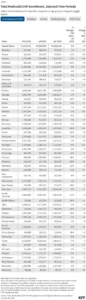
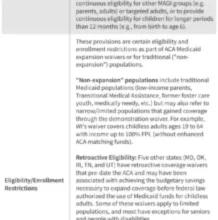
To understand the nationwide scope of public health coverage, KFF maintains a rigorous 50-state survey of Medicaid eligibility and enrollment policies. This comprehensive data collection tracks how different states manage their Medicaid programs, particularly in the wake of the Affordable Care Act’s Medicaid expansion.
States that adopted the expansion saw millions of low-income adults gain access to health coverage. However, the political landscape surrounding expansion and eligibility remains deeply fragmented. While some states have actively sought federal approval to implement work requirements as a condition of eligibility, others have steadfastly opposed such measures, citing concerns over coverage losses and administrative complexity. The 50-state survey serves as an essential tool for tracking these diverging state trajectories, highlighting how regional policy decisions directly affect uninsured rates, healthcare utilization, and state budget allocations.
Research and Analysis on Medicaid and Employment
A foundational element of KFF’s work involves synthesizing empirical research regarding the actual employment status of Medicaid beneficiaries. Extensive data analyses consistently reveal a fundamental disconnect underpinning the push for work requirements: the vast majority of non-elderly, non-disabled adults enrolled in Medicaid who can work are already working.
According to KFF research, many adult Medicaid beneficiaries are employed in low-wage industries—such as retail, hospitality, food service, and home healthcare—that frequently feature irregular hours, seasonal fluctuations, and a lack of employer-sponsored health insurance. For these individuals, Medicaid serves as a vital financial and medical safety net that enables them to maintain their employment by managing acute and chronic health conditions.
Furthermore, research indicates that imposing work requirements does not significantly increase long-term employment rates. Instead, studies of historical implementation efforts suggest that the policies primarily result in administrative disenrollment, leaving thousands of low-income workers without health insurance and potentially impairing their ability to maintain steady employment due to untreated health issues.
Section 1115 Work Requirement Waivers
Under Section 1115 of the Social Security Act, the Secretary of Health and Human Services (HHS) has the authority to approve experimental, pilot, or demonstration projects that promote the objectives of the Medicaid program. Over the past decade, several conservative-leaning states have utilized Section 1115 waivers to propose and implement work and community engagement requirements as a condition of Medicaid eligibility.
The trajectory of these waivers has been characterized by significant legal and political shifts. During various federal administrations, the stance on 1115 work requirement waivers has changed dramatically. While some federal administrations welcomed and approved these waiver applications, subsequent administrations scrutinized them closely, ultimately revoking approvals on the grounds that work requirements undermine the statutory purpose of Medicaid—which is to furnish medical assistance to eligible individuals. These policy reversals have led to prolonged courtroom battles, creating a landscape of regulatory uncertainty for state health officials and beneficiaries alike.
Implications and State Experience: Lessons from Arkansas
The most extensive real-world data regarding Medicaid work requirements stems from the state of Arkansas, which became the first state in the nation to implement such a policy under an approved Section 1115 waiver. Arkansas launched its work and community engagement requirement for non-elderly adults in 2018.
The outcomes of the Arkansas initiative have been extensively studied by academic researchers and highlighted in KFF analyses. Within the first year of implementation, more than 18,000 adults lost their Medicaid coverage in Arkansas due to failure to comply with the reporting mandates or an inability to successfully navigate the online reporting system. Crucially, subsequent evaluations found that the policy did not lead to a statistically significant increase in employment rates compared to neighboring states without work requirements. Instead, the primary measurable outcome was a sharp drop in health insurance coverage, coupled with increased rates of unmet medical needs, delayed care, and rising out-of-pocket financial strain for low-income residents.
The Arkansas experience provided policymakers across the country with concrete data regarding the operational and human costs associated with work mandates. Legal challenges soon followed, resulting in federal court rulings that temporarily halted the enforcement of the Arkansas waiver and similar initiatives in other states, citing the administration’s failure to adequately consider the core objective of Medicaid: providing health coverage to low-income Americans.
Public Opinion and KFF Polling Data
Public perception of Medicaid work requirements is complex, often reflecting broader political philosophies regarding welfare, government assistance, and personal responsibility. KFF polling data has consistently tracked public sentiment on this issue, revealing nuanced findings.
When presented as a general concept—such as asking whether able-bodied adults should be encouraged to work or participate in community service in exchange for public benefits—polling often shows broad public support across various political demographics. Many respondents initially view work requirements as a reasonable expectation for government-funded assistance.
However, KFF polling also demonstrates that public support shifts significantly when respondents are informed about the practical realities and potential consequences of these policies. When survey participants are asked whether individuals should lose their health coverage if they are working low-wage jobs with fluctuating hours, or if they struggle to navigate complex online reporting systems, support drops markedly. Furthermore, a substantial majority of the public believes that Medicaid should prioritize ensuring access to healthcare services for low-income individuals over enforcing administrative rules that could result in coverage losses.
Perspectives from Leadership: Beyond the Data by CEO Drew Altman
To contextualize the vast array of data and research, KFF leadership, including President and CEO Drew Altman, has regularly provided expert commentary and analysis through the "Beyond the Data" series. These reflections offer a broader perspective on the political, economic, and social forces shaping American healthcare policy.
Altman and other healthcare analysts emphasize that the debate over Medicaid work requirements transcends mere statistics; it touches upon fundamental questions about the social safety net and the societal obligation to provide healthcare to vulnerable populations. Through executive commentary, KFF underscores that policy decisions regarding Medicaid eligibility carry profound human stakes. As debates over work requirements continue to surface in state legislatures and federal policy discussions, the imperative for evidence-based analysis remains critical.
Conclusion and Future Outlook
The comprehensive resources compiled by KFF regarding Medicaid work requirements serve as an indispensable archive for understanding the intersection of public policy, administrative reality, and human health. From the foundational overview of work mandates and medical frailty exemptions to the sobering historical lessons learned from Arkansas, the data consistently points to the delicate balance between promoting economic self-sufficiency and safeguarding access to essential healthcare.
As future legislative sessions approach, policymakers will continue to grapple with the economic and ethical dimensions of public assistance programs. Whether states pursue new waiver applications or focus on streamlining enrollment to reduce uninsured rates, the extensive research, polling, and 50-state tracking provided by organizations like KFF will remain central to navigating the complex future of Medicaid in the United States.