Where Does Your Premium Go? Breaking Down Insurer Profits, Overhead, and the Medicare-for-All Debate


The modern healthcare landscape in the United States is defined by a complex, multi-layered financial ecosystem where private insurers, public programs, employers, and patients constantly negotiate the cost of care. At the center of this intricate web is a fundamental transaction: the collection of insurance premiums. Every time an individual, a family, or an employer pays a monthly health insurance premium, a portion of that dollar is immediately diverted to cover administrative overhead, operational costs, and corporate profits. According to comprehensive data analysis released by KFF (Kaiser Family Foundation), the critical policy question facing the nation is not merely whether health insurance companies turn a profit—which they undeniably do—but rather what tangible value consumers receive in exchange for that substantial financial cut.
In a newly published video and analytical series narrated by Larry Levitt, KFF’s Executive Vice President for Health Policy, the organization breaks down the precise mechanics of how premium dollars are spent. The analysis compares overhead and profit margins across various private insurance markets and public alternatives like Medicare, while critically evaluating the sweeping structural changes—and the distinct limitations—associated with a government-operated "Medicare-for-All" system.
Main Facts and Financial Dissections of Modern Insurance Markets
To understand where healthcare dollars go, one must examine the sheer scale of the funds siphoned away from direct patient care. KFF’s findings reveal that insurance overhead and profit margins are not distributed equally across all sectors of the healthcare industry. Instead, the financial footprint varies significantly depending on whether an individual obtains coverage through an employer-sponsored plan, the individual marketplace, or a private Medicare Advantage plan.
On an annual per-enrollee basis, the financial intake for overhead and profit is substantial:
- Employer-Sponsored Market: Insurers siphon an average of $846 per enrollee annually for overhead and profit.
- Individual Insurance Market: The figure rises to $987 per enrollee annually.
- Medicare Advantage: The cost reaches a staggering $1,655 per enrollee annually.
While these per-enrollee figures highlight the immediate cost of administration, health insurance executives frequently point out that profit margins—when viewed as a percentage of total premium revenue—appear relatively modest on paper. Typically, net profit margins hover around a few percentage points of total revenue. However, health economists and policy analysts emphasize a crucial caveat: a few percentage points of a massive financial stream still translates into staggering corporate earnings.
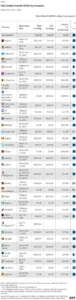
The financial success of the private insurance sector was vividly demonstrated in 2024. Data analyzed by KFF shows that the seven largest publicly traded health insurance companies in the United States pulled in a combined estimated profit of $71 billion. This figure accounts for corporate earnings across diverse revenue streams, including subsidiary operations such as pharmacy benefit managers (PBMs), specialty pharmacies, and healthcare delivery networks. These massive conglomerates have evolved far beyond traditional insurance providers, transforming into multifaceted healthcare giants that influence nearly every stage of patient treatment and medication distribution.
Background Context and Chronology of the Private-Public Divide
The debate over administrative overhead and profit in American health insurance is rooted in decades of legislative and market evolution. For much of the mid-to-late 20th century, traditional fee-for-service Medicare and traditional indemnity insurance dominated the landscape, with administrative structures that grew increasingly complex as medical technologies advanced.
A pivotal turning point in modern insurance oversight occurred with the passage of the Affordable Care Act (ACA) in 2010. Among its many provisions, the ACA introduced the "Medical Loss Ratio" (MLR) rule, colloquially known as the 80/20 rule. This regulation mandated that health insurers in the individual and small-group markets must spend at least 80% (and 85% in the large-group market) of premium dollars directly on medical care and quality improvement activities. The remaining 15% to 20% could be allocated toward administrative costs, marketing, and profit. If insurers failed to meet these thresholds, they were legally required to issue rebates to consumers—a mechanism that injected a degree of transparency into an otherwise opaque market.
Concurrently, the Medicare Advantage program—historically known as Medicare Part C—experienced exponential growth over the past two decades. Originally designed to offer private-market alternatives within the public Medicare system, Medicare Advantage has steadily captured the majority of the market. Today, private Medicare Advantage plans cover over half of all Medicare beneficiaries.
However, this structural shift introduced new financial dynamics. Unlike traditional government-run Medicare, Medicare Advantage plans operate under different reimbursement models, allowing private insurers to retain a larger slice of the financial pie for overhead and internal management.

Supporting Data: Comparing Medicare Advantage to Traditional Medicare
The contrast between private insurance administration and public program administration becomes starkly apparent when comparing Medicare Advantage to traditional, government-administered Medicare.
Under the Medicare Advantage framework, roughly 90 cents of every premium dollar is directed toward actual healthcare delivery, while the remaining 10 cents goes toward overhead, marketing, and corporate profit. While this aligns with the regulatory guardrails established for private insurance, it represents a significantly higher administrative overhead than its public counterpart.
By comparison, traditional Medicare operates with remarkable administrative leanness. Less than two cents—under 2%—of every Medicare dollar goes toward the administrative costs of running traditional Medicare. Furthermore, because traditional Medicare is a direct public program rather than a commercial enterprise, it operates entirely without a profit motive.
The structural divergence stems from fundamental operational differences. Traditional Medicare is administered directly by the federal government, which establishes standardized reimbursement prices for hospitals, physicians, and medical equipment providers by administrative fiat. Private insurance companies, conversely, must maintain massive administrative apparatuses dedicated to negotiating complex, individualized payment rates with countless provider networks, managing prior authorization protocols, processing appeals, and marketing their plans directly to consumers in competitive open-enrollment marketplaces.
Broader Implications of a Single-Payer or Medicare-for-All System
The stark differences in administrative waste between private markets and public programs frequently fuel progressive policy proposals calling for a single-payer, "Medicare-for-All" system. Proponents of such structural overhauls argue that eliminating private health insurance companies entirely would streamline the delivery of care, drastically reduce bureaucratic bloat, and recapture billions of dollars currently lost to corporate profits and redundant administrative operations.
KFF’s analysis acknowledges that taking private health insurance companies out of the equation through a government-operated single-payer system would indeed succeed in driving down administrative costs and eradicating corporate profit margins from the healthcare financing chain. However, policy experts caution that a transition to Medicare-for-All would leave several of the nation’s most entrenched healthcare cost drivers completely unresolved.
According to health policy researchers, the primary engines driving the relentless growth of national health spending are structural, extending far beyond the operational budgets of insurance companies. These underlying cost drivers include:
- Hospital and Provider Consolidation: The increasing monopolization of regional healthcare markets by massive hospital systems, which gives providers immense leverage to demand high reimbursement rates.
- Medical Practice Variability: The utilization of medical treatments, diagnostic tests, and procedures that are not always strictly grounded in robust clinical evidence.
- Advanced Pharmaceuticals and Medical Technology: The high cost of pioneering prescription drugs, genetic therapies, and innovative medical devices, which command premium prices in a global market.
Even in a streamlined, government-run single-payer environment, policymakers would still be forced to confront these difficult economic realities. Someone—whether a private insurance executive or a government health administrator—must ultimately make binding decisions regarding which treatments are approved, how much hospitals and physicians are paid, and what medical innovations are prioritized within a constrained national budget.
Analysis of the Core Dilemma: Trust and Governance
As the debate over the future of American healthcare continues to evolve across political and economic spheres, KFF’s analysis suggests that the public discourse often focuses on the wrong questions. While scrutinizing insurance company overhead and profit margins provides a clear picture of corporate financial extraction, it masks a deeper, more fundamental societal dilemma.
The ultimate question facing patients, policymakers, and industry stakeholders is not merely what financial percentage insurers claim for their services, nor even whether a public or private entity writes the check. Rather, the core challenge centers on governance and institutional trust: Who do we ultimately trust to make the agonizing decisions regarding what healthcare gets covered, which treatments are denied, and how much physicians and hospitals are paid for their labor?
Whether those rationing decisions are made by corporate boardrooms seeking shareholder returns or by government bureaucrats operating within a public agency, the fundamental tension of healthcare resource allocation remains unchanged. As long as medical demand outstrips finite financial resources, the debate over who controls the premium dollar—and who decides the value of human health—will remain at the forefront of the American political and economic landscape.
Related posts: