Prevent Catastrophic Falls With These 5 Bathroom Safety Modifications for Seniors


For millions of family caregivers across the globe, a persistent, low-level anxiety defines the daily routine. This worry invariably spikes whenever an aging parent or loved one steps away to use the restroom. While the bathroom is a sanctuary of privacy and personal dignity, it is simultaneously recognized by geriatricians and public health officials as the single most hazardous environment in a residential home. The intersection of hard surfaces, moisture, soap, and declining physical mobility creates a dangerous setting where minor missteps frequently transform into life-altering medical emergencies.
Public health data consistently underscores the urgency of home safety interventions. According to statistics from the Centers for Disease Control and Prevention (CDC), falls are the leading cause of injury and fatal trauma among adults aged 65 and older. Every year, millions of older Americans experience a fall, and a significant percentage of these incidents occur inside the bathroom. The physical and psychological fallout of a bathroom accident can permanently alter an individual’s independence, abruptly ending an aging-in-place strategy and forcing a premature transition into a skilled nursing or assisted living facility.
To combat this widespread public health challenge, geriatric care experts, occupational therapists, and safety advocates emphasize that preventing catastrophic falls requires more than casual housekeeping or off-the-shelf hardware store purchases. It demands clinical precision, structural foresight, and professional execution. Below is an exhaustive breakdown of five essential bathroom modifications designed to neutralize the hazards of aging in place, backed by clinical guidelines, comparative data, and expert recommendations.
Why the Bathroom Ranks as the Most Dangerous Room in the Home
The bathroom presents a unique physical profile that sets the stage for accidents. It is an enclosed space dominated by ceramic, porcelain, glass, and steel—materials that offer zero forgiveness upon impact. When water and soap interact with smooth tile floors, traction is instantly compromised.
When these environmental hazards intersect with the physiological realities of aging, the risk multiplies exponentially. Older adults frequently contend with age-related muscle sarcopenia, joint stiffness, compromised balance proprioception, and degenerative vision loss. Conditions such as neuropathy in the feet can prevent an individual from feeling a slick patch of water until it is too late. Consequently, addressing bathroom safety requires treating the space not merely as a domestic room, but as a high-risk clinical zone that requires targeted environmental engineering.
1. Treat Grab Bars as Clinical Tools, Rather Than DIY Accessories
One of the most common mistakes families make is treating grab bars as simple, decorative bathroom accessories that can be installed on a weekend afternoon using basic tools. In reality, grab bars must be treated as critical clinical safety instruments mapped directly to a user’s specific functional reach, biomechanics, and mobility limitations.
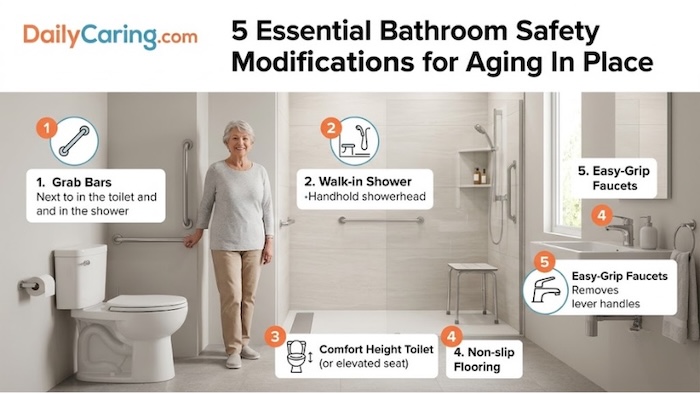
A clinical expert, such as a licensed occupational therapist, evaluates how an individual moves, where their balance falters, and how specific physical limitations dictate where a bar must be anchored to effectively arrest a fall. Furthermore, professional installation is non-negotiable. Suction-cup grab bars, which are frequently marketed for their ease of installation, cannot withstand the sudden kinetic energy and downward force of a falling adult. Under pressure, these temporary devices invariably detach, turning a perceived safety mechanism into a secondary hazard that can cause an even more severe fall.
When shopping for permanent grab bars, consumers should look for diameters measuring between 1.25 and 1.5 inches, as this dimension is ergonomically optimized for aging, arthritic hands. Additionally, experts recommend requesting ADA-compliant knurled finishes rather than smooth chrome surfaces, as the textured grip provides necessary friction for damp hands. Grab bars must always be anchored securely into structural wall studs or reinforced backing boards capable of supporting hundreds of pounds of sudden pressure.
2. Calculating the Optimal Toilet Height for Joint Preservation
Standard residential toilets are typically manufactured at a height of approximately 15 inches from the floor to the top of the bowl rim. For an aging body, this low profile introduces a significant mechanical hazard. A standard toilet demands excessive joint flexion in the knees and hips, alongside substantial quadricep strength, to successfully transition from a sitting position to a standing posture. For seniors with arthritis, joint replacements, or general muscle weakness, this movement is arduous and fraught with the risk of a loss of balance.
While the Americans with Disabilities Act (ADA) recommends a height of 17 to 19 inches specifically to accommodate wheelchair transfers, residential safety requires a customized calculation tailored to the individual’s anthropometric measurements.
To determine the exact height required to reduce joint stress, caregivers can utilize a straightforward anatomical formula:
- Have the senior sit comfortably in a chair with their feet flat on the floor and knees bent at a comfortable 90-degree angle.
- Measure the vertical distance from the floor to the crease behind the senior’s knee (the popliteal fossa).
- Compare this measurement to the height of the existing toilet seat. If the toilet is lower than the back of the knee, calculate the exact raise required using a specialized toilet riser or a comfort-height replacement toilet to match the measurement precisely.
Ensuring the correct toilet height eliminates the dangerous strain associated with rising, thereby stabilizing the user during one of the most frequent daily bathroom routines.
3. High-Contrast Lighting to Combat Declining Vision
Vision impairment is a nearly universal aspect of the aging process. Aging eyes typically suffer from decreased pupil dilation capacity, yellowing of the lenses, and increased sensitivity to glare. These changes demand significantly higher levels of ambient illumination to safely navigate indoor spaces. However, a common pitfall in home modification is simply installing excessively bright, unshielded light bulbs, which creates harsh glares and deep shadows that obscure depth perception and worsen fall risks.

The overarching objective of senior-focused bathroom lighting is uniform illumination paired with high visual contrast. Lighting designers recommend utilizing LED bulbs with a Color Rendering Index (CRI) of 80 or higher and a color temperature maintained in the warm 2700K to 3000K range.
Beyond general illumination, high contrast is vital for spatial awareness. The boundaries of the room—such as the edge of the bathtub, the threshold of the shower stall, and the transition between the wall and the floor—must be visually distinct. Utilizing contrasting colors for bath mats, wall paint, and flooring helps seniors with diminishing peripheral vision accurately gauge distances and avoid missteps.
4. Flooring Modifications to Absorb Impact and Maximize Traction
Traditional bathroom flooring materials, most notably polished ceramic and porcelain tile, are selected primarily for their water resistance and aesthetic appeal. However, they offer zero shock absorption. If a senior loses their footing on ceramic tile, the hard surface provides no energy dissipation, frequently resulting in catastrophic skeletal trauma, including fractured hips, wrist fractures, and severe head injuries.
When planning bathroom safety renovations, homeowners must balance two critical flooring requirements: maximum slip resistance to prevent a fall from occurring in the first place, and high impact absorption to mitigate the severity of trauma should a fall happen anyway.
| Flooring Material | Slip Resistance | Impact Absorption | Cost Factor |
|---|---|---|---|
| Rubber Flooring | Excellent (High Traction) | Maximum (Protects Joints/Bones) | $$$ |
| Textured Cork | High (Natural Grip) | High (Air-filled cells) | $$ |
| Slip-Resistant Vinyl | Moderate to High | Low to Moderate | $ |
| Ceramic Tile | Low (Extreme Fall Risk) | Zero (High Fracture Risk) | $$ |
As outlined in the comparative data above, alternative materials such as specialized rubber flooring and textured cork offer superior performance characteristics compared to standard tile, effectively protecting vulnerable bones while maintaining traction in wet environments.
5. Eliminating Door Saddles and Threshold Transitions
One of the most frequently overlooked architectural hazards in residential homes is the door saddle, or threshold. As flooring materials change from hallway carpeting to bathroom tile, builders traditionally install a raised wooden or metal transition strip. For younger, agile individuals, these minor height variations are unnoticeable. However, for older adults who frequently exhibit a shuffling gait—a common symptom of natural aging, neuropathy, or neurological conditions—a half-inch threshold acts as an immediate physical trap.
A shuffling gait means seniors do not lift their feet high enough off the ground during normal walking strides. Consequently, their toes catch on the raised door saddle, resulting in sudden, forward-momentum falls onto hard bathroom surfaces. Replacing standard, high-profile thresholds with graded, zero-edge transition strips creates a smooth, continuous floor plane that safely accommodates walkers, wheelchairs, and shuffling feet alike.

The Financial Case for Proactive Home Modifications
Families often hesitate to undertake comprehensive bathroom renovations due to initial upfront expenses. Professional modifications—including structural grab bar placement, upgraded lighting arrays, comfort-height toilets, slip-resistant flooring, and threshold removal—typically require a one-time financial investment ranging between $2,000 and $5,000, depending on the scope of the project and local labor rates.
When viewed strictly as a home improvement expense, these figures can appear daunting. However, safety advocates and healthcare economists urge families to evaluate these costs against the reactive financial and personal consequences of a major accident. According to national healthcare data, the baseline cost of a single severe fall resulting in emergency hospitalization, surgical hip replacement, and subsequent weeks or months of skilled nursing facility rehabilitation frequently exceeds $50,000.
Viewed through this lens, investing in professional home modifications is not an optional luxury; it is a vital insurance policy designed to prevent a catastrophic event that can permanently terminate an elderly individual’s ability to live independently at home.
How to Hire the Right Professional: The Value of a CAPS Designation
Executing clinical safety modifications is not a task suited for a general handyman or an amateur do-it-yourselfer. Structural load-bearing requirements, precise ergonomic measurements, and compliance with building codes require specialized expertise.
When searching for a contractor, families should specifically seek out professionals holding the Certified Aging-in-Place Specialist (CAPS) credential. Administered by the National Association of Home Builders (NAHB) in collaboration with AARP, the CAPS designation signifies that a builder, remodeler, or designer has undergone rigorous training regarding the specific biomechanical needs of older adults, accessible architectural design, and the technical execution of safety installations. Vetted professionals with this credential can be located directly through the official NAHB directory of designated home building professionals.
Broader Implications and Summary
Addressing bathroom safety through targeted environmental modifications represents a cornerstone of modern geriatric care. As global populations continue to age, the demand for safe, accessible residential housing will only accelerate. Delaying these crucial structural updates leaves older adults exposed to an unnecessarily hostile physical environment, exponentially increasing the probability of severe trauma.
By treating the bathroom as a high-risk zone requiring clinical precision—installing professionally anchored grab bars, optimizing toilet heights, upgrading lighting for high contrast, selecting impact-absorbing flooring, and eliminating threshold barriers—families and caregivers can successfully safeguard their loved ones. Executing these changes promptly and professionally preserves both physical safety and long-term independence, ensuring that the home remains a place of comfort rather than a source of danger.
Related posts: