Reshaping the Narrative: Contemporary Craft Exhibition Redefines Disability Art Through Tactile Mediums

From a distance, Dominic Quagliozzi’s Blue Morpho appears to be nothing more than a vibrant, multi-hued butterfly pinned gracefully to the gallery wall. Upon closer inspection, however, the materials reveal a deeply personal and starkly clinical reality. Constructed partly from hospital gowns and moving blankets, the piece reflects Quagliozzi’s lifelong navigation of cystic fibrosis and his subsequent double lung transplant in 2015. This intricate duality—where an aesthetically pleasing object transforms into a complex, intimate, and occasionally unsettling exploration of medical trauma—serves as the conceptual anchor for Textures of Being, an exhibition hosted at Contemporary Craft in Pittsburgh’s Lawrenceville neighborhood.
Running through January 16, the exhibition brings together works by 14 artists with disabilities. Curated from a combination of invited creators and a competitive open call, the showcase utilizes fiber, ceramics, metal, paper, and mixed media to challenge conventional paradigms. Rather than positioning disability through a lens of tragedy, heroism, or a medical condition to be corrected, the participating artists draw directly from the lived realities of disabled bodies, asserting autonomy and rewriting cultural vocabularies.
The Evolution and Context of Disability Art
The exhibition arrives amid a broader, long-overdue cultural movement wherein disabled artists are actively reclaiming their narratives from medical and societal paternalism. Historically, mainstream culture has tended to compartmentalize disability, reducing complex human experiences to binary tropes of pity or superhuman triumph. Disability art seeks to dismantle these reductive frameworks by examining how physical differences are viewed, treated, and accommodated by medicine, culture, and societal infrastructure.
Yu-San Cheng, Contemporary Craft’s director of visual engagement and a juror for the exhibition alongside Deaf artist and Anthropology of Motherhood founder Fran Ledonio Flaherty, emphasized the deliberate ambiguity of the exhibition’s title. According to Cheng, the term textures references both tangible, physical surfaces and the intangible fabric of human experience. Furthermore, the prominent use of textiles throughout the gallery space symbolizes softness as an inherent form of strength.
Craft serves as an accessible entry point for gallery visitors who might otherwise feel alienated by discussions surrounding illness and bodily divergence. Because everyday objects like mugs and clothing are universally understood, familiar materials act as a bridge, lowering psychological barriers and inviting viewers into deeper conversations about disability, the body, and healthcare systems.
Challenging Societal Perceptions: Sandie Chun-Shan Yi and Crip Couture
Chicago-based artist Sandie Chun-Shan Yi, one of the exhibition’s two invited visionaries, argues that disabled artists are actively forging an entirely new visual lexicon. Born in Taiwan with two fingers on each hand and two toes on each foot, Yi experienced the societal friction of bodily difference from an early age. Strangers frequently approached her body as an engineering problem to be solved, offering unsolicited assistance or prematurely deciding what she could and could not accomplish.
It took years of community building and exposure to disability studies for Yi to contextualize these interactions within a broader socio-political framework. Encountering disability art provided her with the linguistic tools to articulate experiences she had previously struggled to name. By discarding the dominant narrative of overcoming, she began interrogating the societal assumptions that dictated both public perception and her own self-image.
This intellectual and artistic evolution birthed her Crip Couture series—a form of wearable art centered squarely on disabled bodies and narratives. Reclaiming the historically derogatory term crip, Yi’s work stands in sharp contrast to mainstream adaptive fashion, which typically modifies standard designs to accommodate disabled anatomy. Instead, Yi starts from the foundation of disability itself, designing bespoke items such as two-fingered gloves that integrate the histories, physicalities, and lived realities of disabled wearers. It is an artistic practice rooted fundamentally in care.
Weaving Science and Personal History: Bhavna Mehta’s Structural Narratives
The exhibition’s second invited artist, Bhavna Mehta, explores similar thematic territory through an entirely different medium. Born and raised in India and currently based in San Diego, Mehta contracted polio at the age of seven and has utilized a wheelchair since childhood. Her initial career path was rooted in science and technology; she trained as a software engineer before transitioning to a full-time artistic practice at approximately 40 years of age.
Mehta’s intricate sculptures merge paper-cutting and embroidery, techniques deeply connected to her upbringing in an extended family of female makers in India. In her artist statements, Mehta has frequently described her use of paper as skin and thread as a mechanism for connection and mending, all while channeling traditional Indian folk motifs.
For Textures of Being, these delicate methodologies become tools for interrogating her own medical history. One notable piece originates from a 1980s X-ray of Mehta’s spine that she preserved for decades before meticulously embroidering its surface. By supplanting a cold, clinical document of polio-induced spinal alteration with her own hand-stitched narrative, she reclaims authorship over her medicalized body.
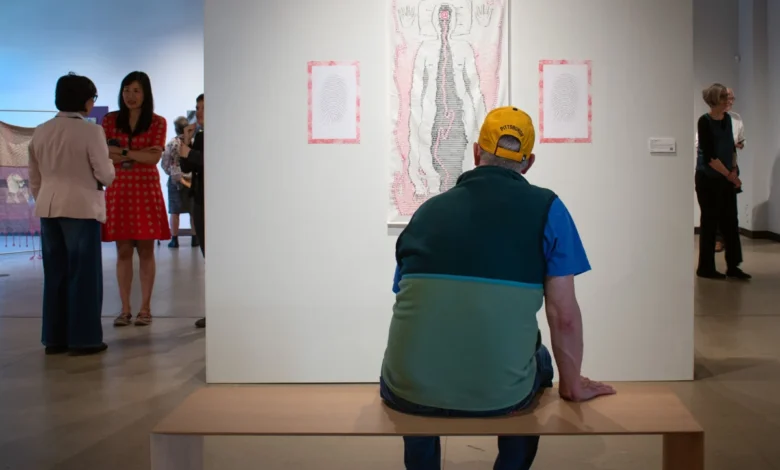
This impulse culminates in Fault Lines, a sprawling, monumental paper installation inspired by a cross-section of the spinal cord. To ensure anatomical accuracy, Mehta consulted researchers at California’s Salk Institute, investigating the precise mechanisms by which the poliovirus attacks motor neurons. The resulting installation comprises thousands of tiny, hand-cut paper forms, individually pinned in place to map the structures and functions of the central nervous system.
The piece achieves a rare equilibrium: it is simultaneously breathtakingly delicate, scientifically rigorous, and intensely personal. Cheng notes that the installation underscores Mehta’s determination to understand her disability on her own terms, refusing to allow clinical explanations to serve as the definitive final word on her physical existence.
The Residue of Illness: Dominic Quagliozzi and the Materiality of Healthcare
Dominic Quagliozzi shares Mehta’s propensity for converting clinical artifacts into artistic mediums. Throughout his career, he has systematically incorporated hospital gowns, linens, nitrile gloves, and Betadine antiseptic into his sculptural repertoire.
Diagnosed with cystic fibrosis, Quagliozzi spent his youth harboring ambitions of becoming an athlete. As his pulmonary function progressively declined, athletic participation became untenable, prompting him to pivot toward drawing athletes, inventing imaginary team logos, and crafting conceptual jerseys. Eventually, chronic illness transitioned from a peripheral obstacle into the central subject matter of his artistic practice.
Art provided a crucial mechanism for processing trauma and articulating the otherwise unspeakable realities of chronic disease. His featured piece, Blue Morpho, derives its textural richness from colored and cut hospital gowns and moving blankets. The fabric bears the physical scars of its previous life—stains, tears, and wear that Quagliozzi characterizes as the physical, emotional, and labor-intensive residue of prolonged hospitalization. Moving blankets, in particular, carry a poignant subtext, symbolizing the recurring disruption of chronic illness, which repeatedly uproots patients from ordinary life and confines them to institutional settings for weeks at a time.
Quagliozzi’s second contribution, Co-Parenting, introduces an even higher degree of intimacy. Following his 2015 double lung transplant, he was given a lung-shaped pillow designed to be held against the chest to mitigate pain during coughing fits or movement. Years later, after becoming a father, Quagliozzi deconstructed one of his son’s old teddy bears, reshaping the fabric into anatomical lung forms and permanently affixing them to the transplant recovery pillow.
The title serves as a poignant acknowledgment of his symbiotic relationship with the anonymous organ donor whose lungs saved his life. Without the transplant, fatherhood would have been an impossibility. Maintaining the health of the donated organs has paradoxically enabled him to nurture and care for his child.
However, Quagliozzi’s medical trajectory remains dynamic. Eleven years post-transplant, he has begun exhibiting signs of organ rejection and is currently undergoing medical treatment. Rather than viewing this development with pure despair, Quagliozzi regards it with the characteristic pragmatism of an artist who views life’s disruptions as raw material. While acknowledging the inevitable grief and disappointment, he views the new chapter as an opportunity to generate fresh experiences from which his artistic practice can draw.
Broader Implications and Societal Impact
The collective output featured in Textures of Being challenges the societal impulse to cast individuals with disabilities into rigid archetypes of perpetual suffering or inspirational heroism. As Yi observes, true representation requires holding space for the full spectrum of the human condition—encompassing joy, pain, grief, resilience, and everything in between.
By reframing disability not as a personal failure or a medical anomaly to be eradicated, but as a valid, culturally rich identity and perspective, the artists in this exhibition are expanding the boundaries of contemporary art. Through textiles, paper, metal, and mixed media, they invite the public to look closer, discard preconceived notions, and engage directly with the textures of lived experience.
Textures of Being remains open to the public through January 16 at Contemporary Craft in Pittsburgh’s Lawrenceville neighborhood. Admission to the gallery is free of charge, ensuring broad community access to this vital cultural discourse.