Navigating the Leash: The Growing Debate Over Service Dog Fraud and Accessibility in Connecticut

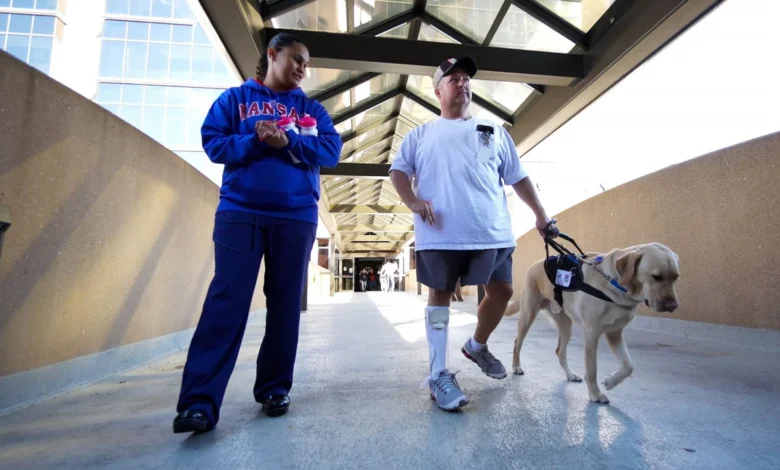
HARTFORD, Conn. — For Olivia Streaman, the profound impact of a service animal is not an abstract concept; it is a daily reality. Four years ago, Streaman initiated the application process for a service dog to assist her father, who lives with Parkinson’s disease. The resulting match—a meticulously trained canine named Peanut—proved to be transformative, allowing her father to preserve his physical mobility, regain a vital sense of independence, and navigate public spaces with confidence.
However, this hard-won autonomy has increasingly been undermined by a modern phenomenon: the proliferation of pets falsely presented as legitimate working service animals. Witnessing firsthand how public skepticism, fueled by ill-behaved or untrained animals, impacts legitimate handlers, Streaman transitioned her personal experience into professional advocacy. Today, she serves as a development associate at Educating Canines Assisting with Disabilities (ECAD), a Winsted-based nonprofit founded in 1995 by Lu and Dale Picard. The organization’s enduring mission is to empower individuals with disabilities to achieve greater mobility and independence through specially trained dogs.
Now, Streaman and her colleagues at ECAD are spearheading an advocacy campaign to enact stricter legislation in Connecticut. Their primary objective is to make the intentional misrepresentation of a pet as a service animal a punishable offense under state law. To bolster this initiative, ECAD has launched an online petition designed to safeguard working service dogs and protect the dignity and safety of the individuals who depend upon them.
The Legislative Push and the Problem of Misrepresentation
At the heart of the current debate is the distinction between a true service animal and an ordinary pet outfitted with internet-purchased accessories. According to Streaman, a misrepresented service dog is typically an untrained companion animal whose owner falsely claims it possesses official working status. To lend credence to these falsehoods, owners frequently utilize fraudulent vests, harnesses, badges, certificates, or digital registries readily available for purchase online.
The consequences of this trend extend far beyond mere inconvenience, often inflicting psychological and emotional distress on legitimate handlers. Streaman recounted a recent incident at a local Costco wholesale club where her father was subjected to aggressive questioning by staff members. The employees’ apprehension stemmed from prior negative encounters with poorly behaved animals—including a dog that eliminated inside the facility and another that barked aggressively. Because her father struggles with speech clarity and vocal projection, the unwarranted interrogation triggered severe anxiety, causing him to retreat inward and hesitate before venturing out into public spaces again.
"One of the purposes of a service dog is to give their handlers greater mobility and confidence to be independent and leave their homes," Streaman explained. "But when they are being questioned constantly, it makes them want to be more reclusive and stay indoors."
ECAD’s push for legal reform mirrors a broader national movement. Streaman notes that more than half of U.S. states have already established statutes penalizing the fraudulent representation of service animals, leaving Connecticut lagging behind in legislative protections.
The legislative landscape in Connecticut has seen incremental movement without reaching final enactment. Last year, the Connecticut Senate passed Senate Bill 1386. While the legislation primarily addressed dog-breed insurance regulations, it also mandated a state commission to study whether civil or criminal penalties should be established for service dog misrepresentation. Ultimately, the commission did not formulate a penalty recommendation, and the measure failed to become law.
"We are asking the Connecticut General Assembly that if someone knowingly misrepresents their pet as a service dog, they will have to face repercussions," Streaman said. "We’re just asking to keep the momentum going and have circulated a petition online. We just want there to be a penalty in place, as many states already have."
The Nuanced Reality of Owner-Training and Financial Barriers
While advocacy groups like ECAD emphasize the urgent need to crack down on fraudulent claims, other professionals within the canine assistance community urge caution, highlighting the complex socioeconomic factors underlying the issue.
Kasey Nash, founder of Joyful Paws Service Dogs in Windsor—established in 2017—offers a more nuanced perspective on the debate. While acknowledging the challenges posed by disruptive animals in public settings, Nash contends that many problematic situations stem not from deliberate deception, but from inadequate training resources.
"I think there has to be some nuance in this debate from my experience working with service dog owners," Nash said. "Many times, dogs are not trained adequately. You have to remember some of these handlers are severely disabled, and sometimes the dog is not properly or professionally trained and can exhibit behavioral issues. It’s not that the owner is being intentionally misleading; it’s that the dog just isn’t trained properly."
Nash cautions against the indiscriminate use of the term "fake," noting that it carries a pejorative implication that an individual is entirely uncompromised by a disability and is willfully gaming the system. In reality, she notes, many handlers are genuinely disabled individuals who attempted to train their own service animals due to prohibitive financial constraints, but lacked access to professional guidance or ongoing support.
The financial barrier to acquiring a fully trained service animal is formidable. A professionally trained service dog can cost upwards of $40,000, placing the resource completely out of reach for many low- and fixed-income individuals living with disabilities. To address this disparity, Nash’s organization provides alternative pathways, offering customized training lessons that allow handlers to bring their own dogs into a structured training environment. Nash utilizes group classes, seminars, and webinars to minimize costs, tailoring programs to fit individual budgets and operational needs.
Understanding Federal Standards and the ADA Framework
To comprehend the ongoing friction between business establishments, legitimate handlers, and individuals with poorly trained animals, experts point to the overarching framework of the federal Americans with Disabilities Act (ADA).
Under current federal regulations, the legal definition and certification requirements for service animals are intentionally flexible. The ADA does not mandate that a service dog undergo training by an accredited professional or a formal organization. Furthermore, federal law requires no official government registry, identification card, certification papers, or specialized vests.
Because the statutory language is broadly written, it ensures widespread accessibility for individuals with diverse disabilities who might otherwise be priced out of obtaining assistance animals. However, this flexibility creates enforcement challenges for local businesses attempting to maintain order and hygiene within their establishments.
According to guidelines compiled by the Advocates for Service Animal Partners, business owners and their employees are legally restricted to asking only two specific questions when a service animal enters a facility:
- Is the dog a service animal required because of a disability?
- What work or task has the dog been trained to perform?
Staff members are strictly prohibited from demanding medical documentation, identification cards, or proof of specialized training. Legally, trained service animals are permitted to accompany their handlers into any public area where the general public is allowed. Conversely, emotional support animals and standard household pets—which lack specific task-training—do not share this legal status and can lawfully be denied entry.
"Part of the way businesses can defend themselves is through asking those two questions," Nash noted. "If someone was intentionally faking a service dog, they would probably not be able to answer those questions very well. Also, the other side of it is that even if someone answers those questions appropriately, there are behaviors to look for. If the dog is behaving aggressively or jumping on people, it can become more obvious the dog is not properly trained."
Defining Characteristics of Legitimate Working Canines
Differentiating between a genuinely trained service animal and an impostor often relies on observing behavioral patterns rather than inspecting paperwork. Streaman outlines the rigorous standards to which legitimate service dogs are held, noting that a certified animal typically undergoes approximately 1,500 hours—or roughly two years—of intensive training before being placed with a handler.
Unlike household pets or emotional support animals, legitimate service dogs exhibit distinct behavioral traits in public environments. "A true service dog will have a very good temperament; they will not bark or get too excited, and they will also not leave their owner’s side," Streaman explained. "Being able to watch how the dog behaves with its handler is the biggest tell. A legitimate service dog will not get distracted easily, bark, or sniff around. Once the vest is put on a service dog, it’s incredible to watch them step into that helper role immediately."
Conversely, untrained animals frequently display signs of environmental overstimulation, including excessive vocalization, sniffing merchandise, pulling on the leash, displaying reactivity toward strangers or other animals, and failing to maintain focus on the handler.
Broader Implications and Potential Solutions
As the debate over service animal regulation continues to evolve in Connecticut and across the nation, stakeholders are divided on the most effective path forward. While organizations like ECAD advocate for punitive measures—pointing out that states enacting fines ranging from $100 to $500 for first offenses, and misdemeanor charges for repeat violations, have seen positive deterrence—others emphasize education over enforcement.
Nash argues that targeting individual handlers with punitive laws may inadvertently penalize vulnerable disabled individuals who are already struggling to navigate an inaccessible world. Instead, she suggests that the systemic solution lies in broader education campaigns directed at businesses, empowering retail and service workers to understand their rights under the ADA, recognize behavioral warning signs, and appropriately manage public spaces without alienating legitimate handlers.
As the online petition circulates and the conversation gains traction among lawmakers, advocates on both sides agree on one fundamental principle: protecting the integrity of the service dog system is essential to ensuring that individuals with disabilities can navigate society safely, independently, and free from discrimination.