How Modern Medical Alert Systems Transformed From the Panic Button Into Proactive Health Hubs


The landscape of senior care and independent living is experiencing a profound technological transformation, driven by an aging global demographic and a widespread preference among older adults to age in place. According to data compiled by AARP, nearly 90 percent of individuals aged 65 and older express a strong desire to remain in their private homes rather than transition into assisted living facilities or nursing homes. To meet this massive demographic shift, the global medical alert systems market—formally known as Personal Emergency Response Systems (PERS)—has expanded rapidly, with industry valuations projected to approach $11.8 billion.
At the center of this market growth is a radical reinvention of safety hardware. Long gone are the days when medical alerts were defined solely by the classic, stigmatized "I’ve fallen and I can’t get up" wearable pendant connected to a stationary household landline. Today, advanced artificial intelligence, ubiquitous cellular connectivity, and passive ambient sensing have converted simple panic buttons into comprehensive health-monitoring hubs. These modern devices do not merely react to a crisis after it happens; they actively monitor health patterns, predict environmental risks, and provide real-time peace of mind for family caregivers across the nation.
The Evolution of Personal Safety Technology: A Chronological Overview
To understand the scope of contemporary health-monitoring technology, industry analysts look back at the decades-long evolution of emergency response systems.
In the early decades of personal emergency response systems, the technology was rudimentary. The standard setup required a wearable radio-frequency transmitter—usually a chunky plastic button worn around the neck or wrist—that communicated exclusively with a localized base unit plugged into a traditional copper landline telephone. While revolutionary for its era, this first-generation equipment carried severe limitations. It functioned only within a restrictive radius of roughly 300 to 800 feet from the base station. Furthermore, it completely failed if the user ventured outside, forgot to wear the device, or lost consciousness immediately upon impact, rendering them unable to physically depress the activation switch.
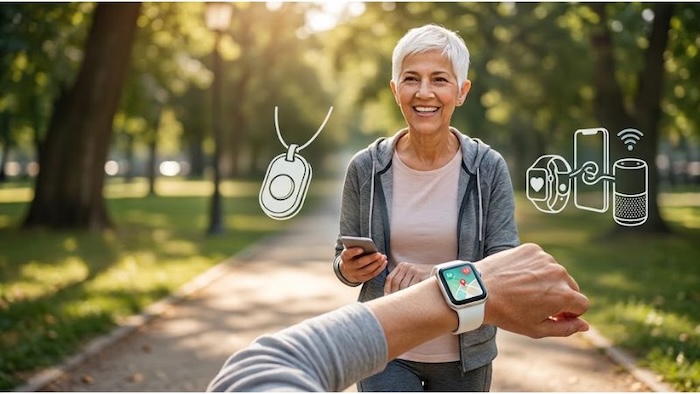
By the early 2010s, the rollout of nationwide cellular networks prompted the industry’s first major pivot. Manufacturers began introducing mobile PERS (mPERS) devices featuring integrated GPS chips and cellular chips. This breakthrough unshackled seniors from their living rooms, allowing them to travel, walk in public parks, and drive while maintaining a direct audio link to a monitoring center anywhere cellular coverage existed.
By 2026, the integration of wearable artificial intelligence and sophisticated sensor algorithms initiated the current era of proactive health monitoring. Modern devices are no longer passive triggers waiting to be pushed; they are intelligent health assistants capable of analyzing gait, detecting abrupt falls automatically via gyroscopes, tracking medication schedules, and pushing vital data straight to dedicated smartphone applications used by family members and professional caregivers.
Comparing Traditional Infrastructure With Modern Smart Solutions
The technological gap between legacy systems and modern emergency architecture is vast, fundamentally changing how safety is managed within the home.
Traditional landline-based systems offered basic, low-cost protection primarily suited for homebound seniors on tight budgets, but they suffered from high vulnerability to power outages, restricted range, and a complete lack of caregiver integration beyond a simple phone call from a dispatch center.
In contrast, modern cellular smartwatches bridge the gap between consumer technology and medical-grade reliability. These devices combine unlimited nationwide cellular coverage, discrete everyday aesthetics, and advanced AI-filtered accelerometers that dramatically reduce the false-alarm rates common in earlier fall-detection iterations.

Meanwhile, for older adults experiencing cognitive decline or dementia who consistently refuse to wear traditional watches or pendants, whole-home ambient radar and wall-mounted AI sensors have emerged as the gold standard. These non-intrusive systems track movement patterns, monitor daily routines, and instantly signal anomalies—such as a failure to get out of bed by a customary hour or an uncharacteristic prolonged stillness in a bathroom—without requiring the senior to interact with any hardware whatsoever.
Strategic Considerations for Caregivers and Families
Despite the remarkable capabilities of modern medical alert systems, healthcare professionals and elder-care advocates emphasize that technology should be viewed strictly as a risk-mitigation tool rather than a replacement for human oversight. Selecting the appropriate device requires an objective assessment of the senior’s cognitive state, physical dexterity, and daily routines.
For instance, an advanced smartwatch featuring a complex touchscreen interface and multiple biometric menus may prove overwhelming or entirely unusable for an individual battling advanced macular degeneration or moderate-to-severe dementia. Conversely, a passive radar sensor or a simple, single-function waterproof pendant may provide optimal protection without inducing technological frustration.
Caregivers are strongly encouraged to consult foundational safety resources, such as the fall prevention guidelines published by the National Institute on Aging, before deploying any single electronic intervention. Home modifications—including the removal of tripping hazards, the installation of secure grab bars in bathrooms, and the optimization of ambient household lighting—remain critical baseline requirements for effective aging-in-place strategies.
Financial Realities and Insurance Coverage Realities
As families evaluate the integration of modern medical alert systems into their long-term care plans, financial questions frequently arise regarding reimbursement and insurance coverage. Under standard guidelines set by Original Medicare (Parts A and B), medical alert systems and personal emergency response technologies are generally not classified as "durable medical equipment." Consequently, they are typically not covered directly by federal Medicare programs.

However, the proliferation of managed care has shifted options at the regional level. Many Medicare Advantage (Part C) plans, as well as specific state-administered Medicaid waiver programs, have begun recognizing the preventative value of emergency monitoring. These programs increasingly offer limited financial subsidies, monthly subscription discounts, or full reimbursements for qualified subscribers, depending on individual policy terms and local healthcare regulations. Families are advised to contact their specific insurance providers directly to explore available supplemental benefits.
Broader Implications and Industry Future
The rapid modernization of medical alert systems reflects a broader societal pivot toward technology-enabled aging. As healthcare systems face the mounting pressures of an aging population, decentralized health monitoring reduces the burden on emergency medical services by filtering out false alarms and providing dispatchers with precise biometric and locational data prior to arrival.
Ultimately, today’s advanced safety ecosystems successfully balance the delicate dichotomy of modern caregiving: preserving the personal dignity, autonomy, and privacy of the older adult while alleviating the relentless anxiety experienced by family caregivers. While no electronic sensor can replicate the empathy and warmth of dedicated human care, modern medical alert systems ensure that a reliable safety net is always quietly active in the background, safeguarding independence for millions of aging adults.