The Post-Dobbs Landscape: How 2026 Midterm Ballot Initiatives Shifted Abortion Access Across State Lines

Four years after the landmark United States Supreme Court ruling in Dobbs v. Jackson Women’s Health Organization—a decision that fundamentally dismantled federal constitutional protections for abortion by overturning Roe v. Wade—state-level ballot measures have evolved into the definitive battleground for reproductive rights in America. As voters across the country headed to the polls for the 2026 midterm elections, the future of reproductive health care, bodily autonomy, and clinical practice hung in the balance once again. The outcomes of four critical state ballot initiatives in Nevada, Virginia, Missouri, and Idaho have now permanently redrawn the legislative and constitutional map of abortion access, demonstrating both the potency and the administrative friction of direct democracy.
Main Facts of the 2026 Midterm Abortion Measures
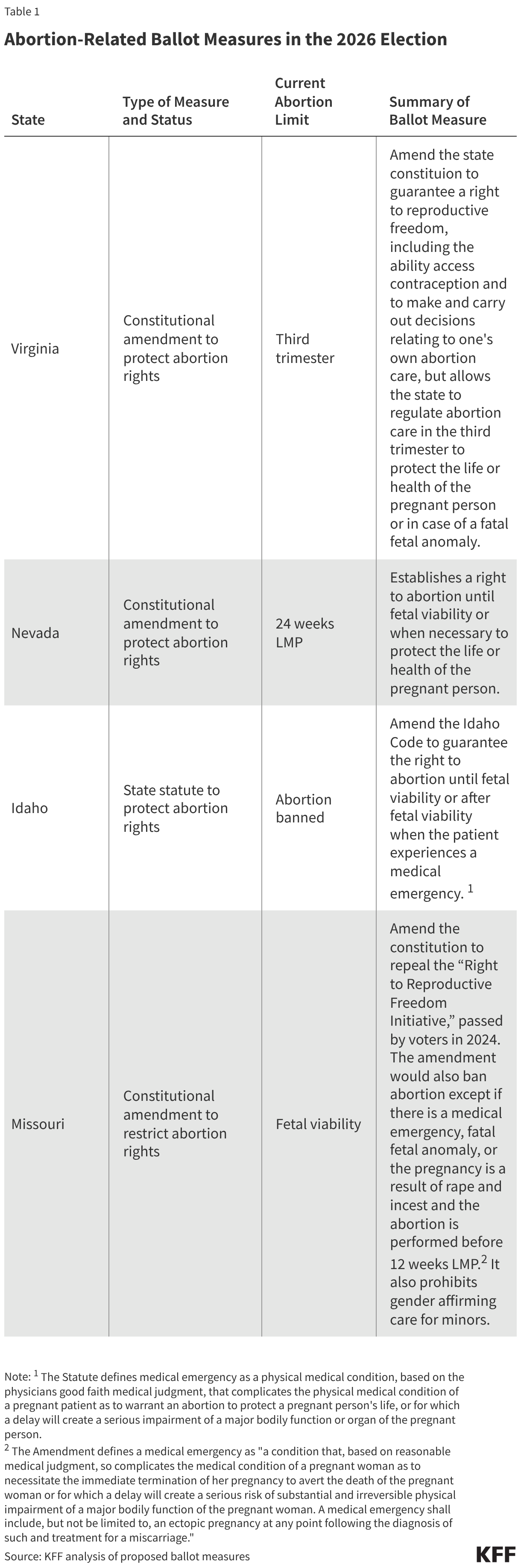
The 2026 election cycle featured four high-stakes state battles over reproductive freedom, engaging millions of voters in both defensive maneuvers and offensive expansions of health care rights. In Nevada and Virginia, voters successfully enshrined the fundamental right to abortion directly into their state constitutions, creating permanent structural barriers against future legislative interference. Conversely, the political landscape in the Midwest and the Mountain West saw intense counter-mobilizations. In Missouri, voters firmly rejected a conservative constitutional amendment designed to repeal the state’s 2024 "Right to Reproductive Freedom Initiative"—a measure that would have banned nearly all abortion provisions and restricted gender-affirming care for minors. In Idaho, voters similarly turned down a statutory measure that would have reversed the state’s draconian near-total abortion ban by legally establishing rights up to fetal viability.
Chronology and Legal Battles Surrounding the 2026 Initiatives
The path to the November 2026 ballot boxes was paved with complex legal maneuvers, aggressive signature verification drives, and intense judicial interventions across multiple jurisdictions.
In Virginia, which remains an outlier as the only Southern state without an early gestational ban or sweeping prohibitions, Governor Spanberger signed a historic bill on February 6, 2026. This act successfully placed the Right to Reproductive Freedom Amendment before voters after legislative approval in two successive sessions. However, opponents immediately launched a multi-front legal offensive. On March 3, 2026, Bedford County Supervisor Charla Bansley filed a lawsuit aiming to block the initiative over alleged technical failures in distributing the language to circuit clerks. Although a district court dismissed the suit with prejudice on July 24, 2026, due to a lack of plaintiff standing and reliance on repealed laws, subsequent appeals kept the legal drama alive into the autumn. A separate lawsuit filed on April 30, 2026, by medical advocacy groups and local officials argued that the ballot language failed to adequately convey its true legal impact. Despite these challenges, early voting in Virginia commenced on September 18, 2026, ultimately culminating in the constitutional enshrinement of abortion access.
In Nevada, the journey to the ballot followed a strict state constitutional mandate requiring citizen-initiated amendments to pass across two consecutive general elections. Having cleared the first hurdle in 2024, Nevadans faced a definitive second vote on the Reproductive Rights Amendment. Anticipating victory, legal analysts and reproductive rights advocates have already signaled plans to leverage this new constitutional authority to dismantle Nevada’s revived parental notification law for minors, which a lower court briefly revived before facing preliminary injunctions from the Nevada Supreme Court.
Meanwhile, Idaho’s journey toward the ballot was defined by grassroots mobilization against a backdrop of severe statutory restrictions. Enforcing a near-total abortion ban with extremely narrow life-and-death exceptions, Idaho has long been a focal point for anti-abortion legislation. To counter this, Idahoans United for Women and Families organized a massive signature-gathering campaign for the Reproductive Freedom and Privacy Act. Despite navigating stringent threshold requirements across multiple legislative districts, the campaign faced persistent pushback from the state Attorney General’s office regarding biased financial impact statements and misleading ballot titles. Following multiple interventions by the Idaho Supreme Court in mid-2025 and late 2026 ordering comprehensive rewrites of the "YES" and "NO" explanatory language, the initiative officially qualified for the November ballot, though it ultimately failed to secure voter approval.
Missouri’s path highlights the unprecedented scenario of a state electorate attempting to unseat its own recently established constitutional rights. In 2024, Missouri voters passed Amendment 3, successfully protecting abortion access up to fetal viability. In response, state lawmakers drafted a counter-measure for the 2026 ballot to repeal Amendment 3, reinstate a sweeping abortion ban, prohibit state funding, and ban gender-affirming care for minors. The American Civil Liberties Union ( ACLU) of Missouri immediately challenged the initiative, arguing the language was deceptive and violated single-subject constitutional rules. The Missouri Western District Court of Appeals intervened in July 2025, certifying revised language to ensure voters understood the repeal nature of the measure. Ultimately, Missouri voters chose to reject the repeal, signaling sustained public support for the protections established just two years prior.
Broader Legal Context: Residual Restrictions Post-Amendment
The inclusion of abortion rights into state constitutions has not automatically translated into a seamless, barrier-free clinical environment. Experience from pioneering states like Arizona and Ohio demonstrates that while constitutional amendments successfully dismantle outright bans and major gestational limits, secondary regulations—such as mandatory waiting periods, targeted regulations of abortion providers (TRAP laws), telemedicine prohibitions, and parental consent mandates—frequently require separate, prolonged judicial battles.
In Arizona, where voters passed Proposition 139 in November 2024 to protect access until viability, courts subsequently struck down the state’s 15-week ban and invalidated telemedicine bans and 24-hour waiting periods in early 2026. However, state-funded abortion bans, parental consent rules, and physician-only staffing mandates remain the subject of ongoing litigation led by organizations like the American Civil Liberties Union. Similarly, Ohio’s passage of Issue 1 in November 2023 permanently blocked a strict six-week ban, yet parental consent requirements and public funding restrictions continue to operate within the state’s regulatory framework.
Implications and Future Outlook for Direct Democracy
The 2026 midterm election results underscore the shifting dynamics of federalism and reproductive rights in post-Dobbs America. With majorities of voters in states like Nevada and Virginia solidifying protections, and voters in Missouri and Idaho drawing lines against regressive repeals, state constitutions have proven to be exceptionally durable shields against shifting legislative majorities.
However, structural limitations continue to constrain the power of direct democracy. Citizen-led constitutional amendment processes exist in only 17 states, and heavily restricted jurisdictions—particularly in the South and parts of the Midwest—leave millions of residents with few localized remedies against total bans. As seen in Arkansas and Florida during previous cycles, aggressive signature verification hurdles and high supermajority thresholds (such as Florida’s 60% requirement) can thwart popular policy outcomes even when a majority of the electorate voices support.
As the dust settles on the 2026 midterms, the legal landscape of American reproductive health care remains decentralized, complex, and intensely litigated. State courts will continue to serve as the ultimate arbiters of how broad constitutional guarantees interact with statutory regulations, ensuring that the battle over abortion access remains a central pillar of American jurisprudence for years to come.
Related posts: