Prevent catastrophic falls with these 5 bathroom safety modifications for seniors.

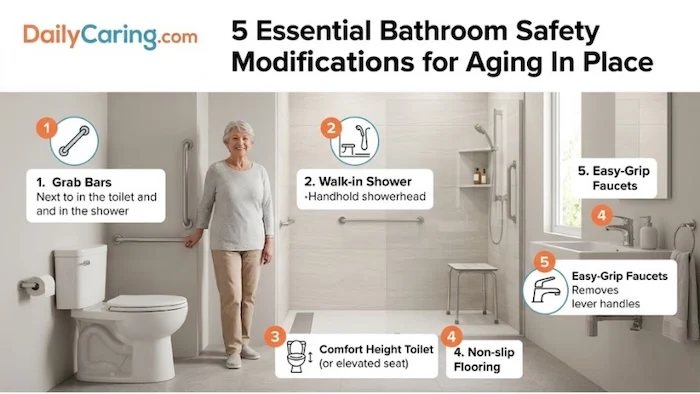
For millions of family caregivers navigating the complexities of eldercare, a persistent undercurrent of anxiety often centers around a single room in the home: the bathroom. While privacy is deeply valued by aging adults, the standard residential bathroom represents a high-risk environment where safety is frequently compromised by hard surfaces, moisture, and restricted mobility. According to public health data compiled by federal agencies, millions of older adults experience falls annually, with a significant percentage of these incidents occurring within the confines of the bathroom. To mitigate these dangers, public health advocates, occupational therapists, and home modification specialists emphasize that proactive structural changes are essential for supporting safe aging in place.
Understanding the Hazards of the Residential Bathroom
The modern bathroom is characterized by a combination of architectural and environmental factors that create a high risk for accidents. Hard ceramic tiles, porcelain fixtures, glass enclosures, and the presence of soap and water combine to reduce traction significantly. When these physical hurdles intersect with the natural physiological changes associated with aging—such as diminished muscle mass, declining balance, joint stiffness, and deteriorating eyesight—the margin for error narrows drastically.
Public health researchers note that a fall for an older adult is rarely a minor event. It often serves as a tipping point that transitions an independent senior into a cycle of hospitalization, surgical intervention, and long-term institutional care. Consequently, addressing bathroom safety requires moving past superficial adjustments or temporary solutions. It demands a clinical, systematic approach to home architecture that accounts for human biomechanics.
1. Professional Assessment and Clinical Placement of Grab Bars
One of the most common mistakes made during home renovations is treating grab bars as simple, do-it-yourself accessories that can be purchased and installed without expert guidance. In clinical practice, grab bars must be regarded as specialized mobility tools mapped directly to an individual’s specific functional reach and physical limitations.
Occupational therapists evaluate how a senior moves within a space, identifying where support is critically needed—such as transitioning from a sitting position to standing, or stepping over a bathtub threshold. Furthermore, professional installation is non-negotiable. Suction-cup or tension-mounted grab bars are structurally inadequate; they frequently fail under the dynamic kinetic energy of a falling adult, turning a perceived safety device into a secondary hazard.
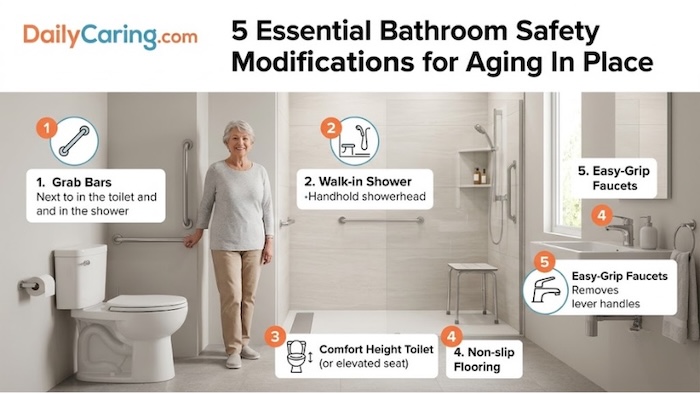
When acquiring grab bars, experts recommend selecting models with diameters between 1.25 and 1.5 inches to accommodate aging hands comfortably. Additionally, ADA-compliant knurled or textured finishes are preferred over smooth chrome surfaces to ensure a secure grip, even when hands are wet or soapy. Proper installation also requires anchoring directly into structural wall studs or utilizing specialized reinforcement plates capable of withstanding hundreds of pounds of downward and lateral force.
2. Optimizing Toilet Height and Joint Ergonomics
Standard residential toilets, typically standing at a height of 15 inches from the floor to the top of the bowl, present a major ergonomic challenge for older adults. Lower toilets demand excessive knee and hip flexion, requiring substantial lower-body strength and quadriceps power to successfully transition from a seated position to a standing posture.
While the Americans with Disabilities Act (ADA) establishes commercial standards between 17 and 19 inches primarily for wheelchair accessibility, residential modifications require a customized calculation tailored to the specific biomechanics of the senior user. Specialists determine the ideal height by measuring the distance from the floor to the back of the individual’s knee, ensuring that their feet rest flat on the floor with hips and knees aligned at a comfortable angle. Adjusting the toilet height through specialized risers, wall-hung modifications, or the installation of a comfort-height toilet significantly reduces joint strain and minimizes the likelihood of a loss of balance during use.
3. Upgrading Illumination and Maximizing Visual Contrast
Vision changes are a natural part of the aging process, frequently accompanied by smaller pupil sizes, a yellowing of the lens, and decreased light transmission to the retina. These physiological shifts mean that an older adult requires significantly more ambient light to navigate safely than a younger person. However, simply installing higher-wattage bulbs often backfires by creating harsh glare and deep shadows, which severely impair depth perception and increase fall risks.
To counter this, lighting design must focus on uniform illumination, high contrast, and glare reduction. Home safety experts recommend utilizing LED fixtures with a Color Rendering Index (CRI) of 80 or higher and a warm color temperature ranging between 2700K and 3000K. Creating stark visual boundaries—such as contrasting colors between the bathroom floor and bathroom fixtures, or highlighting the edge of a tub—helps individuals with declining vision accurately gauge spatial dimensions and avoid missteps.
4. Selecting Shock-Absorbing and Slip-Resistant Flooring
Traditional ceramic and porcelain tiles are selected for bathrooms primarily due to their water resistance, but they offer zero shock absorption. If a fall does occur on ceramic tile, the hard surface fails to dissipate impact energy, frequently resulting in severe fractures, hip breaks, and long-term physical trauma.

When planning comprehensive safety modifications, property owners are advised to evaluate alternative flooring materials that balance slip resistance with impact cushioning.
- Rubber flooring offers exceptional traction and maximum shock absorption, effectively protecting joints and bones in the event of a fall, though it typically represents a higher financial investment.
- Textured cork provides a natural grip and high impact cushioning due to its cellular structure.
- Slip-resistant vinyl provides a moderate-to-high level of traction at a more accessible cost point.
Conversely, untreated ceramic tile remains a primary hazard and should be retrofitted with non-slip treatments or covered with secured, low-profile safety mats if replacement is immediately unfeasible.
5. Eliminating Door Thresholds and Transition Hazards
Threshold transitions between rooms are frequently overlooked during general interior assessments, yet they represent a major tripping hazard for seniors. Standard door saddles create a sudden height variation where hallway carpeting meets bathroom tile. For older adults experiencing a shuffle gait—a common walking pattern associated with neurological changes or joint stiffness—even a half-inch elevation change is enough to catch a foot and cause a catastrophic fall.
Addressing this issue involves removing traditional raised saddles and replacing them with graded, flush, or zero-edge transitions. These modifications smooth out the architectural boundaries between rooms, allowing for unobstructed walking paths that accommodate walkers, wheelchairs, and shuffling feet alike.
The Importance of Certified Expertise: CAPS Professionals
Executing these structural modifications requires specialized knowledge that extends beyond the capabilities of a standard handyman or general contractor. Industry standards strongly encourage families to work with a Certified Aging-in-Place Specialist (CAPS). Administered by the National Association of Home Builders (NAHB), the CAPS designation certifies that a builder, remodeler, or designer has undergone rigorous training regarding the specific accessibility needs, biomechanical challenges, and structural load requirements necessary for retrofitting residential homes.
Utilizing a certified professional ensures that structural updates comply with safety engineering principles rather than aesthetic preferences alone. While professional modifications and installations require a significant upfront financial investment—often ranging between $2,000 and $5,000 for comprehensive bathroom overhauls—analysts frame this expenditure as an essential safeguard. When compared against the baseline costs of a single major fall requiring emergency hospitalization, surgical hip replacement, and subsequent skilled nursing rehabilitation, proactive home modification is widely recognized as a cost-effective strategy for preserving independence.
Ultimately, addressing bathroom safety is a fundamental requirement for maintaining the viability of aging in place. By approaching these modifications with clinical precision and executing them through certified professionals, families can neutralize the highest-risk environment in the home, protect the physical well-being of older adults, and preserve their autonomy and dignity for years to come.