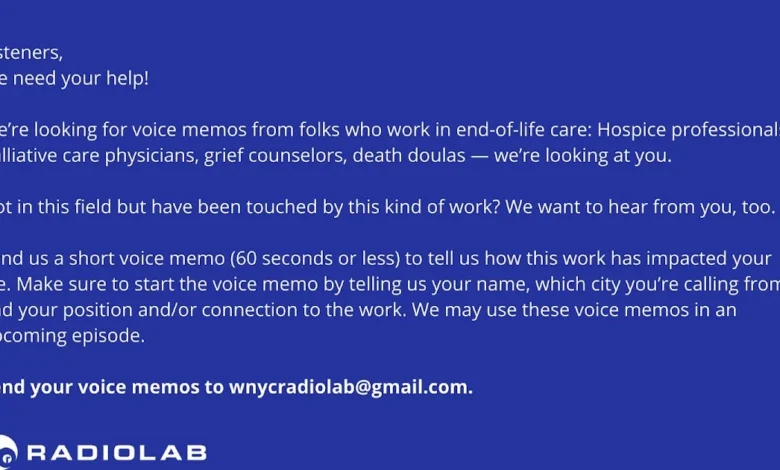
Hospice and palliative care professionals, alongside the patients and families whose lives they touch, are being presented with two distinct national platforms to share their personal experiences, professional journeys, and the profound realities of end-of-life care. Announced by Dr. Christian Sinclair, editor of the medical humanities and palliative care publication Pallimed, these initiatives arrive at a critical juncture when public understanding of specialized medical care for serious illness remains both vital and deeply misunderstood. The first opportunity involves a nationwide call for audio submissions by the acclaimed public radio program and podcast Radiolab, while the second centers on an academic research project led by Dr. Kayla Sheehan, which seeks to document the defining moments that draw physicians into the specialty. Together, these projects offer a rare window into a medical discipline that operates largely behind closed doors, providing healthcare workers and families a public voice to demystify dying, grief, and compassionate intervention.
Radiolab’s National Audio Call for End-of-Life Perspectives
The Peabody Award-winning radio program and podcast Radiolab, produced by WNYC Studios, has launched an open call for audio submissions focused on the realities of end-of-life care. Known for its deeply reported, narrative-driven science journalism and its unique ability to render complex, emotionally heavy topics accessible to millions of listeners, Radiolab is casting a wide net to capture authentic human experiences from the front lines of mortality.
According to the production guidelines distributed via social media and healthcare networks, the show is actively seeking 60-second voice memos from two primary groups: professionals working within hospice and palliative care, and patients or family members who have been directly impacted by the end-of-life care system. Participants are instructed to record a concise audio clip lasting one minute or less, detailing a singular moment, realization, or emotional truth tied to their connection with the field.
Submissions are being collected electronically via a dedicated email address managed by the production team ([email protected]). Contributors are required to provide their full name, city of residence, and professional title or personal relationship to end-of-life care. While the broadcast network has not yet announced a specific air date or dedicated episode title for the collected recordings, the open-ended nature of the call suggests producers are compiling an audio collage or developing a serialized exploration of mortality in modern medicine.
For decades, mainstream media coverage of death and dying has frequently oscillated between clinical detachment and sensationalized tragedy. By turning the microphone directly over to clinicians, bedside nurses, social workers, chaplains, and grieving families, Radiolab’s initiative bypasses traditional journalistic intermediaries. This crowdsourced approach allows the raw, unvarnished texture of hospice work—marked by acute grief, unexpected grace, and quiet resilience—to reach a vast, mainstream audience that might otherwise remain insulated from the realities of aging and terminal illness.
Uncovering the Origins: Dr. Kayla Sheehan’s Physician Survey
Parallel to the broad cultural reach of the Radiolab initiative, the medical community is being offered an introspective opportunity through a targeted research project spearheaded by Dr. Kayla Sheehan, a notable contributor to Pallimed and an active voice in modern palliative medicine. Dr. Sheehan has initiated a formal qualitative inquiry designed to capture the "origin stories" of hospice and palliative care physicians—specifically, the defining moments, turning points, or personal epiphanies that led them to commit their careers to a specialty frequently associated with professional burnout, emotional fatigue, and systemic undervaluation.
The project utilizes a digital questionnaire hosted on Typeform, allowing physicians to submit their narratives anonymously. This guarantee of anonymity is a critical design feature, enabling clinicians to speak with unvarnished candor about the institutional hurdles, existential realizations, or personal losses that shaped their professional trajectories. Dr. Sheehan’s survey asks respondents to reflect on the exact juncture in their medical training or early practice when they realized traditional curative medicine was insufficient, and when palliative philosophy—focusing on symptom management, quality of life, and holistic support—became their guiding framework.
While palliative care has achieved formal recognition as a distinct medical subspecialty by the American Board of Medical Specialties (ABMS) since the early 2000s, the pathway into the field remains notoriously non-traditional. Unlike internal medicine, pediatrics, or surgery, where career trajectories are often solidified early in medical school, palliative physicians frequently arrive via circuitous routes, transitioning from oncology, critical care, geriatrics, or emergency medicine after experiencing moral injury or witnessing systemic failures in how terminal patients are managed within acute care hospitals.

Background and Context of Palliative Care Visibility
The launch of these two storytelling initiatives highlights an ongoing, systemic challenge within modern healthcare: the persistent public invisibility of palliative care and hospice medicine. Despite decades of clinical advancements, robust health economics research demonstrating improved patient outcomes, and a growing aging demographic, misconceptions about the specialty remain deeply entrenched among both the general public and traditional medical practitioners.
Historically, palliative care has suffered from a pervasive semantic confusion, with patients, families, and even primary care physicians frequently conflating it with giving up, transitioning exclusively to active dying, or premature termination of life-prolonging therapies. In reality, modern palliative medicine is an evidence-based medical specialty focused on relieving the symptoms, pain, and stress of serious illness—regardless of the diagnosis or whether the patient is pursuing curative treatments. It is designed to run concurrently with disease-modifying therapies, improving not only the comfort of the patient but frequently extending survival and drastically reducing costly, non-beneficial interventions in intensive care units.
Data compiled by the Center to Advance Palliative Care (CAPC) and the National Hospice and Palliative Organization (NHPCO) underscores a severe structural imbalance between clinical demand and workforce supply. With the population of adults aged 65 and older projected to reach over 80 million by the year 2040 in the United States alone, the need for trained palliative clinicians has reached a critical threshold. Yet, recruitment and retention within the field continue to face headwinds driven by administrative burdens, emotional strain, and a cultural reluctance within Western medicine to openly discuss mortality.
Initiatives like Radiolab’s audio project and Dr. Sheehan’s physician survey serve a vital socio-cultural function by breaking through this silence. By encouraging practitioners to share their personal motivations and daily realities, these projects humanize the specialty, transforming abstract medical statistics into relatable, deeply moving human narratives.
Chronology of the Announcements and Industry Response
The rollout of these storytelling platforms occurred during a concentrated window in June 2021, disseminated primarily through specialized medical blogs, professional networks, and academic social media channels.
- Early June 2021: WNYC’s Radiolab quietly initiates its digital call for end-of-life audio submissions, utilizing Twitter and public-facing newsletters to solicit 60-second voice memos from clinicians and families.
- Mid-June 2021: Dr. Christian Sinclair utilizes the Pallimed platform to amplify both the Radiolab project and Dr. Kayla Sheehan’s anonymous physician origin-story survey, framing them as unique avenues for professional expression and public advocacy.
- June 14, 2021: Official promotional graphics and direct submission links are widely shared across healthcare Twitter (#HPM), generating immediate engagement from palliative care physicians, nurses, and interdisciplinary team members across North America.
- Ongoing: Submissions for Dr. Sheehan’s Typeform survey remain open on a rolling basis, while Radiolab producers continue to process incoming audio files for potential integration into upcoming broadcast seasons.
The response from the healthcare community has been swift and overwhelmingly positive. Prominent voices within the Hospice and Palliative Medicine (HPM) digital sphere praised the initiatives for offering a constructive outlet for pandemic-fatigued healthcare workers. The COVID-19 pandemic, which placed unprecedented psychological and physical strain on end-of-life clinicians who managed thousands of isolated deaths, created an acute need for narrative processing and collective grieving within the medical community.
Fact-Based Analysis of Implications for the Profession
The convergence of these two storytelling platforms carries several significant implications for the future of palliative medicine, institutional policy, and public health communication:
- Combating Workforce Burnout through Shared Narrative: Palliative care clinicians experience high rates of compassion fatigue due to continuous exposure to existential distress and systemic resource limitations. Providing structured, external outlets for clinicians to articulate why they do this work helps reinforce professional identity and mitigate burnout by reconnecting practitioners to their core values.
- Shifting Public Perceptions via Mass Media: By leveraging a high-profile media outlet like Radiolab, the palliative care community gains access to millions of lay listeners who may have distorted or non-existent understandings of end-of-life care. Personal, audio-driven narratives bypass intellectual resistance, fostering empathy and encouraging proactive advance care planning among families before a medical crisis strikes.
- Qualitative Research as Advocacy: Dr. Sheehan’s anonymous survey goes beyond mere catharsis; it generates valuable qualitative data regarding the psychological and vocational drivers of palliative physicians. Documenting these origin stories can inform medical school curriculum design, residency recruitment strategies, and institutional leadership development, helping health systems better understand how to attract and retain specialized talent.
- Democratizing the Medical Narrative: Traditional medical journalism often privileges institutional spokespeople, healthcare executives, or detached researchers. By prioritizing the micro-narratives of bedside nurses, social workers, chaplains, and grieving relatives, these projects democratize the discourse surrounding death, validating the experiential knowledge of interdisciplinary care teams and families.
As healthcare systems globally grapple with an aging demographic and the complex ethical dilemmas of modern medical technology, the imperative to communicate clearly and compassionately about the end of life has never been greater. Through audio memos sent to public radio producers and anonymous confessions typed into digital forms, the hidden architecture of hospice and palliative care is slowly stepping into the light, offering a testament to the resilience, empathy, and quiet courage required to accompany human beings to the edge of life.