Unveiling the Hidden Conflicts: How Undisclosed Ties to Anti-Opioid Activists Compromised the CDC’s 2016 and 2022 Opioid Prescribing Guidelines

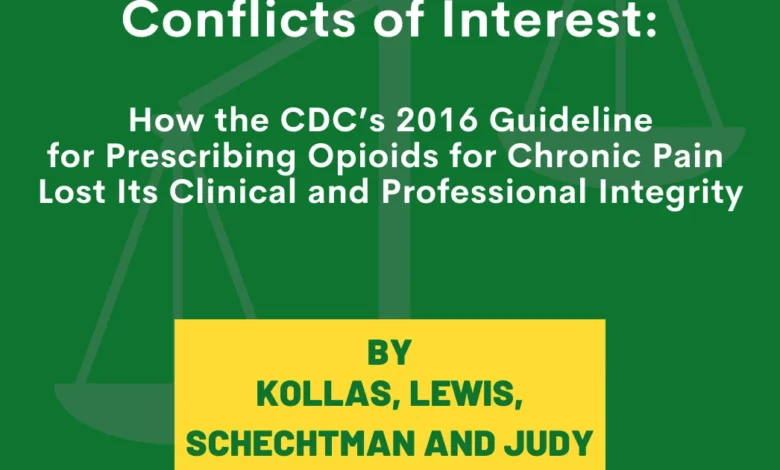
The integrity of federal health policymaking has been drawn into question following a stunning admission by Dr. Roger Chou during a Centers for Disease Control and Prevention (CDC) advisory meeting. Dr. Chou, a prominent researcher whose systematic reviews have served as the foundational bedrock for federal opioid policies, casually disclosed receiving funding to conduct reviews on opioids before temporarily recusing himself. This disclosure has reignited a fierce debate over potential conflicts of interest (COIs) that critics argue have fundamentally skewed national healthcare policy, disproportionately harming millions of Americans living with chronic pain.
For years, the intersection between anti-opioid advocacy groups—most notably Health Professionals for Responsible Opioid Prescribing (PROP)—and federal regulatory agencies has been a source of intense controversy. Dr. Chou’s recent statements, however, provide the most concrete link yet between the architects of restrictive federal guidelines and the activist networks that campaigned for them. As the CDC prepares to roll out its revised and expanded 2022 Opioid Prescribing Guidelines, medical professionals, patient advocates, and legal scholars are demanding a comprehensive accounting of how these policies were formulated and whether federal ethics rules were bypassed.

A Chronology of Entanglement: From Washington State to National Policy
The roots of the modern restrictive opioid framework trace back well before the publication of the CDC’s landmark 2016 Guideline. In the mid-2000s, the state of Washington implemented aggressive interventions within its Workers’ Compensation and Medicaid programs aimed at curbing opioid prescriptions. Dr. Gary Franklin, who later became PROP’s Vice President of State Regulatory Affairs, spearheaded these efforts through the Washington State Agency Medical Directors Group (AMDG).
In 2007, the AMDG published the Interagency Guideline on Opioid Dosing for Chronic Non-Cancer Pain, introducing rigid dosing thresholds. While justified by state officials as a cost-saving measure—notably steering prescribers toward cheaper alternatives like methadone—investigative reporting by the Seattle Times later revealed catastrophic human costs. The push toward high-dose methadone correlated with thousands of preventable overdose deaths among state beneficiaries, prompting emergency public health warnings.
Despite these documented harms, the policy framework tested in Washington State was adopted on a national scale. Dr. Chou, who co-authored a 2011 article announcing PROP’s formation and signed a 2012 petition urging the FDA to alter opioid labeling, positioned himself as a pivotal evidence synthesizer. Operating primarily through the Pacific Northwest Evidence-based Practice Center at Oregon Health and Science University (OHSU), Dr. Chou received substantial funding from the Agency for Healthcare Research and Quality (AHRQ)—an agency that funnels research directly to the CDC to inform federal guidelines.

The Conflict of Interest Controversy and Federal Reporting Rules
Under the CDC’s official protocols for the creation of the 2016 Guideline, panel experts and core contributors were strictly required to disclose financial relationships, intellectual preconceptions, and previously stated public positions. The agency’s guidelines explicitly mandated the exclusion of experts whose past activities might have a "direct and predictable effect on the recommendations."
When the 2016 Guideline was published, the CDC maintained that none of the core expert group members—including Dr. Chou—held conflicting financial interests. However, subsequent disclosures by PROP members revealed a web of interconnected relationships. While figures like PROP President Dr. Jane Ballantyne and board member Dr. Anna Lembke eventually disclosed consulting fees related to multi-district opioid litigation and advocacy work, Dr. Chou maintained that his methodological reviews were independent.
That defense crumbled during the July 16, 2021, meeting of the CDC National Center for Injury Prevention and Control (NCIPC) Board of Scientific Counselors (BSC). During the roll call, Dr. Chou stated: "I’m present. Uh … I do have a conflict. I receive funding to conduct reviews on opioids, and I’ll be recusing myself after the um, director’s, uh, um, um, uh … update."

The disclosure sent shockwaves through the medical community. Patient advocates who had spent years challenging the scientific validity of the 2016 Guidelines pointed out that Dr. Chou had helped set AHRQ research priorities, authored the reviews paid for by federal grants, co-authored the draft CDC guidelines based on those reviews, and sat on the advisory board tasked with approving them.
Emerging Clinical Harms and the Fallout of Rigid Dosing Limits
The real-world consequences of these policies have been heavily documented in the years following the 2016 Guideline’s release. While the document was formally framed as a voluntary advisory tool for primary care physicians, its recommendations were rapidly operationalized into mandatory rules by state legislatures, health insurers, pharmacy chains, and the Department of Veterans Affairs.
Arbitrary morphine milligram equivalent (MME) thresholds triggered widespread, involuntary opioid tapering. Subsequent clinical studies have underscored the profound dangers of this approach. Research published in prominent medical journals, including the BMJ and JAMA, demonstrated a statistically significant correlation between forced opioid tapers and escalated risks of severe mental health crises, overdoses, and suicides among vulnerable chronic pain patients. Furthermore, retrospective analyses revealed that these restrictions inadvertently bled into populations explicitly excluded from the 2016 guidelines, including palliative care patients and individuals suffering from advanced cancer pain.

In response to mounting pressure from the American Medical Association (AMA), the National Comprehensive Cancer Network (NCCN), and numerous patient advocacy groups, federal agencies belatedly attempted to course-correct. In April 2019, both the FDA and the CDC issued safety announcements and public advisories cautioning against the sudden discontinuation of opioid pain medications and the misapplication of rigid dosing caps. Yet critics argue these warnings were insufficient to reverse the systemic damage already inflicted upon the chronic pain community.
Implications for the 2022 Revised Guidelines and Calls for Investigation
As the CDC moves forward with the publication of its revised and expanded 2022 Opioid Prescribing Guideline, stakeholders remain deeply skeptical of the administrative process. Public records requests filed by investigative outlets under the Freedom of Information Act (FOIA) yielded hundreds of heavily redacted, virtually blank pages from federal agencies, fueling accusations of a lack of transparency.
Although Dr. Chou briefly recused himself during the July 16, 2021, BSC meeting, subsequent meeting roll calls showed him returning to active participation with "no conflicts" listed for routine business, leaving ambiguity as to whether his self-recusal applied to the broader 2022 guideline development process.

The convergence of undisclosed financial loops involving AHRQ, OHSU, PROP, and the CDC Foundation has prompted urgent calls for institutional accountability. Prominent medical societies and advocacy coalitions are now pressing federal authorities to enact sweeping reforms:
- Immediate rescission of the most restrictive portions of the 2016 Guideline, specifically targeting arbitrary MME dosing thresholds and mandating a complete ban on involuntary, non-consensual opioid tapers.
- A formal agency commitment to balanced, individualized pain management that acknowledges the legitimate therapeutic benefits of opioid analgesics for complex and serious illnesses.
- An indefinite suspension of the pending 2022 Guideline until an independent, uncompromised audit of the drafting process can be completed.
Furthermore, industry observers and legal analysts are calling upon the U.S. Department of Justice and congressional oversight committees to investigate whether federal ethics laws and transparency statutes were violated during the drafting of both the 2016 and 2022 guidelines. As public health officials grapple with the ongoing fallout of the opioid crisis, restoring scientific credibility will require an uncompromising reckoning with past administrative conflicts and a renewed commitment to evidence-based, compassionate care for millions of chronic pain sufferers.