New KFF Survey Reveals Severe Health Care Access and Affordability Crisis Facing Chronically Ill and Uninsured Adults in the United States

The foundational premise of any advanced health care system is straightforward: to protect, heal, and care for the most vulnerable and the severely ill. Yet, a comprehensive new study reveals that this fundamental obligation is falling short for millions of Americans. Adults managing multiple or complex health conditions are routinely trapped in a relentless cycle of financial distress, struggling to pay exorbitant medical bills, secure necessary treatments, and afford essential medications. These compounding burdens fall disproportionately hardest on those who lack health insurance entirely, exposing profound vulnerabilities in the modern American health care infrastructure.
Published by KFF—an independent health policy research, polling, and journalism organization—the exhaustive Survey of Health Access and Caregiving sheds critical light on a population too frequently overlooked in national policy debates. According to Dr. Drew Altman, KFF Founding President and CEO, the data highlights a systemic failure to protect chronically ill patients from the crushing weight of medical debt and administrative barriers. As health care affordability dominates political rhetoric, this new research argues that the national discourse has largely missed the demographic suffering the most acute consequences of the crisis.
Unprecedented Scope and Methodology of the KFF Survey
To capture an accurate, granular picture of patient experiences, KFF executed one of the largest public opinion polling initiatives of its kind. Conducted between May 4 and May 26, the survey engaged a nationally representative sample of 25,873 adults across the United States. Crucially, the methodology deliberately oversampled individuals with high health needs, capturing detailed responses from 16,677 adults who reported receiving treatment for at least one serious or complex health condition within the past year.
Administered both online and via telephone in English and Spanish, the study allowed researchers to analyze the lived realities of patients managing severe diagnoses—including cancer, cardiovascular disease, chronic lung disease, diabetes, and mental health conditions—as well as those balancing multiple concurrent health problems. With a margin of sampling error of plus or minus one percentage point for the full sample, the dataset provides policymakers, healthcare providers, and economists with an unvarnished look at the barriers preventing patients from achieving optimal health outcomes.
The Financial Toll: Medical Debt and Sacrificing Basic Needs
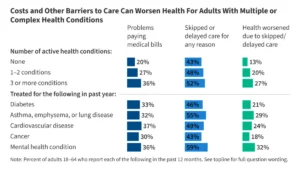
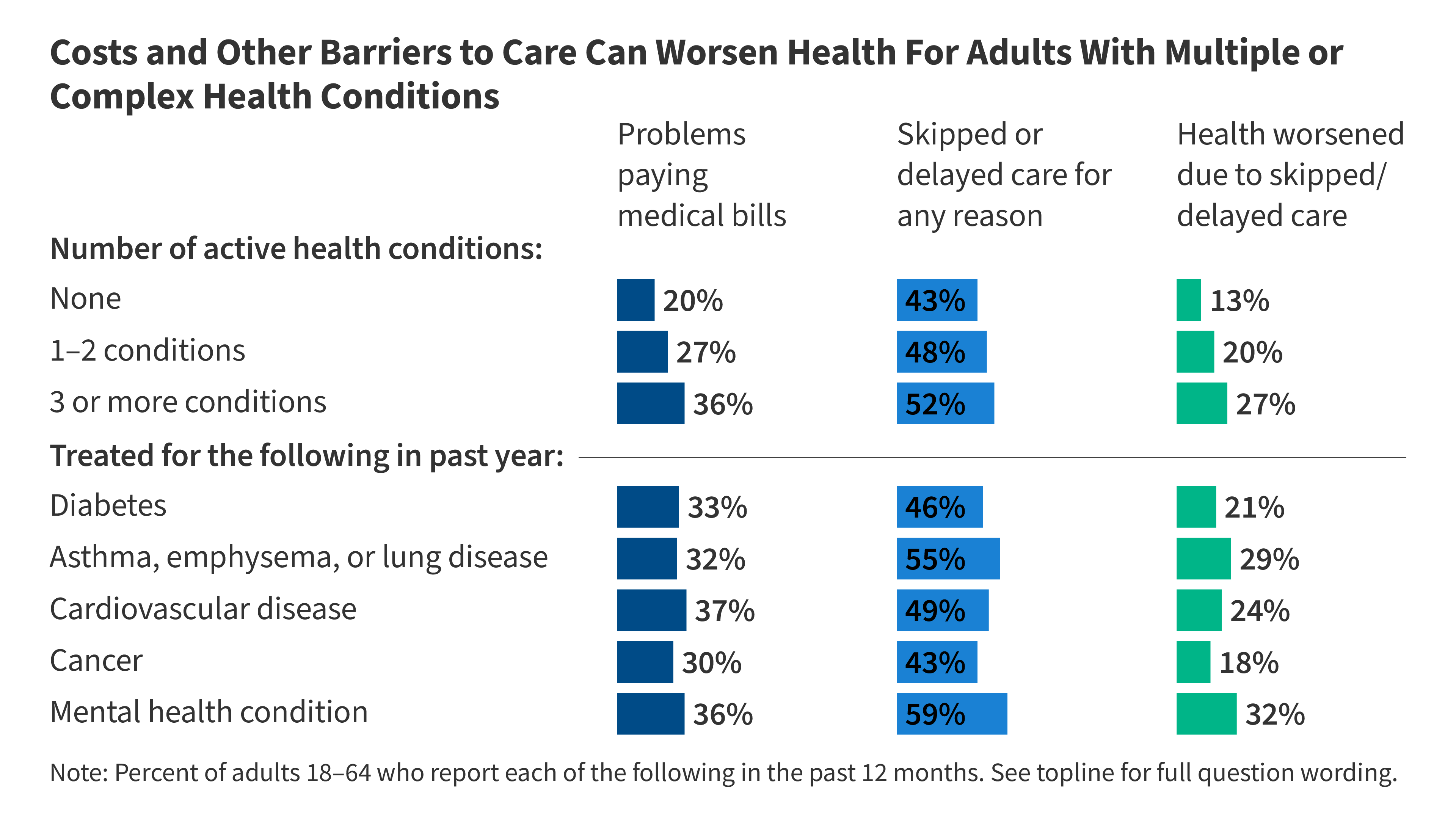
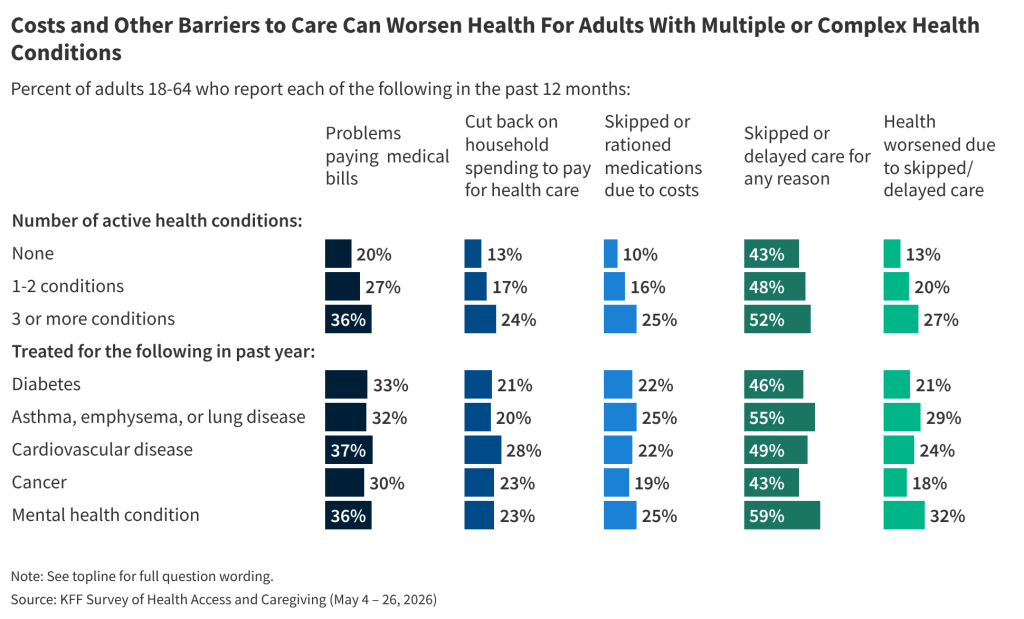
The financial architecture of the American health care system imposes heavy burdens on individuals whose bodies demand ongoing medical intervention. Approximately one-third of non-elderly adults (ages 18–64) coping with multiple or complex health conditions report that they struggled to pay or outright could not pay their medical bills over the past year.
This financial strain is heavily concentrated among specific diagnostic groups. Individuals managing three or more concurrent health conditions report a 36% medical bill burden, while those battling cardiovascular disease and mental health conditions report struggles at 37% and 36%, respectively.
The repercussions of these medical debts extend far beyond hospitals and clinics, bleeding into everyday household survival. About a quarter of adults juggling three or more health conditions state they have been forced to cut back on fundamental household expenses—such as groceries, utilities, and housing costs—specifically to cover accumulating medical bills. By comparison, only about 1 in 10 adults without active, complex health conditions report making similar sacrifices. The data illustrates a grim reality: for millions of chronically ill Americans, managing a disease means actively choosing between financial solvency and physical survival.
Barriers to Care: Skipping Treatments and Deteriorating Health
When healthcare costs escalate beyond reach, patients inevitably begin rationing their care. The KFF survey found that roughly half of all adults with three or more health conditions skipped or delayed medical care in the past year. Crucially, about 1 in 3 pointed directly to cost as the primary deterrent. Furthermore, roughly 1 in 5 adults with multiple or complex conditions admitted they intentionally failed to take their prescribed medications because they simply could not afford them.
The consequences of deferred care are immediate and frequently severe. When patients forego physician visits, diagnostic tests, or pharmaceutical regimens, underlying pathologies often advance unchecked. Substantial shares of survey respondents across various diagnostic categories reported that their health actively deteriorated as a direct result of skipped or delayed care:
- Mental Health Conditions: 32% reported a decline in health.
- Lung Disease: 29% reported a decline in health.
- Cardiovascular Disease: 24% reported a decline in health.
- Diabetes: 21% reported a decline in health.
- Cancer: 18% reported a decline in health.
These statistics underscore a tragic paradox of modern medicine: financial barriers designed to curb healthcare utilization ultimately result in acute health crises that require far more expensive, intensive interventions down the line.
Insurance Headaches: Delays and Denials for the Insured
Securing health insurance coverage is widely viewed as a vital shield against medical destitution, yet the KFF findings reveal that coverage alone does not guarantee smooth access to care. Insured adults aged 18 to 64 with greater health needs frequently encounter administrative roadblocks, including pre-authorization delays, bureaucratic red tape, and outright coverage denials from insurance providers.
Among insured adults managing three or more conditions, approximately half reported that their health insurer either delayed or denied coverage for a specific medical service, treatment, or prescription drug ordered by their doctor. These administrative friction points are widespread across specific diseases as well:
- Mental Health Conditions: 47% faced denials or delays.
- Cardiovascular Disease: 45% faced denials or delays.
- Cancer: 43% faced denials or delays.
- Lung Disease: 43% faced denials or delays.
- Diabetes: 38% faced denials or delays.
These administrative bottlenecks force patients and their physicians into adversarial relationships with insurance companies, consuming precious time and energy while patients battle serious, progressive illnesses.
The Uninsured Crisis: Facing the Highest Hurdles
While insured patients face significant hurdles, the situation for uninsured adults with multiple or complex health conditions is markedly more severe. As detailed in a companion "Beyond the Data" column by Dr. Drew Altman, the intersection of chronic illness and a lack of insurance coverage produces the most extreme financial and clinical distress within the American healthcare system.
An overwhelming 72% of uninsured adults with multiple health conditions report struggling with medical bills, and half state they must actively cut back on basic household spending just to manage health-related expenses. The gap in care-seeking behavior is equally stark: uninsured adults with three or more health conditions are 20 percentage points more likely than their insured peers to skip or delay needed care (71% compared to 51%).
When it comes to pharmaceutical management, the disparity widens. Uninsured chronically ill adults are roughly twice as likely as insured patients to report not taking medications as prescribed due to cost (51% versus 24%).
Consequently, the health consequences for the uninsured are magnified. Approximately 43% of uninsured adults with multiple conditions—and 47% of those managing mental health conditions—say their health worsened after skipping or delaying care. This makes uninsured patients roughly one and a half times as likely as insured individuals to experience a tangible decline in health resulting from delayed medical intervention.
Official Reactions and Policy Implications
The release of the KFF survey data has sparked urgent conversations among health policy experts, patient advocacy groups, and economists. The findings arrive at a critical political juncture, challenging conventional narratives that focus solely on broad insurance coverage expansion without addressing the underlying cost-sharing, out-of-pocket expenses, and drug pricing structures that burden chronically ill patients.
In his analysis, Dr. Drew Altman emphasized the moral imperative facing policymakers. "If the first obligation of a health care system is to take care of the sick, we are failing that test," Altman stated. "Cost and access problems are hitting the chronically ill hard, and the chronically ill and uninsured especially hard."
Dr. Altman is scheduled to expand upon these findings, contextualizing them within the broader American health policy landscape during a keynote address at the National Academy of Medicine’s Annual Meeting. Observers anticipate that his remarks will press lawmakers, insurers, and healthcare providers to reevaluate how safety-net programs support individuals with high-utilization, complex medical needs.
Broader Economic and Societal Impacts
The implications of the KFF study extend far beyond individual clinical outcomes, touching on macroeconomic stability and workforce productivity. When chronically ill workers and their families are forced to sacrifice basic household expenses, skip necessary medications, and watch their health deteriorate due to administrative hurdles or high costs, the broader economy suffers.
Untreated chronic illnesses drive up emergency room utilization, increase long-term disability rates, and contribute to lost labor productivity. Furthermore, the immense psychological toll of managing medical debt and systemic health barriers exacerbates mental health crises across the population.
As healthcare reform remains a perennial debate in Washington and state legislatures nationwide, the KFF survey serves as an empirical anchor, demanding that future policy solutions prioritize the most vulnerable patients. Without targeted interventions to alleviate out-of-pocket costs, streamline insurance approvals, and expand affordable coverage options for the chronically ill and uninsured, the American healthcare system will continue to fail its most fundamental test: caring for those who need it most.
Related posts: