The 2026 Report on Children’s TV Representation: A Stagnant Landscape for Disability Inclusion

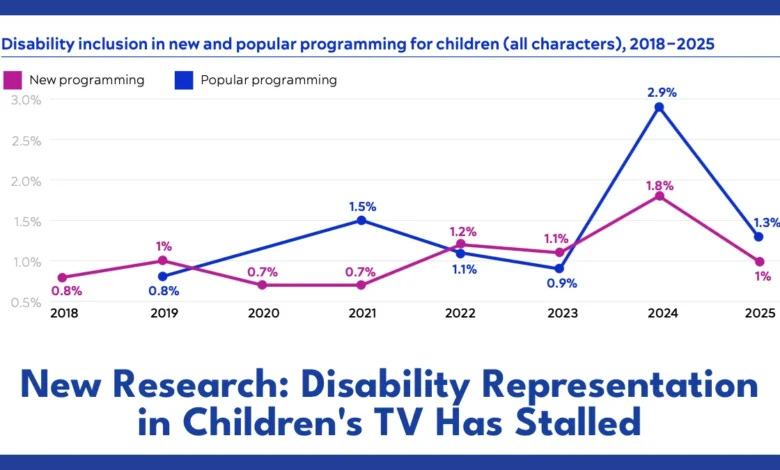
The dream of a representative media landscape for the next generation remains largely unfulfilled, as recent data from the Geena Davis Institute reveals a troubling regression in disability inclusion within children’s television. Following a 2024 peak that sparked optimism among advocates, the 2026 Report on Children’s TV Representation indicates that the industry has failed to maintain momentum. With disabled characters accounting for a mere 1% of new programming and 1.3% of popular series in 2025, the disconnect between on-screen storytelling and the lived reality of the global population—where approximately one in six individuals lives with a significant disability—has reached a critical juncture.
A Chronology of Stagnation: Eight Years of Data
To understand the current crisis, one must look at the trajectory of the last eight years. Since 2018, the Geena Davis Institute has meticulously tracked the presence of disability in children’s media. The historical data paints a picture of systemic inertia. In 2018, when tracking for new programming began, disabled characters represented just 0.8% of the landscape. Over the subsequent years, that figure has fluctuated within a narrow, insufficient margin, rarely climbing above 2%.
The 2024 "record high" proved to be a statistical anomaly rather than the inflection point many had hoped for. By 2025, the share of disabled characters in new programming fell from 1.8% to 1.0%. In the realm of popular, highly-watched scripted programming, the decline was even more precipitous: representation plummeted from 2.9% in 2024 to 1.3% in 2025. This volatility suggests that while individual studios may occasionally greenlight inclusive projects, there is no institutionalized strategy for consistent representation across the broader entertainment ecosystem.
The Scope of the Research
The Geena Davis Institute’s methodology is intentionally broad, designed to capture the nuance of the human experience. The 2026 report defines disability as an umbrella encompassing physical, cognitive, communication, and mental health conditions. Crucially, the research accounts for the "hidden" nature of many disabilities; for characters whose condition is not physically apparent, the report relies on dialogue, narrative context, or specific visual cues—such as a character attending a support group or using assistive technology—to ensure accurate coding.
The data sources provide a comprehensive view of the industry. "New programming" is defined by Luminate’s trade database, reflecting the current output of U.S. studios. "Popular programming" is derived from Nielsen metrics for children aged 2 to 11, covering the shows that dominate the attention of the most influential demographic in media. By examining both categories, the report highlights a systemic failure that spans from the initial development of new intellectual property to the curation of the most successful, high-budget hits.
The Disparity Between Reality and Representation
The statistical gap between the screen and the real world is profound. The Centers for Disease Control and Prevention (CDC) reports that 28.7% of adults in the United States identify as having a disability. When comparing this nearly 30% figure to the 1% to 1.3% presence on children’s television, the discrepancy is not merely a rounding error; it is a fundamental misrepresentation of the human condition.
This failure of representation has profound psychological implications for children. Media serves as a primary vehicle for socialization, teaching children about the diversity of the world around them. When children with disabilities are absent from the screen, it reinforces a narrative of "otherness." Conversely, when non-disabled children are never exposed to disabled characters in a professional or social context on screen, they are denied the opportunity to normalize the diverse range of abilities that define the real world.
The Role of Animation and the AI Frontier
A unique factor in children’s media is the dominance of animation. In 2025, 90.2% of new programming and 64.2% of popular programming were animated. While this medium offers a canvas for limitless creativity, it is currently underutilized as a tool for inclusive storytelling. Characters in animation—be they animals, monsters, or robots—can be depicted with various disabilities, from mobility aids to sensory differences, in ways that transcend traditional human portrayals.

However, the rise of Artificial Intelligence (AI) in content creation threatens to solidify current biases. AI systems are trained on massive datasets of existing media; if that training data lacks disabled representation, the resulting AI-generated stories will naturally replicate that omission. The Geena Davis Institute has issued a stern recommendation to studios: proactively audit all AI tools for representation gaps before they are integrated into the writing and development process. Without such oversight, the industry risks automating the exclusion of the disability community, turning a temporary trend into a permanent technological barrier.
The Economic and Creative Case for Inclusion
Beyond the moral imperative, there is a strong business case for authentic representation. The global disability community controls an estimated $8 trillion in annual disposable income. When media companies ignore this demographic, they are effectively leaving a significant portion of their potential audience behind.
Furthermore, the data regarding professional roles offers a glimmer of insight into how representation is currently handled. In 2025, 22.2% of disabled characters in new programming were depicted as employed, with 11.1% working in STEM fields and 11.1% in leadership roles. While these figures are on par with non-disabled characters, the rarity of the characters themselves remains the primary hurdle. The report notes that disabled characters are five times more likely to be depicted in STEM roles than their non-disabled counterparts, suggesting that when studios do choose to include a disabled character, they often rely on narrow tropes of "the brilliant outlier" rather than portraying a diverse range of lived experiences.
A Call for Structural Reform
To reverse these trends, advocates and researchers argue that the industry must move beyond reactive, intermittent efforts and toward a policy of "trackable targets." The Geena Davis Institute recommends that studios set specific, measurable goals for the inclusion of disabled characters in leading and supporting roles each season. By treating representation as a key performance indicator (KPI) rather than a secondary creative consideration, studios can ensure consistent growth.
Central to this effort is the diversification of the creative workforce. As Lauren Appelbaum, Senior Vice President of Advocacy at Disability Belongs, has emphasized, authentic representation begins behind the camera. "Increasing the number of disabled characters on screen starts with hiring disabled talent behind the camera," Appelbaum noted. The reliance on non-disabled writers to define the experiences of disabled characters often leads to caricatures rather than fully realized, three-dimensional individuals.
By connecting studios with networks of disabled writers, directors, and producers—such as those found in the Disability Belongs Entertainment Lab—the industry can bridge the gap between intent and impact. The inclusion of disabled creatives ensures that stories reflect the complexity, humor, and depth of the disability experience, rather than relying on tired tropes that prioritize the comfort of a non-disabled gaze.
Looking Toward the Future
The path forward requires a shift in the corporate culture of major media conglomerates. The 2025 data serves as a stark reminder that the entertainment industry’s progress is not linear. Without a sustained commitment to institutional change—including the hiring of disabled personnel, the setting of concrete diversity targets, and the auditing of AI development tools—the record highs of 2024 will remain a historical footnote.
Children’s television has the potential to be a powerful, inclusive, and profitable mirror of our society. It is a medium that shapes how the next generation perceives power, friendship, and identity. If the industry chooses to act with the same intentionality it brings to its production values and marketing, it can transform the current landscape from one of marginalization to one of true inclusion. The data is clear: the current trajectory is insufficient. The next step is a deliberate, industry-wide strategy to ensure that all children, regardless of ability, see themselves reflected in the stories that shape their lives.