Groundbreaking Study Maps Autism-Linked Proteins and Points Toward Unified Treatments

Researchers at the University of California, San Francisco (UCSF), alongside an international consortium of geneticists and molecular biologists, have published a landmark study that illuminates how autism-linked genes physically rewire cellular machinery in the human brain. By constructing the largest and most comprehensive molecular map of autism-associated risk proteins to date, the scientific team has uncovered fundamental insights that could fundamentally shift the paradigm of pharmacological treatment for neurodevelopmental conditions.
The research, detailed in the scientific journal Science, provides a detailed blueprint of how dozens of distinct genetic mutations converge on shared cellular pathways. Rather than acting in complete isolation, diverse mutations frequently disrupt the exact same protein complexes within neurons, creating molecular bottlenecks. This convergence suggests that future therapeutics do not need to be custom-tailored to every single one of the hundreds of distinct genetic forms of autism. Instead, treatments could target centralized molecular hubs, potentially offering broad-spectrum relief for individuals across the neurodivergent spectrum.
The Scale of the Mapping Project
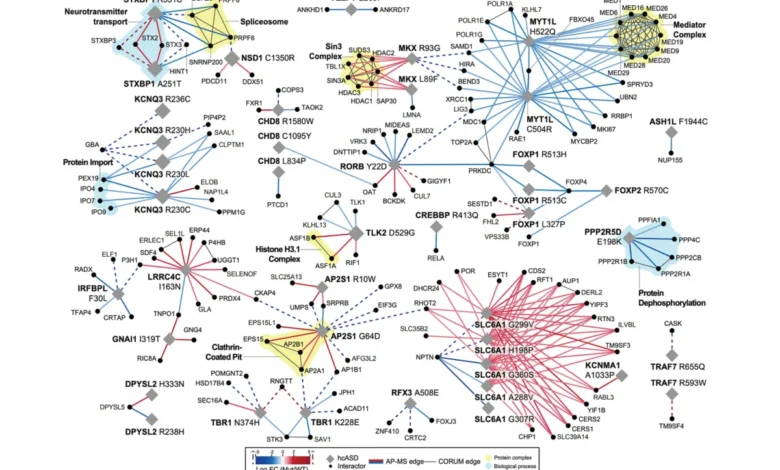
To construct this unprecedented molecular atlas, the UCSF-led research team systematically mapped proteins encoded by 100 high-confidence autism risk genes. In doing so, the investigators successfully documented more than 1,800 distinct protein-protein interactions. Strikingly, 87 percent of these interactions had never been identified previously in scientific literature.
The resulting map functions similarly to an intricate wiring diagram of the cellular architecture within the developing brain. Within this diagram, researchers meticulously cataloged both lost and weakened protein interactions—denoted as blue lines in experimental models—alongside gained or aberrantly strengthened interactions, which were marked in red. These shifts highlight how genetic mutations do not merely switch proteins off; rather, they actively distort the delicate biochemical signaling networks that govern synapse formation, neural connectivity, and cognitive development.
Dr. Nevan J. Krogan, a professor at UCSF and one of the study’s principal authors, emphasized the extreme precision achieved during the research process. "The science demonstrates that autism is written in our genes," Dr. Krogan stated. "This study maps the exact molecular machinery that is altered, including the specific protein interactions, down to the interfaces we can target with a drug."
Context and the Genetic Architecture of Autism
Autism spectrum disorder (ASD) is a complex neurodevelopmental condition characterized by varying degrees of challenges in social interaction, verbal and nonverbal communication, and repetitive behaviors. For decades, clinicians and researchers have grappled with the immense heterogeneity of the condition. Epidemiological data indicates that ASD affects approximately one in 36 children in the United States, according to estimates from the Centers for Disease Control and Prevention (CDC).
While environmental factors play a contributory role, the genetic architecture of autism is remarkably intricate. Modern genomic sequencing has linked hundreds of distinct genes to an elevated risk of developing ASD. However, this genetic diversity has historically presented a formidable barrier to drug development. Pharmaceutical companies have struggled to justify the immense cost of developing individual targeted therapies for ultra-rare genetic mutations that affect only a fraction of the population on the spectrum.
This new study addresses that exact bottleneck. By demonstrating that disparate high-risk genes funnel their pathological effects through shared protein hubs, the research shifts the focus from individual genetic anomalies to collective functional pathways. This conceptual leap mirrors advancements in oncology, where cancer therapies are increasingly designed to target specific signaling pathways rather than the specific tissue of origin.
Implications for Profound Autism
The clinical implications of the UCSF study are expected to resonate most profoundly within the subset of the autism community diagnosed with profound autism. Defined clinically as individuals on the spectrum who are nonverbal, intellectually disabled, or require lifelong round-the-clock care, this group accounts for approximately 30 percent of all individuals with an ASD diagnosis.
People with profound autism frequently harbor rare, high-impact genetic mutations that severely disrupt early brain development. Because their clinical presentation is often accompanied by significant co-occurring medical challenges, such as treatment-resistant epilepsy and severe cognitive impairment, they have traditionally been the most underserved by existing behavioral therapies and educational interventions.
By mapping the exact molecular interfaces disrupted by these rare mutations, researchers hope to pave the way for mechanism-based pharmacological interventions. While behavioral therapies remain the cornerstone of autism support, targeted pharmaceutical agents could eventually alleviate debilitating symptoms, improve cognitive flexibility, and enhance overall quality of life for individuals with profound support needs.
A New Era for Neuropharmacology
Dr. Matthew W. State, chair of the Department of Psychiatry and Behavioral Sciences at UCSF and a senior author of the study, underscored the transformative potential of the findings for clinical practice. "This current work opens up a whole new world of possibilities for therapeutic targets and promises a generation of novel drugs that can transform what we are able to do in the clinic," Dr. State remarked.
The transition from genomic discovery to clinical application, however, will require rigorous follow-up. Pharmaceutical researchers will now need to screen chemical libraries to identify small molecules capable of binding to the newly mapped protein interfaces, repairing weakened interactions, or blocking aberrant ones. While clinical trials remain years away, the existence of a definitive structural map removes much of the guesswork that has historically stymied neurodevelopmental drug discovery.
Furthermore, the methodology pioneered in this study has broad applicability across biomedical science. The research team noted that their systematic approach to mapping mutant protein interactomes can serve as a universal blueprint for investigating the molecular roots of other complex, polygenic disorders, including schizophrenia, Alzheimer’s disease, and various forms of cancer.
Broader Horizons and Future Directions
As the scientific community digests the implications of the Science publication, academic and industrial laboratories are already working to expand the protein interaction map. Future phases of the research will likely involve scaling the methodology to encompass hundreds of additional moderate- and high-risk autism genes, as well as investigating how these protein networks evolve across different stages of embryonic and postnatal brain development.
For families, clinicians, and advocates, the publication represents a beacon of tangible progress in a field that has long relied on symptomatic management rather than disease-modifying treatments. By bridging the vast chasm between human genomics and cellular biochemistry, the UCSF-led team has established a rigorous, data-driven foundation for the next generation of neurological therapeutics.
Related posts: