The landscape of reproductive healthcare in the United States has undergone a seismic shift over the last half-century, evolving from a federally protected right to a fragmented patchwork of state-level mandates and prohibitions. As of mid-2026, the ability of an individual to access and afford abortion services depends almost entirely on their state of residence and the type of insurance coverage they possess. This divergence in policy reflects a deep ideological divide that has intensified since the Supreme Court’s 2022 decision to overturn the constitutional right to abortion, leaving states as the primary arbiters of healthcare access.
The history of abortion coverage restrictions is rooted in the immediate aftermath of the 1973 Roe v. Wade decision. While the Supreme Court initially established a constitutional right to the procedure, the federal government moved quickly to limit the use of public funds for it. In 1977, Congress passed the Hyde Amendment, a legislative provision that bars the use of federal funds to pay for abortions, except in cases where the life of the pregnant person is at risk or when the pregnancy is the result of rape or incest. This amendment primarily affects Medicaid, the joint federal and state program providing health coverage for low-income individuals. Over the decades, the Hyde Amendment has become a permanent fixture of federal appropriations bills, effectively creating a financial barrier for millions of low-income Americans.
The Impact of the Affordable Care Act and Private Insurance Restrictions
The passage of the Patient Protection and Affordable Care Act (ACA) in 2010 introduced new complexities to the debate over abortion coverage. While the ACA sought to expand healthcare access to millions, it also maintained the Hyde Amendment’s restrictions on federal funding. Furthermore, Section 1303 of the ACA explicitly permits states to prohibit abortion coverage in plans offered through the state’s healthcare Marketplace.
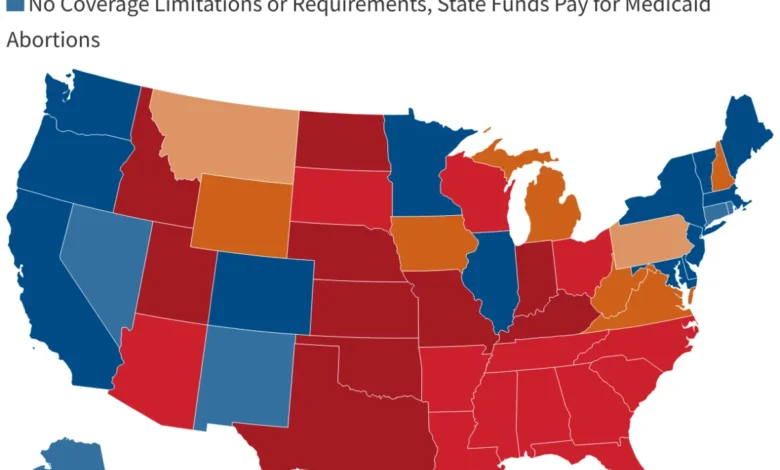
Since the ACA’s implementation, many states have moved to restrict not only Marketplace plans but also private insurance policies sold within their borders. As of early 2026, 25 states have enacted laws that prohibit plans on the state Marketplace from covering abortion services, with varying degrees of exceptions for life endangerment or sexual assault. Furthermore, 10 states have extended these restrictions to the entire private insurance market, including individual, small group, and large group plans. In these states, even individuals who pay for their own private insurance may find that abortion services are excluded from their benefits package, though some states allow for the purchase of a separate "rider" at an additional cost.
The Post-Dobbs Reality: A Nation Divided
The most significant turning point in the modern history of reproductive rights occurred on June 24, 2022, when the Supreme Court issued its ruling in Dobbs v. Jackson Women’s Health Organization. By overturning Roe v. Wade and Planned Parenthood v. Casey, the Court eliminated the federal standard that had protected abortion access for nearly 50 years. This decision catalyzed a wave of "trigger laws" and new legislation across the country.
By January 6, 2026, 13 states—Alabama, Arkansas, Idaho, Indiana, Kentucky, Louisiana, North Dakota, Mississippi, Oklahoma, South Dakota, Tennessee, Texas, and West Virginia—had enacted near-total bans on abortion. In these jurisdictions, the question of insurance coverage is often secondary to the fact that the procedure itself is illegal, with narrow exceptions that are frequently difficult to navigate in clinical practice. The legal status of abortion remains in a state of flux in several other regions, as state supreme courts weigh the validity of bans against state constitutional protections.
Medicaid Coverage and the Role of State Funds
For the 29 states and the District of Columbia that limit Medicaid coverage to the Hyde Amendment’s strict exceptions, the financial burden of an abortion falls entirely on the patient. For a low-income individual, the out-of-pocket cost of an abortion—which can range from $500 for a first-trimester medication abortion to several thousand dollars for later procedures—can be insurmountable. This often leads to delays in seeking care, which in turn increases the cost and medical complexity of the procedure.
Conversely, a growing number of states have taken the opposite approach, using state-only funds (non-federal dollars) to cover abortion services for Medicaid enrollees beyond the Hyde limitations. These states recognize abortion as a medically necessary component of reproductive healthcare. As of 2026, 13 states have established mandates requiring both Medicaid and private insurance plans to cover abortion services.
The Rise of Coverage Mandates in Progressive States
While many states have moved to restrict access, a significant cohort has enacted laws to ensure that abortion is treated like any other medical service. These 13 states—including California, New York, Oregon, and Washington—require all fully insured group and individual plans to include abortion coverage.
A critical component of these mandates is the elimination of cost-sharing. In 10 of these states, insurers are prohibited from imposing deductibles, co-payments, or co-insurance for abortion services, ensuring that the procedure is available at no out-of-pocket cost to the enrollee. Other states have implemented partial protections; for example, Minnesota and Illinois allow cost-sharing only if it is consistent with other similar services in the plan, while Delaware prohibits cost-sharing for abortions up to a cap of $750. These policies are designed to remove the financial hurdles that often prevent timely access to care.
Regional Developments: The Pennsylvania Context
Recent updates in Pennsylvania highlight the ongoing volatility of state-level policy. As of July 24, 2026, Pennsylvania has seen renewed legislative and executive efforts to clarify the scope of abortion coverage. While the state has historically limited Medicaid coverage to the Hyde exceptions, recent administrative shifts and court challenges have sought to expand access through state-funded programs.
Pennsylvania’s landscape is representative of a "purple" state where the executive branch and the legislature are often at odds over reproductive rights. The 2026 updates suggest a move toward protecting the existing infrastructure of clinics while navigating a divided legislature that has previously attempted to codify stricter insurance bans. The situation in Pennsylvania serves as a microcosm of the national struggle, where every election cycle can result in a fundamental shift in healthcare policy.
Chronology of Key Policy Shifts (1973–2026)
- 1973: Roe v. Wade establishes the constitutional right to abortion.
- 1977: The Hyde Amendment is enacted, banning federal Medicaid funds for abortion except in limited cases.
- 2010: The Affordable Care Act (ACA) is passed, allowing states to ban abortion coverage in Marketplace plans.
- 2011–2021: A wave of state-level "TRAP" (Targeted Regulation of Abortion Providers) laws and insurance restrictions are passed across the Midwest and South.
- June 2022: The Supreme Court overturns Roe v. Wade in the Dobbs decision.
- 2023–2025: Thirteen states implement total or near-total bans. Concurrently, several states (e.g., Michigan, Ohio) pass state constitutional amendments protecting reproductive freedom.
- 2026: The number of states mandating insurance coverage for abortion grows to 13, emphasizing a stark geographic and economic divide in healthcare access.
Socioeconomic and Public Health Implications
The disparity in abortion coverage has profound implications for public health and economic stability. Data from the Guttmacher Institute and the Kaiser Family Foundation indicate that individuals living in states with restrictive coverage policies are more likely to experience "financial catastrophe" when seeking reproductive healthcare. When insurance does not cover the procedure, patients often divert funds from essential needs such as rent, groceries, and utilities.
Furthermore, there is a documented correlation between abortion restrictions and maternal mortality rates. States with the most restrictive abortion laws often have the highest rates of maternal mortality, particularly among women of color. Public health experts argue that by limiting coverage and access, states are exacerbating existing healthcare inequities. Conversely, states that mandate coverage and eliminate cost-sharing see earlier intervention and better overall reproductive health outcomes, as patients are not forced to wait weeks to gather the necessary funds.
Official Responses and Advocacy Perspectives
The divergence in state policies has drawn sharp reactions from various stakeholders. Advocacy groups such as Planned Parenthood and the ACLU have focused their efforts on state-level litigation and ballot initiatives, arguing that insurance coverage is a matter of economic justice. "A right without the means to exercise it is no right at all," has become a rallying cry for those pushing for state-funded Medicaid coverage.
On the other side of the debate, organizations such as the National Right to Life Committee and the Susan B. Anthony Pro-Life America support state-level bans and insurance restrictions. They argue that taxpayers and employers should not be compelled to fund or provide coverage for a procedure they find morally objectionable. These groups have been instrumental in lobbying for the 25 state laws that currently prohibit abortion coverage in ACA Marketplace plans.
Conclusion: The Future of Abortion Coverage
As the United States moves further into 2026, the trend toward polarization shows no signs of abating. The "Two Americas" of reproductive healthcare—one where abortion is a covered, protected medical service and another where it is a criminalized or financially inaccessible procedure—has become a settled reality.
The legal battles are expected to continue, particularly regarding the "extra-territorial" reach of state laws and the legality of mailing medication abortion pills across state lines. For now, the primary determinant of whether a person can access abortion coverage remains their zip code, a fact that continues to challenge the concept of equitable healthcare access in the United States. With 29 states still adhering to the minimum federal standards and 13 states leading a movement toward universal coverage, the debate over who pays for abortion remains at the heart of the nation’s political and social discourse.
Related posts: