Bridging the Gap: Empowering Disabled LGBTQ+ Individuals in Faith Communities

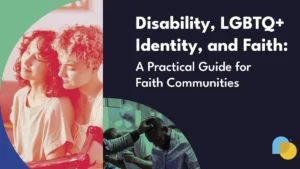
For many, faith communities serve as essential sanctuaries for spiritual growth and social connection. Yet, for a significant portion of the population, these same spaces have historically acted as sites of exclusion, silence, and invisibility. As recent data from the Center for American Progress and the University of Chicago’s NORC indicate, 48% of LGBTQI+ people in the United States identify as having a disability. This intersectional reality presents a critical challenge for religious institutions: how to transform environments that have long been inaccessible into spaces of radical welcome, equity, and belonging.
The movement toward inclusive ministry is no longer a peripheral concern but a central necessity. Recent research confirms that disability and LGBTQ+ identity are deeply intertwined. For instance, data shows that 70% of transgender individuals in the U.S. identify as having a disability, while those with long-term service and support (LTSS) needs report the highest rates of LGBTQ+ identification. These statistics suggest that faith communities that fail to address both identities simultaneously leave a vast segment of their congregants unseen and unsupported.
The Evolution of Inclusion Efforts
The push for accessibility in religious settings has evolved from a sporadic, charity-based model to a systemic approach rooted in justice. Historically, faith leaders viewed accessibility as a "checklist" of physical modifications—such as installing a ramp or widening a doorway. However, modern advocacy groups, such as Disability Belongs, are shifting the narrative. They argue that true inclusion is not an act of kindness, but a fundamental requirement of justice.
This shift mirrors a broader cultural change over the last decade. As civil rights organizations have increasingly focused on intersectionality—a term coined by Kimberlé Crenshaw to describe how overlapping identities create distinct experiences of privilege and oppression—faith communities have been forced to confront their own limitations. The realization that an individual can be marginalized for their disability and their sexual orientation at the same time has prompted a re-evaluation of how churches, synagogues, mosques, and temples structure their programs, liturgies, and leadership pipelines.
Understanding the Intersectional Barrier
The challenges faced by disabled LGBTQ+ individuals are multifaceted. Physical barriers remain the most visible, as many historic houses of worship were constructed centuries before modern accessibility standards were conceived. Stairs, narrow corridors, and inaccessible pulpits serve as physical gatekeepers, silently telling congregants that their presence is not expected.
Beyond the physical, sensory and communication barriers often create "invisible" walls. Loud, high-decibel music, flashing light displays during services, and the absence of American Sign Language (ASL) interpretation or closed captioning create environments where those with neurodivergence, sensory processing disorders, or hearing impairments are effectively barred from participating.
Furthermore, cultural barriers—such as rigid, heteronormative expectations regarding family roles or marriage—often alienate LGBTQ+ individuals before they even step through the door. When these cultural expectations are paired with stigma surrounding disability or mental health, the result is a compounded form of exclusion that requires a comprehensive, intentional strategy to dismantle.
Establishing Foundational Principles
Experts in the field of inclusive ministry emphasize three core principles that should guide any organizational policy. First, the acknowledgment that every person possesses inherent dignity. This principle rejects the idea that disabled bodies or queer identities are "flaws to be fixed." Instead, they are viewed as expressions of human diversity.
Second, the principle of justice over charity. By framing accessibility as a right rather than a favor, faith leaders can better prioritize budget allocations and policy changes. This includes the move toward "Nothing about us, without us"—a philosophy insisting that disabled LGBTQ+ individuals must hold seats at the decision-making table. When these individuals are excluded from leadership, the resulting policies are often performative rather than substantive.
Finally, the importance of language. The debate between "person-first" (person with a disability) and "identity-first" (disabled person) language underscores the need for autonomy. For many, disability is a source of pride and a fundamental marker of identity, much like race or sexual orientation. By respecting individual preferences and adopting flexible communication standards, faith communities can foster a climate of trust.
Strategic Recommendations for Leadership
To move from intent to action, organizations are increasingly adopting structured accessibility audits. These assessments go beyond the physical structure to examine every facet of community life, from the way meetings are facilitated to how digital communications are disseminated.
Physical and Sensory Upgrades
Modernizing facilities involves more than just ADA compliance. It includes creating quiet spaces for those experiencing sensory overload, ensuring that restrooms are universally accessible, and providing clear, high-contrast signage that assists those with low vision. For digital engagement, this means ensuring that websites are compatible with screen readers and that all video content is captioned.
Ritual and Liturgical Adaptability
Worship experiences are often rigid in their structure. Expanding these to include non-verbal or non-linear forms of participation—such as silence, art, or movement-based prayer—allows for a broader spectrum of engagement. When rituals are adapted to accommodate different physical and cognitive abilities, the spiritual depth of the community is often enriched, not diminished.
Governance and Accountability
True representation requires a financial commitment. Faith communities are being encouraged to compensate disabled and LGBTQ+ consultants for their expertise, recognizing that their lived experience is a professional asset. Additionally, establishing anonymous, trauma-informed feedback mechanisms allows members to report barriers without the fear of retaliation. This transparency is vital for building institutional trust, particularly among those who have suffered past trauma within religious spaces.
The Path Forward: A Culture of Continuous Learning
The integration of disabled LGBTQ+ individuals into faith life is a marathon, not a sprint. Leaders are encouraged to view this work as an ongoing, cyclical process of auditing, learning, and adapting. The goal is to move past the fear of making mistakes; if an error occurs, the standard response should be a sincere apology followed by a correction and a renewed commitment to change.
The implications of this shift are profound. As faith communities become more accessible, they reflect a truer, more diverse image of the populations they serve. By dismantling the barriers that have historically separated these identities, religious institutions can reclaim their role as genuine spaces of community.
Inclusion is not merely about inviting people to sit in a pew; it is about ensuring that every individual—regardless of their body, mind, or identity—has the agency to lead, to contribute, and to thrive. As organizations continue to adopt these practices, the ripple effects will be felt across the broader society, setting a standard for how institutions can balance tradition with the evolving, diverse needs of a modern congregation. The work is complex, but the mandate is clear: to build a spiritual home that is truly, unequivocally open to all.
Related posts: