Global Dementia Cases Projected to Double by 2050 According to Landmark JAMA Neurology Study

A landmark study published in JAMA Neurology has delivered a sobering projection regarding global public health, estimating that the number of new dementia cases worldwide will more than double by the middle of the century. The research, which models global epidemiological shifts through 2050, indicates that the escalating crisis will place unprecedented demands on healthcare infrastructure, families, and long-term care systems globally. Public health officials, neurologists, and advocacy groups are pointing to the findings as an urgent catalyst for structural reform, expanded research funding, and a renewed global commitment to preventive medicine.
The Scale of the Projections: A 116% Increase
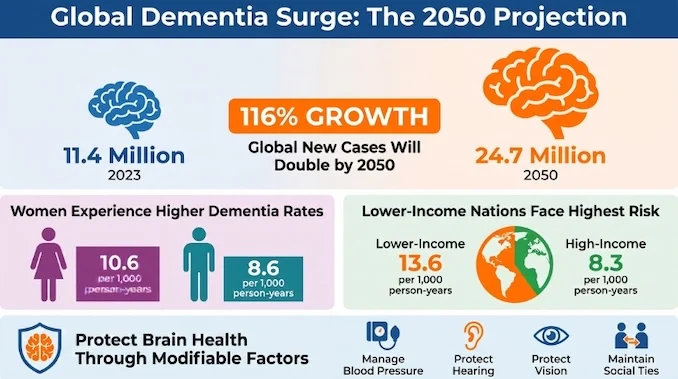
According to the data analyzed in the JAMA Neurology report, the baseline metrics establish a formidable challenge. In 2023, the global incidence of new dementia cases stood at approximately 11.4 million. By 2050, that figure is projected to surge to 24.7 million new cases annually, representing a staggering 116% increase.
Epidemiologists emphasize that this anticipated spike is not primarily driven by an increase in the inherent virulence or aggressiveness of neurodegenerative diseases such as Alzheimer’s. Instead, the primary driver is the rapid and sustained aging of the global population. Life expectancies have risen significantly across many regions over the past several decades, and because age remains the single most substantial risk factor for cognitive decline, a larger cohort of older adults naturally translates to a higher volume of diagnoses.
Dr. Emer MacSweeney, a consultant neuroradiologist, noted that these epidemiological models should serve as an explicit call to action. Rather than viewing the doubling of cases as an inevitable consequence of demographic shifts, health systems must accelerate efforts in early detection, targeted prevention, and innovative treatment pipelines to alter the trajectory before mid-century.

Global Incidence Comparison Table
Metric
2023 Baseline Data
2050 Projected Data
Annual New Global Cases
11.4 Million
24.7 Million (116% Increase)
Female Incidence Rate
10.6 per 1,000 person-years
Projected proportional increase
Male Incidence Rate
8.6 per 1,000 person-years
Projected proportional increase
Demographic Disparities: The Gender and Regional Divides
A critical component of the JAMA Neurology study involves the granular breakdown of incidence rates across different demographic and geographic segments. The research revealed a pronounced gender disparity, demonstrating that women face a higher risk of developing dementia than men. Specifically, the incidence rate for women was recorded at 10.6 new cases per 1,000 person-years, compared to 8.6 new cases per 1,000 person-years for men.
While public health researchers acknowledge that women, on average, live longer than men—thereby spending more years in the high-risk age brackets—longevity alone does not account for the entire gap. Emerging scientific consensus points to sex-specific biological variables, including lifelong hormonal exposures, the physiological transitions associated with menopause, and distinct neuroinflammatory responses, as contributing factors to brain health vulnerabilities in women. These findings underscore the necessity of customized preventative care models tailored to female health across the lifespan.
Geographically, the study highlights a stark divide between high-income nations and low- and middle-income countries (LMICs). The incidence of dementia in LMICs was found to be notably higher at 13.6 cases per 1,000 person-years, compared to 8.3 cases per 1,000 person-years in high-income countries.
This geographic discrepancy heavily implicates the established connection between cardiovascular health and neurological function. Over recent decades, high-income nations have experienced notable public health successes in reducing smoking rates, improving the management of hypertension, and controlling hypercholesterolemia. Conversely, many low- and middle-income regions are navigating rapid nutritional and lifestyle transitions that correlate with rising rates of obesity, stroke, and cardiovascular disease. Because cerebral blood flow is fundamentally tied to cognitive preservation, systemic improvements in cardiovascular care are increasingly recognized as essential tools for dementia mitigation.

Modifiable Risk Factors and Preventative Strategies
Medical experts emphasize that while immutable factors such as genetics and chronological age cannot be altered, a significant proportion of dementia risk is tied to modifiable lifestyle and environmental factors. Longitudinal studies suggest that addressing these variables early in life can delay or even prevent the onset of cognitive decline.
Public health frameworks routinely emphasize several core areas for intervention:
- Blood Pressure Management: Controlling hypertension minimizes microvascular damage in the brain, preserving neural pathways and reducing the risk of vascular dementia.
- Metabolic Health: Maintaining healthy blood glucose levels and managing diabetes reduces systemic inflammation and oxidative stress linked to neurodegeneration.
- Cardiovascular Fitness: Regular physical activity enhances cerebral perfusion, supports neurogenesis in the hippocampus, and improves overall heart health.
- Social and Cognitive Engagement: Maintaining lifelong learning, complex mental stimulation, and robust social networks builds cognitive reserve, potentially buffering the brain against pathological changes.
- Sensory Preservation: Addressing hearing and vision loss early prevents sensory deprivation, which has been independently linked to accelerated cognitive decline.
Socioeconomic Implications and Caregiver Burdens
The impending expansion of the dementia population carries profound economic and societal implications. Long-term care facilities, home health agencies, and informal family caregivers currently bear the brunt of care delivery. Without significant policy interventions, the projected doubling of cases threatens to overwhelm healthcare systems, straining public budgets and depleting private resources.
Family caregivers, who often provide unpaid, round-the-clock care, face elevated rates of physical exhaustion, financial strain, and mental health challenges. Health economists and policy analysts argue that national strategies must incorporate robust support systems for caregivers, including subsidized respite care, enhanced training programs, and stronger legal and financial protections for working family members who balance employment with caregiving responsibilities.

Furthermore, healthcare systems must prepare for a massive scaling-up of diagnostic capabilities. The advent of advanced biomarker testing, including blood-based diagnostics and specialized neuroimaging, means that primary care physicians will increasingly be tasked with early identification. Equipping community health clinics and primary care providers with the tools necessary for early screening will be essential to ensure equitable access to emerging disease-modifying therapies.
Conclusion and Future Outlook
The projection of 24.7 million annual dementia cases by 2050 presents a formidable challenge to the global community, but it is not an immutable destiny. By addressing the root causes of cardiovascular and neurological disease, prioritizing sex-specific health research, and reducing global health disparities between high- and low-income nations, public health systems retain the capacity to alter this trajectory.
Mitigating the impact of the coming demographic shift will require coordinated, international leadership, sustained investment in medical research, and systemic support for the millions of individuals and families navigating the complexities of cognitive decline.